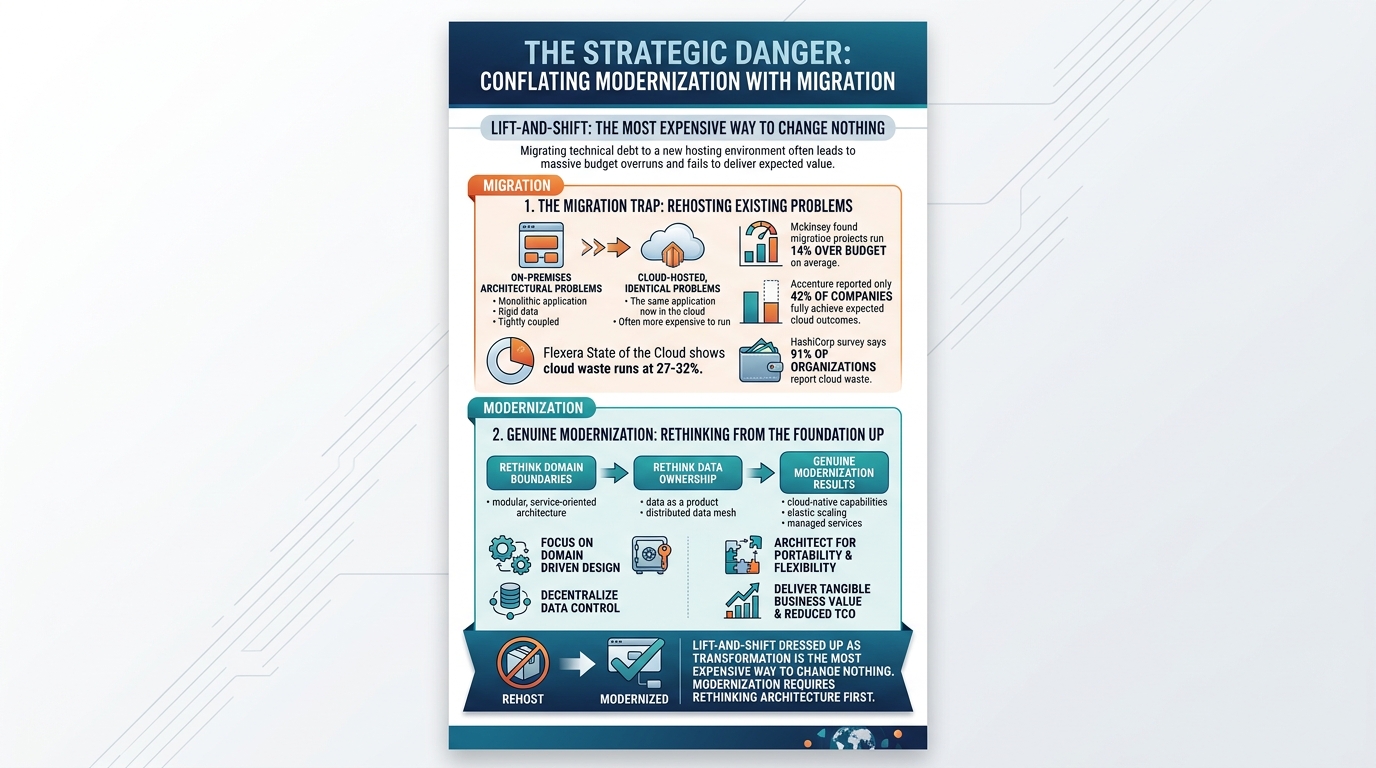
I've been thinking about something that keeps showing up in boardroom presentations I review. A company announces a major "cloud transformation" initiative. Eighteen months later, they've spent tens of millions of dollars and have... the same tangled architecture, the same tightly coupled data dependencies, the same brittle deployment processes. Just running on someone else's servers at a higher monthly cost.
This is more common than anyone wants to admit.
McKinsey surveyed roughly 450 CIOs and found that 75% of cloud migrations exceeded their budgets, with average cost overruns at 14%. Scaled globally, they estimated over $100 billion in wasted migration spend. Accenture tracked outcomes across three studies from 2018 to 2023 and found that only 42% of companies fully achieved their expected cloud outcomes. That number barely moved in five years, even as the industry poured hundreds of billions more into these programs. The majority of organizations still experience what Accenture calls a "cloud value gap."
And the waste numbers are staggering. Flexera's State of the Cloud reports show organizations waste somewhere between 27% and 32% of their total cloud spend year after year. Managing cloud costs became the number one cloud challenge in 2023, overtaking security for the first time, and it has held that position for four consecutive years. Optimizing existing cloud use has been the top cloud initiative for nine straight years. Think about that. An entire industry spending a decade trying to get costs under control on infrastructure it voluntarily adopted.
The root cause is simple. People confuse migration with modernization. They are not the same thing.
Migration is relocation. You pick up your applications and put them somewhere else. Modernization is transformation. You rethink how your systems are designed, where domain boundaries live, who owns which data, and how services interact. Gartner's own research is blunt about this: most lift-and-shift migrations fail to produce desired business outcomes and often increase total cost of ownership rather than reduce it. One analysis found lift-and-shift migrations complete about 3x faster than refactoring projects but result in 40% higher ongoing cloud costs.
The a16z analysis by Sarah Wang and Martin Casado, "The Cost of Cloud, a Trillion Dollar Paradox," put a number on the margin destruction. Among 50 top public software companies, committed cloud spend averaged 50% of cost of revenue. They estimated that optimizing or selectively repatriating that spend could unlock $100 billion in market cap among just those 50 companies. Dropbox's move off AWS saved $75 million over two years and helped push gross margins from 33% to 67%. DHH at 37signals published their $3.2 million annual AWS bill, invested roughly $600K in hardware, and projects well over $10 million in savings over five years.
Now, these are specific cases with specific characteristics. Stable workloads, predictable usage patterns, teams with deep infrastructure expertise. Cloud spending overall continues to grow at 21%+ annually. Repatriation is a correction at the margins, not a reversal. But the cases are instructive because they share a common trait: these teams treated infrastructure economics as an engineering discipline, not a procurement exercise.
BCG found something important. Cloud transitions executed as part of broader business transformation generate 12 to 15x the benefits of purely infrastructure-focused transitions. That ratio tells you exactly where the value lives. Not in moving boxes. In rethinking the system.
The intellectual tools to avoid this mistake have existed since 2010, when Gartner published the original migration decision framework. AWS expanded it to the 7 Rs, which include "Retain" (don't move it) and "Retire" (turn it off) as legitimate outcomes. Roughly 10% of enterprise IT systems are zombie applications that companies keep running out of inertia. The framework forces you to ask, workload by workload, whether each application deserves to survive the move and in what form.
But in practice, organizations default to rehosting because it is faster to plan, easier to staff, and simpler to put on a Gantt chart. The refactoring phase gets deferred. Then deferred again. Then quietly dropped. The rehost becomes the end state. Someone declares victory. The architecture remains unchanged.
Genuine modernization starts before you touch any infrastructure. It starts with hard questions about domain boundaries. Which services actually need to be coupled? Who owns this data, and why does it get copied into six different systems? What would we design if we were starting fresh? Only after you have credible answers should you decide where anything runs.
A lift-and-shift dressed up as transformation is the most expensive way to change nothing. The migration might succeed on its own terms. Every server moved, every checkbox checked, every milestone green on the dashboard. And the organization ends up exactly where it started, paying more for the privilege.
The most expensive way to change nothing
Lift-and-shift cloud migrations dressed up as digital transformation are burning through budgets at an alarming rate while reproducing the same architectural problems in a more expensive hosting environment. McKinsey found that cloud migration projects run 14% over budget on average, with global enterprises collectively wasting over $100 billion on migration spend that fails to deliver expected value. Accenture's longitudinal research across three studies (2018–2023) shows that only 42% of companies fully achieve their expected cloud outcomes — a number that has barely budged in five years. The core problem is structural: organizations conflate moving infrastructure with modernizing it, and the industry has built a trillion-dollar ecosystem around that confusion.
This research brief compiles the concrete statistics, frameworks, and case studies needed to make the argument that genuine modernization requires rethinking domain boundaries and data ownership — not just changing where your servers live.
The budget overrun problem is systemic, not anecdotal
The data on cloud migration cost overruns comes from every major analyst firm and tells a remarkably consistent story. McKinsey's 2021 survey of ~450 CIOs found that 75% of cloud migrations exceeded their budgets, with the average annual cost overrun at 14%. Scaled across all enterprises, McKinsey estimated $100+ billion in wasted migration spend globally over three years, with $500 billion in shareholder value at risk. One case study they cited: a global pharmaceutical company found itself 75% behind its migration plan and spending 50% more than budgeted after just 12 months.
Accenture has tracked this problem longitudinally across three surveys (2018, 2020, 2023), and the results are striking in their consistency. In 2018, only 35% of companies fully achieved their expected cloud outcomes. By 2020, that number had barely moved to 37%. By 2023, with hundreds of billions more invested industry-wide, it reached just 42%. Accenture's own framing: 58% of organizations still experience a "cloud value gap." The 2023 report explicitly noted that companies had "picked the low-hanging fruit — i.e., lifting and shifting an application from an on-premise host to a cloud service" and were now hitting a wall.
Gartner has stated that 83% of data migration projects either fail outright or significantly exceed their budgets and timelines. They predicted that through 2024, 60% of infrastructure and operations leaders would encounter public cloud cost overruns that negatively impacted their on-premises budgets. BCG's analysis of 850+ companies found that only 35% of digital transformation initiatives achieve their objectives, and that cloud transitions executed as part of broader business transformation generate 12 to 15x the benefits of purely infrastructure-focused transitions — a direct indictment of lift-and-shift thinking.
A 2025 CloudBees/TrendCandy survey of 300+ enterprise IT leaders found the average business loses $315,000 per platform migration project, with 57% spending more than $1 million on migrations in a single year. Perhaps most damning: 94% reported slower or similar system performance post-migration — meaning nearly all migrations failed to deliver even the basic performance improvements that justified the investment.
Cloud waste runs at 27–32% of total spend and cost management is now the top challenge
Flexera's State of the Cloud reports provide the most consistent longitudinal data on cloud waste. Their tracking shows estimated IaaS/PaaS waste held at 32% in 2022, declined to 27% by 2024–2025, then ticked back up to 29% in 2026 as AI workloads introduced new cost complexity. Organizations consistently exceed cloud budgets by 17–18% annually. In 2025, 33% of organizations were spending more than $12 million per year on public cloud, up from 24% just two years earlier.
The most te�[200~# The most expensive way to change nothing
Lift-and-shift cloud migrations dressed up as digital transformation are burning through budgets at an alarming rate while reproducing the same architectural problems in a more expensive hosting environment. McKinsey found that cloud migration projects run 14% over budget on average, with global enterprises collectively wasting over $100 billion on migration spend that fails to deliver expected value. Accenture's longitudinal research across three studies (2018–2023) shows that only 42% of companies fully achieve their expected cloud outcomes — a number that has barely budged in five years. The core problem is structural: organizations conflate moving infrastructure with modernizing it, and the industry has built a trillion-dollar ecosystem around that confusion.
This research brief compiles the concrete statistics, frameworks, and case studies needed to make the argument that genuine modernization requires rethinking domain boundaries and data ownership — not just changing where your servers live.
The budget overrun problem is systemic, not anecdotal
The data on cloud migration cost overruns comes from every major analyst firm and tells a remarkably consistent story. McKinsey's 2021 survey of ~450 CIOs found that 75% of cloud migrations exceeded their budgets, with the average annual cost overrun at 14%. Scaled across all enterprises, McKinsey estimated $100+ billion in wasted migration spend globally over three years, with $500 billion in shareholder value at risk. One case study they cited: a global pharmaceutical company found itself 75% behind its migration plan and spending 50% more than budgeted after just 12 months.
Accenture has tracked this problem longitudinally across three surveys (2018, 2020, 2023), and the results are striking in their consistency. In 2018, only 35% of companies fully achieved their expected cloud outcomes. By 2020, that number had barely moved to 37%. By 2023, with hundreds of billions more invested industry-wide, it reached just 42%. Accenture's own framing: 58% of organizations still experience a "cloud value gap." The 2023 report explicitly noted that companies had "picked the low-hanging fruit — i.e., lifting and shifting an application from an on-premise host to a cloud service" and were now hitting a wall.
Gartner has stated that 83% of data migration projects either fail outright or significantly exceed their budgets and timelines. They predicted that through 2024, 60% of infrastructure and operations leaders would encounter public cloud cost overruns that negatively impacted their on-premises budgets. BCG's analysis of 850+ companies found that only 35% of digital transformation initiatives achieve their objectives, and that cloud transitions executed as part of broader business transformation generate 12 to 15x the benefits of purely infrastructure-focused transitions — a direct indictment of lift-and-shift thinking.
A 2025 CloudBees/TrendCandy survey of 300+ enterprise IT leaders found the average business loses $315,000 per platform migration project, with 57% spending more than $1 million on migrations in a single year. Perhaps most damning: 94% reported slower or similar system performance post-migration — meaning nearly all migrations failed to deliver even the basic performance improvements that justified the investment.
Cloud waste runs at 27–32% of total spend and cost management is now the top challenge
Flexera's State of the Cloud reports provide the most consistent longitudinal data on cloud waste. Their tracking shows estimated IaaS/PaaS waste held at 32% in 2022, declined to 27% by 2024–2025, then ticked back up to 29% in 2026 as AI workloads introduced new cost complexity. Organizations consistently exceed cloud budgets by 17–18% annually. In 2025, 33% of organizations were spending more than $12 million per year on public cloud, up from 24% just two years earlier.
The most telling shift in Flexera's data: managing cloud spend became the #1 cloud challenge in 2023, overtaking security for the first time in the report's history, and has held that position for four consecutive years at 84% of respondents. Optimizing existing cloud use has been the #1 cloud initiative for nine consecutive years, with 72% ranking it as a top priority. These numbers describe an industry that has systematically overprovisioned and underoptimized.
Other sources corroborate the waste picture. HashiCorp's 2024 State of Cloud Strategy survey (conducted by Forrester, ~1,200 respondents) found 91% of organizations report cloud waste. The Virtana State of Hybrid Cloud study found 82% of companies have spent more on cloud than they needed to, with average waste at 32%. Gartner estimated in 2022 that approximately $160 billion of roughly $500 billion in cloud spend was unnecessary. Extrapolated to 2024 spending levels, global cloud waste likely exceeds $225 billion annually.
The FinOps Foundation's 2025 report confirms the pattern from the practitioner side: reducing waste is the #1 FinOps priority for the second consecutive year, with 50% of practitioners naming it their top concern. Yet only 14.2% of organizations have reached a mature ("Run") stage in their FinOps practice — most are still at the "Walk" stage, meaning they're optimizing reactively rather than by design.
The a16z "Trillion Dollar Paradox" quantified cloud's margin destruction
In May 2021, a16z general partners Sarah Wang and Martin Casado published "The Cost of Cloud, a Trillion Dollar Paradox," which remains the most cited analysis of cloud economics at scale. Their central finding: among 50 top publicly traded software companies, contractually committed cloud spend averaged 50% of cost of revenue (COGS). Actual spend ran roughly 20% higher than committed amounts, and one billion-dollar private company reported cloud spend at 81% of COGS.
The financial implications were staggering. Wang and Casado estimated these 50 companies' aggregate cloud bill at $8 billion. Assuming a 50% cost reduction from optimization or repatriation, that would yield $4 billion in recovered gross profit, which at the prevailing 24–25x enterprise value-to-gross-profit multiple translates to $100 billion in market capitalization creation among just those 50 companies. Extended to the broader universe of software and internet companies, they estimated the figure exceeds $500 billion.
Their marquee case study was Dropbox, which in 2015–2016 moved 90% of its roughly 600 petabytes off AWS onto custom-built infrastructure. Per Dropbox's audited S-1 filing, this yielded $75 million in cumulative savings over two years and helped drive gross margins from 33% to 67% between 2015 and 2017. The a16z team also pointed to Datadog, which had a $225 million three-year AWS commitment — and argued that repatriating even half that spend could create roughly $1.5 billion in market capitalization.
The article's most quoted line captured the paradox: "You're crazy if you don't start in the cloud; you're crazy if you stay on it." Cloud delivers value early in a company's life, but the pressure it puts on margins starts to outweigh benefits as a company scales and growth slows. The authors were careful to note they weren't advocating wholesale repatriation — rather, that infrastructure spend should be treated as a "first-class metric" and that companies should architect for portability from the start.
Critics offered important counterpoints. Corey Quinn (The Duckbill Group) noted the Dropbox savings didn't account for approximately $200 million in CapEx around its IPO. Multiple analysts argued that repatriation requires scarce engineering talent better spent on product development, and that the 24–25x valuation multiplier was inflated by 2021's frothy tech market. 451 Research analyst Melanie Posey called Dropbox "more of an outlier than a harbinger," feasible mainly for companies with massive, predictable single workloads.
Repatriation is real but selective — and the poster children are instructive
Cloud repatriation has moved from fringe to mainstream. Flexera's 2025 report found that 21% of cloud workloads have been repatriated. A Barclays CIO survey from late 2024 found 86% of CIOs planned to move some public cloud workloads back to private cloud or on-premises — the highest figure on record, up from 43% in late 2020. IDC's June 2024 study found approximately 80% of respondents expected some level of compute or storage repatriation within 12 months. However, only about 8% planned full workload repatriation — the overwhelming pattern is selective, not wholesale.
The highest-profile case remains 37signals (Basecamp/HEY). DHH published their 2022 AWS spend at $3,201,564 per year, broken down across EC2/EKS ($760K), S3 ($908K), ElastiCache ($124K), and other services. Their hardware investment was approximately $600,000–$700,000 in Dell servers, recouped during 2023. By 2024, their cloud bill had dropped from $3.2 million to roughly $1.3 million per year — nearly all of which was AWS S3 storage on a contract expiring in summer 2025. They then invested $1.5 million in Pure Storage for 18 petabytes, expecting operating costs under $200,000 per year. DHH's projected total: "well over $10 million in savings over five years," with plans to delete their AWS account entirely. As DHH put it: "Renting computers is mostly a bad deal for medium-sized companies like ours with stable growth. The savings promised in reduced complexity never materialized."
These cases are powerful but carry important caveats. Both Dropbox and 37signals had stable, predictable workloads — Dropbox was essentially a single massive file-storage workload, and 37signals runs a relatively small set of well-understood applications with an 80-person team. Net cloud spending continues to grow at 21%+ annually, reaching a projected $723.4 billion in 2025 according to Gartner. Repatriation represents a correction at the margins, not a reversal of cloud adoption.
Lift-and-shift is the root cause of migration disappointment
Gartner's research is unambiguous: "Most lift-and-shift cloud migrations fail to produce desired business outcomes" and "often increase TCO, rather than reduce it." The data supports this across multiple dimensions. Lift-and-shift migrations complete roughly 3x faster than refactoring projects but result in 40% higher ongoing cloud costs. One case study from TotalCloudAI documented a UK logistics company whose monthly cloud bill came in at 140% of previous on-premises costs after a lift-and-shift to AWS — with no auto-scaling, no right-sizing, and no reserved instances configured. A retail e-commerce company's actual cloud spend ended up 2.7x higher than initial projections.
The contrast with genuine re-architecture is stark. Forrester found that companies modernizing applications with Azure PaaS cut infrastructure costs by nearly 40% and earned a 228% ROI over three years. Stephen Orban, former AWS VP and former CIO of Dow Jones, documented a customer that first rehosted for a 30% TCO reduction, then re-architected to serverless for an additional 80% TCO reduction — demonstrating that the real savings live in the architectural transformation, not the infrastructure relocation.
BCG articulated the problem precisely in 2024: "Applications are primarily migrated to infrastructure-as-a-service... This is a signal that the company is too focused on moving applications and workloads to the cloud as is. If infrastructure-as-a-service is the end goal, the company won't achieve the cost benefits of flexible scaling." Industry practitioners recommend a migration portfolio of roughly 40% modernize, 30% replace with SaaS, 20% lift-and-shift, and 10% retire — but in practice, the ratio skews heavily toward rehosting because it's faster and requires less organizational change.
The 7 Rs framework exists precisely to prevent this conflation
The intellectual infrastructure to avoid this mistake has existed since 2010, when Gartner analyst Richard Watson published the original 5 Rs of cloud migration: Rehost, Refactor, Revise, Rebuild, and Replace. AWS expanded this to the 7 Rs (adding Retire and Retain) in 2016–2017 through Stephen Orban's work. The framework forces a workload-by-workload decision about the appropriate migration strategy — and critically, it includes Retain (don't move it) and Retire (turn it off) as legitimate outcomes. Orban estimated that roughly 10% of enterprise IT systems are "zombie" applications that companies keep running simply because they've always been there.
The distinction the framework encodes is fundamental. Migration is relocation — moving applications, data, and infrastructure to a new hosting environment. Modernization is transformation — redesigning applications to leverage cloud-native capabilities like managed services, serverless compute, and elastic scaling. Google Cloud's own documentation draws the line clearly: "Migration involves moving your data to the cloud. Cloud modernization is a strategy for transforming existing applications, data, and infrastructure to take better advantage of cloud-native benefits."
AWS itself warns against conflating the two. Their prescriptive guidance explicitly states: "Refactor is not recommended for large migrations because it involves modernizing the application during the migration." They recommend rehosting or replatforming first, then modernizing after migration — an approach that acknowledges the difference but in practice often results in the second phase never happening. The rehost becomes the end state, and the organization declares victory on migration without ever beginning modernization.
The failed migration pattern repeats across sectors
The Pentagon's JEDI (Joint Enterprise Defense Infrastructure) contract stands as the most expensive cloud migration failure in history. Conceived in 2017 as a single-vendor, $10 billion, 10-year cloud contract, it was awarded to Microsoft in October 2019, immediately challenged by Amazon in court, frozen by a federal judge in February 2020, and canceled entirely in July 2021 — four years and zero operational capability delivered. It was replaced by the multi-vendor JWCC contract in December 2022.
In the UK, the government's "cloud-first" policy adopted in 2013 has resulted in £1.1 billion in public sector spending flowing to AWS through the G-Cloud framework. A survey of 300 UK public sector organizations found 85% believe cloud is more expensive than on-premises for traditional applications. A former government official summarized: "We put all of our data, all of our infrastructure, with some US corporations... Have we benefitted, have we lowered our costs? No."
McKinsey's survey of approximately 50 European cloud leaders revealed a subtler failure mode: 95% said they were capturing value from cloud, but only one in three monitored non-IT outcomes like cost savings outside IT (37%) or new revenue generation (32%). The value stayed locked inside technology departments — security improvements, quality gains — rather than delivering broader business transformation. McKinsey concluded: "The vast majority of the value companies have captured remains in isolated pockets and at subscale."
Conclusion
The data tells a clear story: the cloud migration industry has a transformation problem, not a technology problem. When 58% of organizations report a cloud value gap (Accenture), 27–32% of cloud spend is wasted (Flexera, Virtana), and lift-and-shift migrations produce 40% higher ongoing costs than re-architected alternatives, the pattern is unmistakable. Organizations are spending unprecedented sums to relocate their technical debt to a more expensive address.
The critical insight for technical leadership is that migration and modernization are fundamentally different activities that require different investment theses. A migration budget buys infrastructure relocation. A modernization budget buys architectural transformation — rethinking domain boundaries, data ownership, and service design. The 7 Rs framework has encoded this distinction since 2010, yet the industry continues to fund rehosting programs under modernization banners because moving boxes is easier to plan, staff, and measure than rethinking systems.
The companies that have succeeded — whether by optimizing their cloud architecture or selectively repatriating — share one trait: they treated infrastructure economics as a first-class engineering discipline rather than a procurement exercise. The a16z analysis, DHH's cloud exit, and Dropbox's infrastructure optimization all point to the same conclusion. The most expensive way to change nothing is to fund a migration program that never asks whether the architecture deserves to survive the move.
Commissioned from our research desk. Subject to final editorial discretion.