The proof is indisputable.
The hardest recommendation I make is four words long: do nothing right now.
Not because the analysis is complex. The hard part is that every organization hears "do nothing" and translates it to "has no plan." Strategic patience and indecision look identical from the outside. That confusion costs companies a staggering amount of money.
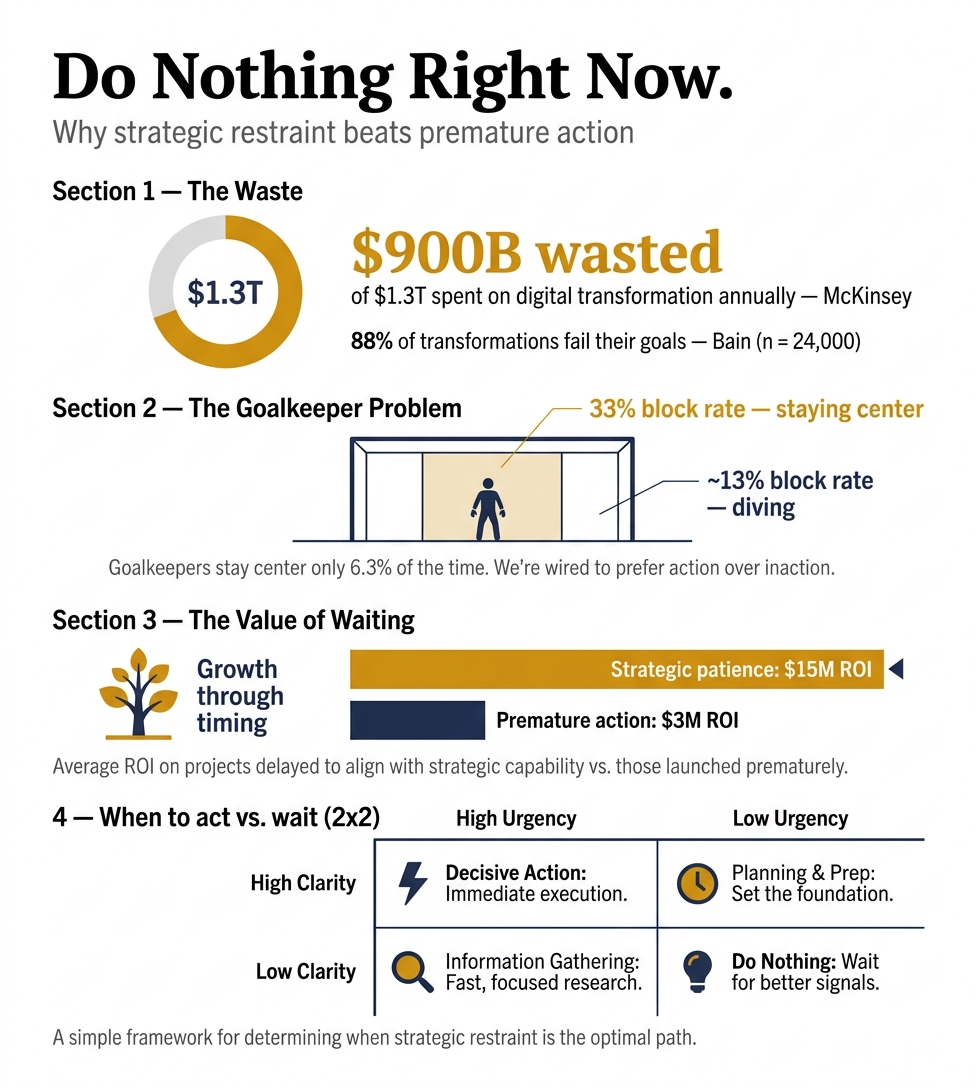
Of $1.3 trillion spent on digital transformation in one year, roughly $900 billion was wasted (McKinsey). Bain found 88% of 24,000 transformation initiatives failed to achieve their ambitions. The Standish Group's data is even more telling: small projects succeed about 90% of the time, large projects less than 10%. And 17% of large IT projects go so badly they threaten the company's existence.
The case studies are painful. Lidl spent €500M over seven years on a SAP migration, then abandoned it entirely. Hershey's compressed a 48 month ERP rollout into 30, launched three systems simultaneously, and couldn't fulfill $100M in Halloween orders. Stock dropped 35%.
Every one of these organizations moved before they were ready.
There's a concept from financial economics called real options theory that explains why waiting has quantifiable value. For reasonable assumptions about uncertainty, it can be optimal to wait until benefits are twice the investment cost before committing. In one NYU analysis, a project worth $547M on standard net present value was worth $907M when you accounted for the option to delay. A $360M premium just for preserving flexibility.
Behavioral science explains why organizations keep making this mistake. A study of 286 penalty kicks found goalkeepers stayed center only 6.3% of the time, even though staying center produced a 33% block rate versus ~13% when diving. We prefer action with bad outcomes over inaction with good outcomes. In organizations, this compounds with hierarchy. People get promoted for launching things. Nobody gets promoted for the migration they prevented.
The best technology leaders make restraint a real option. Dan McKinley's innovation tokens: every company gets about three. If the only reason to adopt something new is that someone is excited about the technology, stop. Kellan Elliott McCrea, former CTO of Etsy, set a demanding bar: new technology needs to make something completely impossible with the existing stack, or represent at least a 3x productivity improvement.
Gartner predicts 30% of GenAI projects will be abandoned after proof of concept by end of 2025. The pattern repeats at accelerated speed.
Strategic restraint is a harder sell than any migration plan. It requires more courage, more analytical rigor, and more willingness to look like you're doing nothing while you're actually doing the most important work: making sure that when you move, you move at the right time, at the right scale, toward the right target.
The trillion-dollar case for doing nothing
"Do nothing right now" may be the most career-threatening sentence a technical strategist can utter — and the most financially sound. Across every major consulting firm's data, premature technology investments destroy more value than patience ever could. McKinsey's research shows 70% of all transformations fail, [1] with large IT projects running 45% over budget while delivering 56% less value than predicted. [2][3] Bain's 2024 analysis of 24,000 transformation initiatives found 88% fail to achieve their original ambitions. [4] Gartner's 2024 CIO survey of 3,186 executives confirmed only 48% of digital initiatives meet or exceed their business outcome targets. [5] The math is brutal: McKinsey estimated that of $1.3 trillion invested in digital transformation in a single year, roughly $900 billion was wasted. [6] Organizations aren't failing because they waited too long. They're failing because they moved before they were ready.
The data on premature action is staggering
The failure statistics aren't just high — they're disproportionately concentrated in large, ambitious initiatives. The Standish Group's CHAOS reports consistently show that small projects succeed ~90% of the time while large projects succeed less than 10%. Projects exceeding $10 million are more than 10× more likely to be canceled than those under $1 million. [7] McKinsey and Oxford's analysis of 5,400+ IT projects found that 17% of large IT projects (those over $15 million) go so badly they threaten the company's existence, [8] with cost overruns reaching 200–400%. [2]
Gartner's own data paints a particularly damning picture for premature platform investments. Their research shows 83% of data migration projects either fail or exceed their budgets. [9] In ERP modernization — the quintessential "big platform bet" — Gartner predicts that by 2027, over 70% of recently implemented ERP initiatives will fail to meet original business case goals, with 25% failing catastrophically. [10][11] Cloud migrations fare no better: [12] 69% of IT leaders reported budget overruns in cloud spending, [13] and lift-and-shift migrations "often increase total cost of ownership rather than reduce it." [12]
The AI investment wave has accelerated the pattern. Gartner predicted 30% of GenAI projects would be abandoned after proof of concept by end of 2025, with costs ranging from $5–20 million per deployment. [14][15] By 2027, Gartner projects over 40% of agentic AI projects will be canceled due to escalating costs and unclear business value. [16][17] As Rita Sallam, Distinguished VP Analyst at Gartner, put it: "After last year's hype, executives are impatient to see returns on GenAI investments, yet organizations are struggling to prove and realize value." [18] Meanwhile, 88% of HR leaders report no significant business value from AI tools — a stat from Gartner's own October 2025 survey. [19]
Why organizations cannot distinguish patience from paralysis
The behavioral science is clear: humans are wired to act even when inaction is optimal. The landmark goalkeeper study by Bar-Eli et al. (2007), analyzing 286 penalty kicks across top leagues, found goalkeepers stayed in the center only 6.3% of the time [20] — despite a 33.3% block rate when staying center versus roughly 13% when diving. [21] The reason isn't ignorance; it's social pressure. As the researchers noted, "a goal scored yields worse feelings for the goalkeeper following inaction than following action." [22] Patt and Zeckhauser's foundational action bias research at Harvard confirmed this extends far beyond sports: people systematically prefer action even when it produces worse outcomes. [23]
In organizations, this bias compounds with hierarchy. Ansgar Baums, former HP strategist, described it precisely: "The more complex and hierarchical an organization is, the more pressure professionals receive to 'deliver' results and take action — making it harder to lobby internally for a 'do nothing' approach." [24] Irina Stanescu, an engineering leader who worked at Google and Uber, argued directly that Amazon-style "bias for action" culture creates dangerous blind spots: "Doing something — even if it's wrong — is not always better than doing nothing. Sometimes, the smartest move is to pause, think, and plan, then act." [25] She identifies specific technology casualties of this mindset: schema changes with data loss, hasty service migrations, premature technology stack replacements — all irreversible decisions treated as if they were reversible. [25]
Dorothy Dalton of 3Plus International named the core confusion: "Doing nothing with its biz speak corporate name, 'strategic inaction,' gets a bad rap. It quite often gets confused with indecision." [26] The distinction matters enormously. Strategic patience is a calculated decision following analysis; indecision is the absence of decision. [24][27] Organizations that cannot tell the difference punish their best strategists for recommending the optimal choice.
Real options theory quantifies the value of waiting
The most rigorous framework for understanding why waiting has value comes from real options theory — the application of financial options pricing to capital investment decisions. [28] The foundational paper by McDonald and Siegel (1986) in The Quarterly Journal of Economics produced a striking result: "For surprisingly reasonable parameter values, it may be optimal to wait until benefits are twice the investment cost." The standard rule of "invest if benefits exceed costs" is fundamentally wrong when investments are irreversible and the future is uncertain, because it ignores the option value of delay. [29][30]
Dixit and Pindyck's seminal 1994 textbook Investment under Uncertainty formalized this insight: [31][32] when you invest, you "kill" the option to wait and learn more. [33][34] That killed option has real, quantifiable value. In Pindyck's MIT lecture examples, the value of being able to wait added $86 to a $300 NPV calculation [35] — a 29% premium just for preserving flexibility. NYU's Aswath Damodaran demonstrated the principle with a pharmaceutical patent worth $547 million on standard NPV but $907 million when the option to delay development was valued — a $360 million time premium. [36]
Applied to technology investments, real options thinking reveals three valuable options that premature commitment destroys: the option to delay (wait for better information), the option to expand (start small, scale if it works), and the option to abandon (cut losses early). [28] Every big-bang platform migration eliminates all three simultaneously. Martin Fowler's YAGNI analysis adds empirical teeth: Kohavi et al.'s research at Microsoft found that only one-third of features improved the metrics they were designed to improve — even with careful up-front analysis. [37] Two-thirds of what organizations build with conviction turns out to be unnecessary or counterproductive.
The case studies spell it out in hundreds of millions
The graveyard of premature platform investments is well-documented and expensive. Lidl spent €500 million over seven years on a SAP migration before abandoning it entirely and reverting to the original system. [38] The German grocery chain tried to force SAP to accommodate its purchase-price-based inventory model rather than adapting to SAP's retail-price standard [39] — a classic case of committing to a platform before understanding whether the platform matched the business.
Hershey's compressed a 48-month ERP implementation into 30 months to beat Y2K, launching three major systems simultaneously. [40][41] The result: $100 million in unfulfilled orders during Halloween 1999, a 35% stock price drop, and an 18% earnings decline. [42] Deutsche Post DHL wrote off €345 million on a failed SAP logistics system; [43][44] profits plunged 90% in the quarter the project was abandoned. [45][44] HP lost $160 million — more than five times the project cost — on the final phase of an ERP centralization effort. [46] In every case, the root cause was not bad technology but premature commitment: moving before organizational readiness, business process alignment, or data quality justified the investment.
The cloud migration wave produced its own crop of expensive premature commitments. GEICO's cloud bill ballooned to over $300 million annually — 2.5× original projections — while reliability actually declined. The insurer is now repatriating workloads to private infrastructure, [47][48] achieving 50% compute cost reduction and 60%+ storage savings. [49] Conversely, Dropbox saved $74.6 million over two years [50] by moving off AWS to custom infrastructure, while 37signals (Basecamp/HEY) projects $10 million+ in savings over five years from its cloud exit. David Heinemeier Hansson's verdict: "Cloud can be a good choice in certain circumstances, but the industry pulled a fast one convincing everyone it's the only way." [51][52]
Most recently, the AI hardware rush produced textbook premature investment failures. Humane burned through $230 million in venture funding on an AI Pin that generated roughly $9 million in revenue before being acquired for $116 million [53][54] — an 85% discount from its asking price. Forward Health raised over $650 million for AI-powered medical kiosks before shutting down entirely in November 2024. [55]
The best technology leaders institutionalize restraint
The most experienced technologists have converged on frameworks that make "do nothing" a first-class strategic option. Dan McKinley's influential 2015 essay "Choose Boring Technology" introduced the concept of innovation tokens: "Every company gets about three innovation tokens. You can spend these however you want, but the supply is fixed." [56] His critical exercise: "Consider how you would solve your immediate problem without adding anything new. If the 'problem' is that someone really wants to use the technology, you should immediately abort." [56]
Thoughtworks institutionalizes restraint through its Technology Radar's Hold ring — a formal mechanism for advising organizations against adopting specific technologies. Neal Ford of Thoughtworks explained its philosophy: "Hold doesn't mean stop what you're doing right this second. It means don't start anything new in that technology. Organizations are like cruise ships. You can't turn them on a dime." [57] Thoughtworks placed cloud lift-and-shift in Hold as early as 2014, [58] years before cloud repatriation became a trend.
Kellan Elliott-McCrea, former CTO of Etsy and VP Engineering at Dropbox, [59] established a demanding threshold for new technology: "New technology either needs to make something possible that isn't possible at all with the existing stack, or it needs to represent at least a 3× productivity improvement." [60] Anything less doesn't justify the unknown unknowns. Ange Ferguson, Thoughtworks' Group Managing Director for Digital Transformation, identified the psychological trap directly: "One of the best initial moves executives can make is to stop thinking of transformation as by definition 'big.' If you've taken a 'big bang' approach, the first time you learn how adoption works is when you're done." [61]
Will Larson, author of The Engineering Executive's Primer, warns new CTOs against their strongest instinct: "Rushing to make changes before understanding the problem's shape is undoubtedly the first trap new executives fall into." [62][63] The irony is that organizations hire senior technical leaders expecting visible action — then suffer when those leaders deliver it prematurely rather than doing the harder, less visible work of strategic assessment.
Conclusion
The evidence forms a clear pattern: premature technology investment is not a failure of execution but a failure of timing, and the organizational bias toward action systematically produces it. Real options theory demonstrates that waiting has quantifiable financial value — potentially doubling the return on investment by preserving flexibility. [30][64] The goalkeeper study shows that humans will choose inferior-outcome action over superior-outcome inaction 93.7% of the time [65] simply because acting feels better than standing still. [66] And the case studies — Lidl's €500 million, [38] GEICO's $300 million annual cloud bill, [48] Hershey's $100 million [67] Halloween disaster — demonstrate that the cost of moving too early dwarfs the cost of patience.
The hardest truth for technical strategists is that recommending restraint looks identical to having no strategy at all — from the outside. [27] Kristin Moyer of Gartner captured the temporal dimension: "The thing about digital business is that it takes a long time to transform, so you need to pace yourself." [68] The organizations that succeed aren't the ones that move fastest. They're the ones that can tell the difference between an innovation worth committing to now and one worth preserving the option to pursue later. That distinction is worth, conservatively, hundreds of billions of dollars annually across the global technology landscape.
Extracted from Claude AI • Conversation ID: 81a8eda2-03b5-4815-8574-159b9ac86031 • Date: 2026-03-24 • [69]
- Integrate.io +2 — https://www.integrate.io/blog/data-transformation-challenge-statistics/
- Cerdanyola Activa — https://www.cerdanyolactiva.cat/delivering-large-scale-it-projects-time/
- McKinsey & Company — https://www.mckinsey.com/capabilities/tech-and-ai/our-insights/delivering-large-scale-it-projects-on-time-on-budget-and-on-value
- Mavim +2 — https://blog.mavim.com/why-70-of-digital-transformations-fail-insights-and-solutions
- Technologymagazine +3 — https://technologymagazine.com/articles/gartner-why-cios-struggle-with-digital-initiative-success
- Medium — https://medium.com/@tomlinsonroland/digitally-transformed-and-still-broken-ee0b374a160a
- Medium — https://medium.com/@marc.bara.iniesta/the-missing-data-why-we-dont-really-know-if-big-companies-fail-more-at-tech-projects-311349cadbb9
- Calleam — https://calleam.com/WTPF/?page_id=1445
- DataCenterKnowledge — https://www.datacenterknowledge.com/cloud/top-cloud-migration-challenges-and-how-to-face-them
- Gartner — https://www.gartner.com/en/information-technology/topics/enterprise-resource-planning
- Labur — https://labur.com/blog/enterprise-resource-planning-erp-why-so-many-implementations-fail/
- Gartner — https://www.gartner.com/en/documents/4529899
- Gartner — https://www.gartner.com/peer-community/oneminuteinsights/omi-keeping-cloud-costs-check-it-leader-perspectives-rfz
- Gartner — https://www.gartner.com/en/newsroom/press-releases/2024-07-29-gartner-predicts-30-percent-of-generative-ai-projects-will-be-abandoned-after-proof-of-concept-by-end-of-2025
- Praecipio — https://www.praecipio.com/resources/articles/we-call-bs-on-transformation
- Gartner — https://www.gartner.com/en/newsroom/press-releases/2025-06-25-gartner-predicts-over-40-percent-of-agentic-ai-projects-will-be-canceled-by-end-of-2027
- Predictiveanalyticsworld — https://www.predictiveanalyticsworld.com/machinelearningtimes/gartner-predicts-over-40-of-agentic-ai-projects-will-be-canceled-by-end-of-2027/13875/
- Sranalytics — https://sranalytics.io/blog/generative-ai-for-business/
- Gartner — https://www.gartner.com/en/newsroom/press-releases/2025-10-28-gartner-survey-shows-88-percent-of-hr-leaders-say-their-organizations-have-not-realized-significant-business-value-from-ai-tools
- Munich Personal RePEc Archive — https://mpra.ub.uni-muenchen.de/4477/
- Vaia — https://www.vaia.com/en-us/textbooks/math/statistics-learning-from-data-1-edition/chapter-5/problem-45-the-paper-action-bias-among-elite-soccer-goalkeep/
- SSRN — https://papers.ssrn.com/sol3/papers.cfm?abstract_id=1091662
- Semantic Scholar +2 — https://www.semanticscholar.org/paper/Action-Bias-Among-Elite-Soccer-Goalkeepers:-The-of-Eli-Azar/07ebc76063e655bd177e12c7cbb9abe73b4986d9
- LinkedIn — https://www.linkedin.com/pulse/action-bias-vs-strategic-patience-why-doing-nothing-can-ansgar-baums
- Thecaringtechie — https://www.thecaringtechie.com/p/why-bias-for-action-is-not-good-enough
- 3Plus International — https://3plusinternational.com/why-strategic-inaction-aka-doing-nothing-can-be-a-valid-option/
- LPCentre — https://lpcentre.com/articles/strategic-patience-a-winning-art
- ScienceDirect +2 — https://www.sciencedirect.com/topics/economics-econometrics-and-finance/real-options-analysis
- Wikipedia — https://en.wikipedia.org/wiki/Real_options_valuation
- NBER — https://www.nber.org/papers/w1019
- AbeBooks — https://www.abebooks.com/9780691034102/Investment-under-Uncertainty-Avinash-Dixit-0691034109/plp
- Princeton University Press — https://press.princeton.edu/books/hardcover/9780691034102/investment-under-uncertainty
- Springer — https://link.springer.com/article/10.1007/s10645-023-09428-w
- Grover Furr — https://msuweb.montclair.edu/~lebelp/DixitPindyck1994.pdf
- MIT — https://web.mit.edu/rpindyck/www/Courses/RO_P1_Handout%20Slides.pdf
- Damodaran Online — https://pages.stern.nyu.edu/~adamodar/pdfiles/DSV2/Ch5.pdf
- Martin Fowler +2 — https://martinfowler.com/bliki/Yagni.html
- Panorama-consulting — https://www.panorama-consulting.com/lidl-erp-failure/
- Cegeka +2 — https://www.cegeka.com/en/blogs/avoiding-data-migration-pitfalls-new-erp-implementation
- FinanSys — https://finansys.com/blog/failed-erp-implementation-hershey/
- Panorama-consulting — https://www.panorama-consulting.com/hersheys-erp-failure/
- SlideShare — https://www.slideshare.net/ankitm2/erp-failure-in-hersheys-presentation
- Computerworld — https://www.computerworld.com/article/1638280/sap-dont-blame-us-for-dhls-logistics-woes.html
- Payload Asia — https://payloadasia.com/2015/12/sap-denies-causing-dhls-it-woes/
- Silicon — https://www.silicon.fr/echec-projet-sap-coute-345-millions-euros-dhl-131307.html
- SlideShare — https://www.slideshare.net/slideshow/erp-implementation-failure-with-example-of-hershey-and-hp/81464432
- Sunbird DCIM — https://www.sunbirddcim.com/blog/3-companies-repatriated-workloads-cloud-and-their-results
- byteiota — https://byteiota.com/cloud-repatriation-exodus/
- The Stack — https://www.thestack.technology/insurer-slashes-compute-costs-with-cloud-repatriation-shift-to-ocp-but/
- Servers.com — https://www.servers.com/news/blog/cloud-repatriation
- The Register — https://www.theregister.com/2025/05/09/37signals_cloud_repatriation_storage_savings/
- Andrea Fortuna — https://andreafortuna.org/2026/03/09/cloud-repatriation
- Jason Deegan — https://jasondeegan.com/why-humanes-ai-pin-and-rabbit-r1-both-flopped-spectacularly/
- Fast Company — https://www.fastcompany.com/91231902/the-great-ai-gadget-debacle-of-2024
- Elephas — https://elephas.app/blog/ai-bubble-sam-altman
- mcfunley — https://mcfunley.com/choose-boring-technology
- Thoughtworks — https://www.thoughtworks.com/insights/podcasts/technology-podcasts/build-your-own-radar-using-technology-radar-governance-tool
- Thoughtworks — https://www.thoughtworks.com/insights/articles/radar-hits-misses
- Chartwell Speakers Bureau +2 — https://www.chartwellspeakers.com/speaker/kellan-elliott-mccrea/
- Simon Willison — https://simonwillison.net/tags/kellan-elliott-mccrea/
- Thoughtworks — https://www.thoughtworks.com/en-us/perspectives/edition8-modern-digital-business/article
- Lethain — https://lethain.com/first-ninety-days-cto-vpe/
- Medium — https://andrewgoehring.medium.com/tactical-patience-c4be6201cf1e
- Google Books — https://books.google.com/books/about/Investment_under_Uncertainty.html?id=8op0btN4mKEC
- ScienceDirect — https://www.sciencedirect.com/science/article/abs/pii/S0167487006001048
- Wikipedia — https://en.wikipedia.org/wiki/Action_bias
- The CFO Club — https://thecfoclub.com/operational-finance/erp-implementation-failure/
- TechTarget — https://www.techtarget.com/searchcio/tip/Top-6-reasons-why-digital-transformation-failures-happen
- View original — https://claude.ai/chat/81a8eda2-03b5-4815-8574-159b9ac86031
Commissioned from our research desk. Subject to final editorial discretion.
Why the most politically difficult recommendation a technical strategist makes is 'do nothing right now.' Explore how organizations conflate inaction with indecision, and how premature platform investments driven by anxiety waste more capital than patience ever would. Research Gartner or Thoughtworks data on failed premature modernization initiatives. The takeaway is that strategic restraint is a harder sell than any migration plan but often delivers better outcomes.