The proof is indisputable.
A design review last quarter went sideways in a way I've seen often enough now to call it a pattern. An engineer proposed a boring, portable option for a new data service. Nobody argued the technical merits. Somebody said we'd already committed the spend, and the room moved on. The decision had been made eighteen months earlier by people who weren't thinking about data services at all.
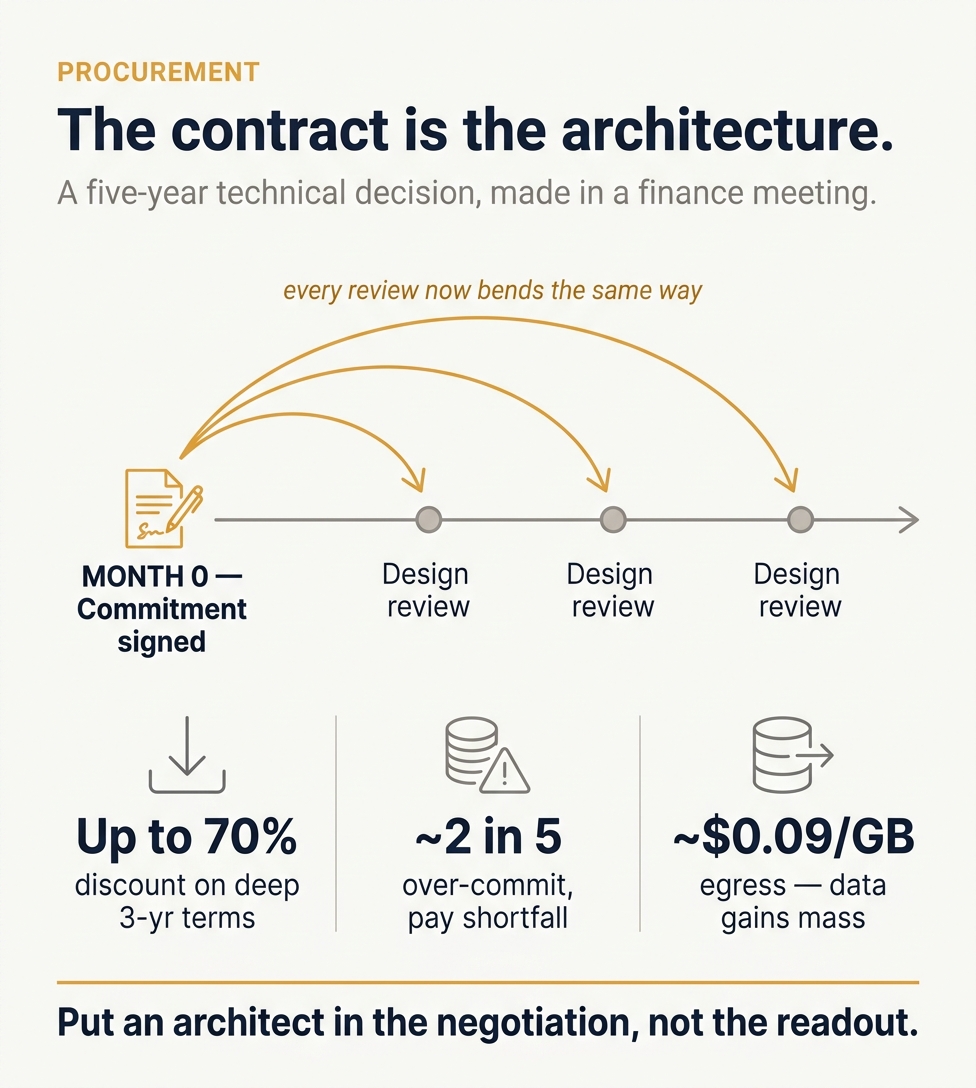
That's what a multi-year committed-spend agreement is: an architecture decision wearing a procurement costume.
The mechanics aren't subtle. Most enterprise agreements carry a shortfall clause: consume less than you promised, pay the difference anyway. Google's docs say it plainly, you can't cancel, and you pay the monthly amount for the full term. So every architect now works inside a system where the cheapest thing on paper is to consume what you already bought. Managed services beat portable ones. Marketplace vendors beat better vendors who aren't on the marketplace, because marketplace spend draws down the commitment. Roughly two in five customers chasing the top discount band end up over-committed and paying shortfall, which tells you how optimistic these forecasts run.
Then there's egress. Around 9 cents a gigabyte out to the internet on AWS, similar on Azure, and transfer often runs 6-12% of a large bill. Your data develops mass. Amazon waived $250,000 in egress fees when 37signals pulled ten petabytes out of S3, and the timing was still gated by a contract running to 2025. A quarter of a million dollars was the discounted price of changing your mind.
Amazon's latest 10-K puts AWS long-duration remaining performance obligations at $244 billion, up from $19.3 billion in 2018. Microsoft reports $625 billion in commercial RPO. That's a lot of five-year technical decisions made in finance conversations.
The other side is strong: these discounts are real, up to 70% on the deepest three-year terms, and refusing to commit on stable workloads is donating money. Gregor Hohpe has it right, architects sell options, and options have value under uncertainty but are never free. The honest question is whether the premium is worth it given how likely you are to exercise it, and most organizations never will. Multi-cloud in practice means 80% on one provider and a few strays.
The fix isn't to stop committing. Put an architect in the room during the negotiation, not in the readout afterward. Size the commitment to the floor of your usage rather than the account team's forecast, ask for a back-weighted ramp, and keep the data layer portable even if compute stays put. It's the cheapest insurance available, and it makes your next renewal a negotiation rather than a ratification.
Finance is going to make a five-year technical decision either way. The only thing you control is whether they knew it at the time.
Research briefing: how multi-year cloud commitments quietly become an organisation's real architecture authority
TL;DR
- The evidence broadly supports the angle: once an enterprise signs a large multi-year cloud commitment, that contract creates a standing financial bias in favour of consuming it. Shortfall clauses (you pay the gap if you underspend), egress economics and marketplace drawdown rules all push design reviews toward the incumbent's proprietary, managed services and away from portable ones.
- The scale is large and mostly invisible on the balance sheet. Amazon disclosed roughly $164bn of performance obligations "primarily related to AWS" as of 30 September 2024, and its 2025 10-K discloses $244bn of AWS long-duration remaining performance obligations (RPO), up from $19.3bn in 2018; Microsoft reported commercial RPO of $625bn at 31 December 2025 (total-company $631bn), up 99% year over year. These are multi-year, largely non-cancellable customer commitments. (Note: Amazon's separate ~$200bn figure is its 2026 capex plan, not RPO.)
- The steelman is real: commitments save genuine money (published maxima up to ~72%), most firms never actually switch clouds, and forced portability ("lowest common denominator") is itself an anti-pattern. The defensible conclusion is not "never commit" but "negotiate procurement and architecture on the same timeline," because a five-year spend commitment is a five-year technical decision.
Key findings
- Commitment discounts are real and large but the deepest tiers demand the least flexibility (3-year, all-upfront, resource-locked).
- Shortfall/true-up clauses across AWS EDP/PPA, Azure MACC and GCP CUDs mean underconsumption is billed anyway, creating "use it or lose it" pressure that lands on architecture teams.
- Marketplace drawdown steers third-party software buying: vendors on the cloud marketplace win deals because they can be paid from committed budget.
- Egress pricing carries very high markups and creates "data gravity" that distorts data placement, analytics and multi-cloud designs.
- The 2024 free-egress-on-exit programmes and the EU Data Act reduce one-time exit costs but do little for day-to-day multi-cloud egress or the broader architectural and skills lock-in.
- Survey data confirms commitment management is a top-tier FinOps priority, waste remains high (27% in 2025, 29% in 2026), and stated multi-cloud rarely means portable workloads.
Details
1. Enterprise commitment structures and discount tiers
AWS EDP / Private Pricing Agreements (PPA). AWS has rebranded the Enterprise Discount Program as the Private Pricing Agreement, but the mechanics are identical: a multi-year commitment to a minimum annual spend in exchange for a percentage discount across most AWS usage, available on 1-to-5-year terms and typically from around $1m of annual spend, with dedicated account attention nearer $5m. These are negotiated privately, so published discount figures are advisory benchmarks not official rates. The consultancy Redress Compliance reports observed discounts running "from around five percent at entry level to around fifteen to twenty percent at the largest commitments," and separately cites a benchmark of "$50M+ annual commit: 22-30%+ discount." The EDP/PPA discount stacks on top of Savings Plans and Reserved Instances rather than replacing them. Key structural features that steer behaviour: [1]
- Shortfall/true-up: if actual spend falls short of the committed minimum, the customer owes the difference at the end of the term. Redress notes that across roughly 20-25 negotiations it benchmarked in 2024-2025, "two out of five customers who chased the top band over committed and paid shortfall or carried unused commitment." [2]
- Ramp structure: AWS's default proposal tends to be front-loaded or flat, creating first-year shortfall risk while migrations slip; a back-weighted ramp cuts early-year risk but must be explicitly requested.
- Enterprise Support: large EDP customers are effectively required to carry Enterprise Support, "approximately 3% of your monthly AWS usage for large accounts, with a minimum floor of $15,000 per month" (Hykell). [3]
- Marketplace drawdown: AWS Marketplace purchases can count toward the commitment; several advisers cite that up to 25% of the annual commitment can be met through Marketplace, though as of May 2025 AWS tightened eligibility so that "only SaaS products fully deployed on AWS infrastructure qualify for retiring EDP commitments through the Marketplace" (Hykell). [3]
AWS Reserved Instances and Savings Plans. These are the resource-level commitment instruments beneath the EDP. Per AWS's own pages and FAQ:
- EC2 Standard Reserved Instances: "up to 72%" versus on-demand, deepest at 3-year All Upfront; Convertible RIs "up to 66%" (more flexible). Non-EC2 RIs publish lower maxima (RDS: up to 63% at 3-year All Upfront), so the 72% headline is EC2-specific.
- EC2 Instance Savings Plans: "up to 72%" (locked to an instance family in a region); Compute Savings Plans: "up to 66%" (flexible across family, region, and covering Fargate and Lambda).
- The trade-off is explicit: the deepest discount requires the longest, least flexible, all-upfront commitment. Payment discount order is All Upfront > Partial Upfront > No Upfront.
- Corey Quinn (Duckbill Group) has documented how commitment structures shape architecture: before Database Savings Plans existed, "'we want to use Lambda, AWS definitely wants us to use Lambda, but the commitments we made to use EC2 and Fargate mean it'd be too expensive for us to move to Lambda' is a story that serves nobody well." AWS launched Database Savings Plans (up to 35%, 1-year) in late 2025 after six years of his advocacy; the deeper point is that the shape of a commitment can freeze a workload on older primitives.
Microsoft Azure (MACC / EA / MCA). A Microsoft Azure Consumption Commitment is a contractual promise to spend a set total on eligible Azure and Microsoft Marketplace services over a multi-year term (usually 1 or 3 years), sitting as an addendum to an Enterprise Agreement or Microsoft Customer Agreement. It operates on a drawdown model. Critically:
- Shortfall clause: "if your eligible consumption over the term comes in below the committed total, you are liable for the unspent balance anyway" (Filipsson / multicloudoptimization.com). [4]
- Marketplace burn-down: eligible third-party software bought through the Microsoft commercial marketplace draws down the MACC. This produces a documented procurement distortion: "When two vendors are otherwise comparable, the one with a Marketplace listing wins because they can be paid with existing committed budget," and "Q3 and Q4 are MACC drawdown season" when procurement teams "aggressively look for spend to route" (Dupple). Microsoft Learn confirms eligible marketplace purchases automatically count toward the commitment. [5]
Google Cloud (CUDs / Commit Contracts). Committed Use Discounts come in two forms:
- Resource-based CUDs (Compute Engine vCPU/memory, scoped to region and machine series): up to ~70% for memory-optimised and up to ~55% for other machine types on 3-year terms (Google Cloud docs; ProsperOps).
- Spend-based / flexible CUDs (commit a minimum $/hour across eligible services): ~28% for 1-year and ~46% for 3-year. Flex CUDs were expanded in 2024 to cover GKE Autopilot/Standard and Cloud Run.
- Google's docs are blunt about lock-in: "You cannot cancel the commitments you have purchased. You must pay the agreed-upon monthly amount for the duration of the commitment." A 3-year CUD is paid regardless of whether usage drops. [6]
- As of 21 January 2026 Google is migrating eligible billing accounts from the legacy credit-based spend CUD model to a direct-discount model.
Discount by spend level (label clearly as anecdotal/consultant benchmarks, not official). The only public numbers come from resellers and negotiation consultancies (Redress Compliance, Vertice, ProsperOps, Tangoe, nOps, Hykell). Redress's benchmark: ~5% entry level, ~15-20% at the largest commitments for the EDP layer specifically, and 22-30%+ at $50m+. These sit on top of RI/SP/CUD instrument discounts. Actual EDP/PPA and MACC discounts are confidential and negotiated privately, so treat all figures as directional.
2. Egress and data transfer pricing
Published internet egress (data transfer out to internet), 2026:
- AWS: $0.09/GB for the first 10TB/month after a 100GB free allowance (raised from 1GB in 2025), then $0.085/GB for the next 40TB, $0.07/GB for the next 100TB, $0.05/GB above 150TB. Cross-AZ traffic is $0.01/GB each way; NAT Gateway processing ~$0.045/GB; cross-region generally $0.02/GB. (EgressCost.com, Usage.ai, Amnic; verify against AWS pricing pages as rates change.)
- Azure: ~$0.087/GB.
- GCP: ~$0.12/GB on Premium tier for the first tier.
- Cloudflare R2, Backblaze B2, Wasabi: $0.00 standard egress (zero-egress positioning).
- Multiple cost analysts estimate data transfer is 6-12% of a typical cloud bill (CloudZero/SpendArk); Usage.ai puts it at "10-20% of total AWS spend at mid-to-large scale." [7]
Markup versus underlying bandwidth cost. Cloudflare's "AWS's Egregious Egress" analysis is the key independent reference: "During the last ten years, industry wholesale transit prices have fallen an average of 23% annually... wholesale bandwidth is 93% less expensive than 10 years ago. However, AWS's egress fees over that same period have fallen by only 25%." Cloudflare calculated AWS charges "at minimum... an 80x markup in the U.S. for data transfer" (Corey Quinn's paraphrase); another analysis frames it as an "8000% markup." These are Cloudflare-originated (a competitor with a commercial interest via R2 and the Bandwidth Alliance, which AWS declined to join in 2018), so label as advocacy-backed but widely accepted directionally.
EU Data Act. The Data Act entered into force on 11 January 2024, most provisions applied from 12 September 2025, and the cloud-specific rules require the full removal of switching charges, including data egress fees, from 12 January 2027 (Regulation (EU) 2023/2854, Article 29(2)). During the transition, switching charges must not exceed the direct cost incurred by the provider and must be disclosed in advance. The Act also requires functional equivalence for IaaS and open interfaces / structured machine-readable data export. Practitioner commentary (cloudmagazin, Kemp IT Law) stresses the deadline is 2027 not 2026, that contracts auto-renewing past the date risk locking in the old fee structure, and that "the fee was only the most visible lock-in: proprietary APIs, vendor-specific data formats and IAM binding keep CIOs locked in longer than any invoice." [8]
2024 free-egress-on-exit programmes and their conditions. Following the Data Act, three providers announced free egress for customers leaving (dates per the UK CMA's Appendix N):
- Google Cloud: 11 January 2024; AWS: 5 March 2024; Microsoft Azure: 13 March 2024.
- AWS is the least restrictive: "We don't require you to close your account or change your relationship with AWS in any way" (AWS News Blog). But you must contact AWS Support, be in good standing, have >100GB of data, intend to move all data, and complete the exit within 60 days; ongoing/repeat requests get "additional scrutiny." It does not cover day-to-day multi-cloud egress. [9]
- Google and Azure require a full exit: Google requires you to "end its relationship with the company and move all its data out of Google Cloud within 60 days"; Azure applies the credit only "when the data transfer process is complete and all Azure subscriptions associated to the account have been canceled." [10][11]
- The UK CMA's finding is the strongest independent critique: eligibility "is largely at the discretion of the providers... made by customer support teams, rather than an automated system," and the exit-only design does not address ongoing multi-cloud egress that entrenches lock-in. The Register characterised Azure's equivalent as "egress ransoms." Net: free-egress-on-exit reduces the one-time cost of a clean full migration but does little to remove the daily egress friction that biases architecture.
Data gravity and quantified examples. The "data gravity" concept (coined by Dave McCrory) holds that as data accumulates it attracts applications and services, making it progressively harder to move; egress pricing is the financial expression of this. Concrete cases:
- 37signals (Basecamp/HEY): the flagship repatriation case. Annual cloud bill of $3,201,564 (2022, mostly AWS); CTO David Heinemeier Hansson spent ~$700,000 on Dell servers, cut the run-rate to ~$1.3m/year, and projects savings that grew from an initial $7m over five years to "well over $10 million." Directly relevant to the angle: AWS waived $250,000 in egress fees to let 37signals extract ~10PB from S3 ("It took a while to get it approved, but in the end we got it"), and the S3 exit was gated by a four-year contract not expiring until summer 2025. [12]
- NASA Earth Science Data (EOSDIS): expected to store 247PB by 2025 and negotiated special AWS egress and storage pricing (Cloudflare) — an example of egress driving a bespoke deal.
- Genomics example (R2 vs S3): a 3.2TB download that cost $0 on R2 "would have cost me $300 on AWS" (Robert Aboukhalil), illustrating how egress steers where analysis happens.
3. FinOps and analyst survey data
FinOps Foundation State of FinOps.
- 2024: reducing waste and managing commitment-based discounts became the top two priorities for the first time, unseating "empowering engineers"; managing commitment-based discounts "increased to 43% (from just 7% in previous years) and is now the second highest priority." The survey had 1,245 respondents, ~$55bn combined cloud spend, ~$44m average annual spend. [13][14]
- 2025: workload optimisation and waste reduction remained the clear top priority (~50% rank it No. 1), followed by cost allocation (~30%) and forecasting (~27%). Notably, "managing commitment-based discounts has dropped to number six" (Ternary), partly attributed to survey-population growth and improving Effective Savings Rates (ProsperOps). 31% of respondents spend >$50m/year, 20% >$100m/year. [15][16]
- 2026: mission broadened from "Value of Cloud" to "Value of Technology"; "98% now manage AI spend (up from 31% two years ago)"; practitioners with executive alignment reported "2-4x more influence over technology selection decisions," and the Foundation frames FinOps as "shaping future technology decisions before commitments are made." [17]
Flexera State of the Cloud.
- 2025: 84% say managing cloud spend is the top challenge; estimated wasted spend 27%; organisations exceed cloud budgets by 17% and expect 28% spend growth; 70% run hybrid, averaging 2.4 public clouds.
- 2026: wasted spend "increased slightly to 29%... for the first time in five years," reversing a five-year downward trend and attributed to AI and new IaaS/PaaS services; 73% run hybrid; AWS (83%) slightly ahead of Azure (79%); "Multi-cloud adoption is also rising, potentially driven by mergers or siloed applications rather than deliberate strategy."
RPO / committed backlog (scale of the phenomenon). These earnings figures are the hard, primary-source evidence of how much committed spend is locked up:
- Amazon: performance obligations "primarily related to AWS" not yet recognised were ~$156.6bn (June 2024) and ~$164bn (Sept 2024), with a weighted-average remaining life of 3.9 years (10-Q filings; the comparable figure was $104.3bn at a 3.8-year weighted-average life in September 2022). AWS long-duration RPO grew from $19.3bn (2018) to $244bn (2025) per the 2025 10-K. Individual customer example: Pinterest's April 2021 AWS private pricing addendum commits it to purchase "at least $3,250.0 million of cloud services from AWS through April 2029," with pay-the-difference shortfall language.
- Microsoft: commercial RPO was $315bn (March 2025), $392bn (Sept 2025), and $625bn (Dec 2025; total-company $631bn), up 99% year over year, with a commercial weighted-average duration of ~2.5 years (Q2 FY2026 10-Q: "Revenue allocated to remaining performance obligations related to the commercial portion of revenue was $625 billion as of December 31, 2025, with a weighted average duration of approximately 2.5 years").
- These backlogs, largely non-cancellable and multi-year, are the aggregate footprint of exactly the commitments this briefing is about.
Multi-cloud rhetoric vs reality. Corey Quinn's widely cited line: "every 'we're multi-cloud' story I've ever seen in the wild means 'we're over 80% on our primary provider, then have a smattering of workloads on others.'" Academic and practitioner sources distinguish having workloads on two clouds from being able to move a workload between them: "Most teams that call themselves multicloud are not portable... That is not portability. That is redundancy with extra operational weight" (Upsun). Gartner and Computer Weekly note portability "is still a pipe dream" for most because moving workloads is far harder than providers imply.
4. Architecture and governance consequences
How commitments bias design reviews. The mechanism is straightforward once the contract exists: eligible spend must reach the committed floor or the shortfall is billed anyway, so there is a standing incentive to route new workloads onto the committed platform and its managed services. DigitalDefynd states it plainly: "A three-year EDP with AWS that commits to $10 million in annual spend gives AWS a structural advantage in any renegotiation during that period, regardless of whether Azure or GCP has introduced a superior capability," and warns that "exit planning must happen at the architecture stage, before a single byte of production data lands in a proprietary storage format."
Vendor lock-in taxonomy. Common four-layer models: data lock-in (formats, metadata, data gravity), platform/architectural lock-in (proprietary managed services, IAM, queues), skills/operational lock-in (runbooks, team muscle memory), and contractual/commercial lock-in (the commitment itself). Sedai notes "Commercial lock-in is the most quantifiable. Reserved Instances, Committed Use Discounts, and enterprise spend agreements carry exit costs you can calculate on a spreadsheet," while operational lock-in "tends to be larger and harder to see coming." One practitioner paper claims switching costs "typically range from 2.3x to 5.7x the original implementation investment, with complete migrations requiring 18-36 months" (label as single-author estimate, not peer-reviewed). The recurring governance insight: "Vendor lock-in does not begin in IT. It begins in procurement" (Monteleone) — a procurement team reaching renewal without having calculated the cost of exit "is not negotiating. It is ratifying."
Sunk cost / commitment escalation. The dynamics map onto classic escalation of commitment: the customer who has spent $8m against a $10m year-one commitment has a strong incentive to reach it, then year two, then year three, deepening dependence with each cycle (DigitalDefynd). This is the "use it or lose it" pressure that lands on architecture teams at year-end.
Aligning procurement and architecture timelines (the recommendations backbone). Practitioner guidance converges on: involve architects in EDP/MACC negotiations; size the commitment to the conservative floor of usage rather than the account team's optimistic forecast ("commit to the floor of their usage rather than the forecast their account team prefers"); negotiate back-weighted ramps; negotiate marketplace inclusion and flexibility/reallocation in writing; time renewals 6-9 months before expiry; and negotiate portability/egress terms explicitly. Google's own recommender advice is to "treat the lowest continuous usage as baseline, buy around 60% of baseline first." [18][19]
5. Counterpoints and steelman
The other side of the argument is strong and should be represented fairly:
- Commitments save real, large money. Up to ~72% (AWS) and ~70% (GCP memory-optimised) are genuine. For stable workloads, not committing is leaving money on the table. Flexera's finding that only ~2% of CIOs spend less than projected shows overspend, not underspend, is the norm.
- Portability has a real cost (the "multi-cloud tax"). Designing for the lowest common denominator forfeits the productivity of managed services. As one AWS Enterprise Strategist notes, companies running the same workload across providers "feel pressure to use the 'lowest common denominator'." David Jonathan: "multi-cloud is a complexity tax you're choosing to pay"; the portability illusion "shatters" at the data layer because "data has mass." Velocity from deep single-platform expertise often beats shallow multi-platform knowledge.
- Most orgs never actually switch, so optionality can be theatre. Ben Kehoe's analogy (via Quinn): multi-cloud is "like cow-tipping: we know it doesn't exist because there are no videos of it on YouTube." There are few if any public case studies of a successful full portability-based cloud switch paying off.
- Optionality has a price, and that is the sophisticated framing. Gregor Hohpe's "architects sell options" argument (Black-Scholes applied to architecture) is the intellectual anchor for both sides: options (portability, deferring lock-in decisions) have real value under uncertainty, but options are not free — you pay a premium for them. The mature question is not "portable or not" but "is the option premium (the multi-cloud tax, forgone managed-service velocity) worth the value of the flexibility it buys, given how likely we are to exercise it?" Hohpe also warns against buying optionality you will never use. A defensible middle path several sources endorse: keep the data layer portable (e.g. open table formats, Snowflake/Databricks) to preserve a credible migration threat and negotiating leverage, while running compute on a single cloud to keep velocity — "capturing leverage without full multi-cloud tax."
6. Where evidence is thin or contested
- EDP/MACC discount percentages by spend tier are not officially published. All specific figures come from resellers and negotiation consultancies (Redress Compliance, Hykell, nOps, Vertice, ProsperOps, Tangoe) and should be treated as directional benchmarks, not confirmed rates.
- Egress markup figures ("80x", "8000%") originate with Cloudflare, a competitor with a commercial interest. The direction is widely accepted; the exact multiple is contested and region-dependent.
- Switching-cost multipliers (2.3x-5.7x, 18-36 months) come from a single practitioner paper, not independent peer-reviewed research.
- Repatriation figures (37signals) are self-reported by the CTO via LinkedIn/blog posts; savings are projections, and one analyst quoted by The Register put active repatriation "in the single digit percentage sphere," i.e. 37signals is not representative. [12]
- The a16z "trillion-dollar paradox" (2021) estimated cloud reduces the market cap of at-scale software companies "by at least $500 billion" and that cloud can be "2-3x" the cost of self-hosting; it is an influential VC argument, not neutral analysis, and was contested at the time (including by Corey Quinn).
- FinOps priority rankings shift year to year and by survey population; "managing commitments" was No. 2 in 2024 but No. 6 in 2025, partly a composition effect, so avoid over-reading a single year.
Recommendations (for the user's own framing, not a LinkedIn post)
- Frame the core thesis as: a multi-year spend commitment is a multi-year technical decision. The strongest single line of evidence is the combination of shortfall clauses (you pay for what you do not consume) + marketplace drawdown (procurement routes purchases to burn the commitment) + egress/data gravity (data placement is financially sticky). Together these bias every subsequent design review toward the incumbent's proprietary services.
- Lead with the hard, primary-source scale numbers (Amazon $244bn AWS long-duration RPO by end-2025; Microsoft $625bn commercial RPO) to show this is a systemic, quantifiable phenomenon, not an anecdote.
- Use 37signals as the concrete anecdote (the $250,000 waived egress fee and the four-year S3 contract gating the exit are perfect illustrations of contractual + data lock-in), but caveat that repatriation is a single-digit-percentage minority behaviour.
- Steelman the other side explicitly using Hohpe's options framing and the "multi-cloud tax" — this makes the piece credible to senior engineers who (correctly) view forced portability as an anti-pattern.
- Land on the actionable takeaway: put architects in the room during EDP/MACC/CUD negotiation; size to the usage floor; negotiate back-weighted ramps, marketplace inclusion, reallocation flexibility and portability/egress terms in writing; and keep the data layer portable as cheap insurance even if compute stays single-cloud.
- Thresholds that would change the recommendation: if annual spend is small (below ~$1m) the EDP layer is not available and RI/SP/CUD flexibility matters more than contract terms; if workloads are genuinely volatile, favour shorter terms and flexible (Compute Savings Plan / spend-based CUD) instruments over resource-locked ones; if the EU Data Act 12 January 2027 egress-fee ban applies to you, factor it into exit-cost modelling and avoid auto-renewals that roll past that date.
Caveats
Most EDP/PPA and MACC discount percentages are confidential and negotiated privately, so tier-by-tier figures are consultant estimates labelled as such. Egress markup multiples originate with a competitor (Cloudflare). Repatriation savings are self-reported projections. Cloud pricing and free-tier allowances change frequently; verify per-GB and discount figures against the providers' live pricing pages before publication. RPO includes some cancellable and non-cloud contracts and is not a pure measure of locked cloud commitments, though it is the best public proxy. Amazon's ~$200bn figure that circulates widely is its 2026 capital-expenditure plan, not a customer-commitment backlog; do not conflate the two.
- Redress Compliance — https://redresscompliance.com/aws-edp-negotiation-enterprise-playbook-2026.html
- Redress Compliance — https://redresscompliance.com/aws-edp-discount-benchmarks
- Hykell — https://hykell.com/knowledge-base/aws-enterprise-discount-program-guide/
- Multicloudoptimization — https://multicloudoptimization.com/blog/macc-shortfall-the-clause-that-bites/
- Techpresso + 2 — https://dupple.com/learn/what-is-macc-microsoft-azure-consumption-commitment
- Google — https://docs.cloud.google.com/docs/cuds-multiprice
- Usage AI — https://www.usage.ai/blogs/aws/networking-cost/data-transfer-costs/
- lindahl.se/en — https://www.lindahl.se/en/latest-news/knowledge/new-requirements-for-cloud-portability-in-the-eu-data-act-practical-implications-for-cloud-service-providers/
- amazon — https://aws.amazon.com/blogs/aws/free-data-transfer-out-to-internet-when-moving-out-of-aws/
- Network World — https://www.networkworld.com/article/1311925/aws-removes-transfer-fees-for-customers-leaving-with-their-data.html
- Slashdot — https://slashdot.org/story/24/03/14/183245/microsoft-drops-azure-egress-fees
- The Register + 3 — https://www.theregister.com/2024/10/21/37signals_aws_savings/
- The FinOps Foundation — https://www.finops.org/insights/key-priorities-shift-in-2024/
- PR Newswire — https://www.prnewswire.com/news-releases/reducing-waste-and-managing-commitments-top-key-priorities-for-finops-practitioners-302068515.html
- Ternary — https://ternary.app/blog/state-of-finops-2025/
- Finops — https://data.finops.org/2025-report/
- Finops + 2 — https://data.finops.org/
- Atonement Licensing — https://atonementlicensing.com/blog/gcp-committed-use-discounts/
- Costimizer — https://costimizer.ai/blogs/committed-use-discounts
Commissioned from our research desk. Subject to final editorial discretion.
How multi-year committed-spend agreements with a cloud provider quietly become the organization's real architecture authority. Take the angle that once a company signs a large commitment, every subsequent design review is implicitly biased toward consuming that commitment—managed services get chosen over portable ones, egress costs kill otherwise sound data placement decisions, and 'multi-cloud optionality' becomes a slide rather than a capability. Research typical discount tiers and commitment structures for enterprise agreements, egress pricing, and FinOps survey data on commitment utilization and overage. The takeaway is that procurement timelines and architecture timelines need to be negotiated together, because the finance team just made a five-year technical decision.