The proof is indisputable.
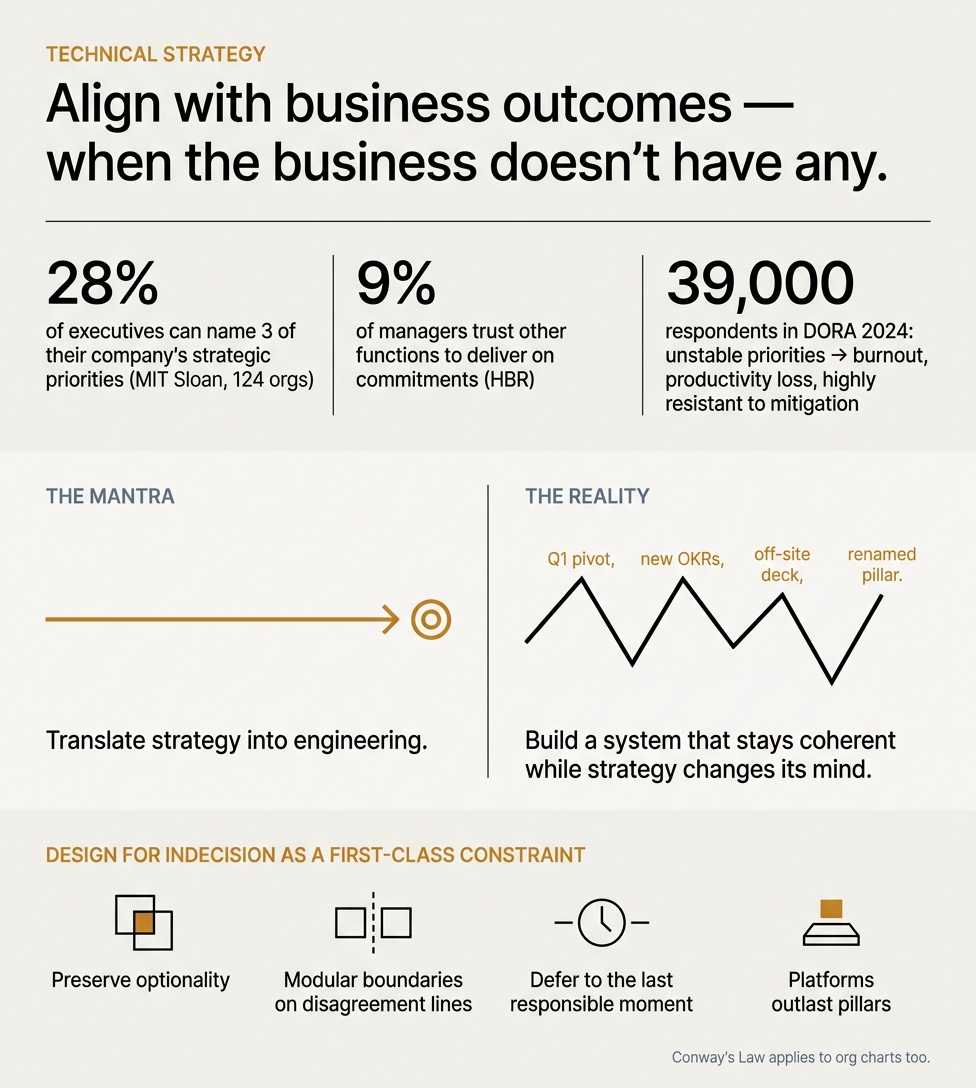
Every engineering leader has heard the line: "align with business outcomes." It sounds obvious. The trouble is that half the time, the business cannot tell you what those outcomes are.
That observation comes from data, not from a bad mood. MIT Sloan studied 124 organizations and found that only 28% of executives could name three of their own company's strategic priorities. Roughly a third could not name one. A separate HBR study found that only 9% of managers said they could rely on colleagues in other functions to deliver on commitments. So when we say "align," we are often aligning to a moving average of contradictory signals from leaders who quietly disagree with each other.
Then the quarterly pivot lands. The OKRs get rewritten. The off-site produces a deck that mostly validates what the CEO already wanted to do. Engineering is told to be more responsive to the business, and a perfectly good roadmap gets shredded for the third time this year.
DORA 2024 surveyed roughly 39,000 people and the finding is blunt: unstable organizational priorities cause real drops in productivity and real increases in burnout, and the damage is highly resistant to mitigation. Strong leaders do not fix it. Good documentation does not fix it. The instability itself is the wound.
So what do you actually do?
You stop treating organizational indecision as a temporary dysfunction that someone, someday, will solve. You treat it as the weather. You design for it.
That means architectures that preserve optionality rather than optimising for the current quarter's stated bet. Modular boundaries placed where the leadership disagreements actually live, because Conway's Law will route those disagreements through your code whether you want it to or not. Decisions deferred to the last responsible moment rather than the most confident one. Platforms that survive a renamed strategic pillar.
The job is no longer to translate the strategy into engineering. The job is to build a system that stays coherent while the strategy keeps changing its mind. Those are very different jobs, and most large organisations only ever staff for the first one.
Research brief: When "align engineering with business outcomes" meets organizational indecision
Format note: Raw research material, organized by the six themes you specified. Dense fact-pack with stats, attributed short quotes, study names/dates, URLs. No narrative framing. Source-quality flags included where data is weak. The user writes the post.
1. Strategic priority churn within fiscal years
Canonical strategy-execution gap stats
- 63% performance gap. "Companies on average deliver only 63% of the financial performance their strategies promise." [1] Mankins & Steele, "Turning Great Strategy into Great Performance," HBR, July–Aug 2005, n=197 senior execs at large companies. Causes named: "inadequate or unavailable resources, poorly communicated strategy, actions required to execute not clearly defined, unclear accountabilities." [2] [3]
- Two-thirds to three-quarters of large organizations struggle to execute strategy. Donald Sull, Rebecca Homkes, Charles Sull, "Why Strategy Execution Unravels — and What to Do About It," HBR, March 2015. [4] Multi-year study, 250+ companies, 8,000+ managers. [5] [6]
- Only 28% of executives can list 3 of their company's strategic priorities. ~30% can't list one. "Little more than half of senior executives agreed on the same list of strategic objectives." [7] Sull, Sull & Yoder, "No One Knows Your Strategy — Not Even Your Top Leaders," MIT Sloan Management Review, Feb 2018, analysis of 124 organizations. [8][9] [10]
Direct quote: "When it comes to setting strategic priorities, the absence of conflict is typically an indicator of failure rather than a sign of a healthy discussion."
- Direct quote: "When it comes to setting strategic priorities, the absence of conflict is typically an indicator of failure rather than a sign of a healthy discussion."
- "3-5 in 3-5" rule. Sull, Turconi, Sull & Yoder, "Turning Strategy Into Results," MIT SMR, Sept 2017: "Well-designed strategies generally contained three to five objectives and extended three to five years." [8] Quote: "When a team announces five-year priorities and changes them a year later, employees dismiss those objectives (and their successors) as the 'flavor of the month' that they can safely ignore." [11] [11]
PMI / Brightline / EIU survey data
- Nearly 90% of large-company execs admit they fail to achieve all their strategic goals due to poor implementation. On average companies miss 20% of strategic objectives because of poor implementation. 59% admit they "often struggle to bridge the gap between strategy development and its practical, day-to-day implementation." EIU/Brightline 2017, 500 senior execs at $1B+ companies. [12]
- Only 56% of strategic initiatives are executed successfully despite 88% saying they're essential. [13] 61% acknowledge a gap between strategy formulation and implementation. [14] EIU/PMI, "Why Good Strategies Fail," 2013. [15]
- PMI 2025 "Step Up" research: 35% of executives cite "disconnect between planning and execution" as the top barrier to reinvention. [16] 93% of execs say they must rethink their business model at least every 5 years; nearly two-thirds do so every 2 years or more frequently. [16] [16]
- PMI/Brightline cost-of-failure figure: ~$2 trillion/year wasted globally; ~$1M every 20 seconds. [17] (Modeled extrapolation, not measured.)
Gartner on annual planning being broken
- Only 29% of strategists agree their organizations change plans fast enough to respond to disruption. [18] Gartner. [18]
- Gartner's "Minimum Viable IT Strategy": "Most CIOs review their strategy only once a year — or less. That's not enough in today's volatile environment." [19] [19]
- Gartner (via Planview): >54% of executives and managers strongly disagreed or were neutral with the statement "My efforts are aligned with strategy." [20]
McKinsey on rigor and decisions
- Only 21% of executives say their corporate strategies pass 4 or more of McKinsey's "Ten Tests of Strategy" — a 40% decrease vs ~15 years ago. [21] "Stragglers are nearly twice as likely as Strategy Champions to have little or no agreement about what constitutes high-quality strategy." [22] McKinsey, "How Strategy Champions Win," 2024. [22]
- Decisions made outside annual planning processes outnumbered those within one. [23] McKinsey Global Survey, n=2,327 execs, Nov 2008. [23]
- Only 20% of respondents say their organizations excel at decision making. 54% spend >30% of their time on decision making; 14% of C-suite spend >70%. McKinsey, "Decision making in the age of urgency," 2019, n=1,259. [24]
Strategic drift
- Strategic drift = "a gradual deterioration of competitive action that results in the failure of an organization to acknowledge and respond to changes in the business environment." [25] Origin: Gerry Johnson 1988; [26] codified in Exploring Corporate Strategy. Symptoms: "homogeneous mind set at managerial and board levels, preservation of the status quo, lack of focus on the external environment, and decline in performance." [25] Sammut-Bonnici, Wiley Encyclopedia of Management Vol. 12, 2015. [25]
IBM CEO/CMO Studies 2025
- 59% of CEOs say "when unexpected changes occur, their organization struggles to balance funding for existing operations and investment in innovation." [27] IBM IBV 2025 CEO Study. [27]
- 54% of CMOs admit they "underestimated the operational complexity of translating AI strategies into tangible outcomes." [28] 84% report rigid, fragmented operations limit ability to harness AI. [28] IBM IBV 2025, n=1,800. [29]
Source-quality flags
- The widely-cited "70% of strategies fail" stat has no rigorous original source. Strongest defensible primary stats: Mankins/Steele 63%/37% and Sull's "two-thirds to three-quarters."
- The "9 out of 10" stat traces to Fortune 1990s + Renaissance Solutions/Kaplan-Norton — practitioner survey, not peer reviewed.
- Brightline = PMI-affiliated; treat as advocacy + EIU survey research.
2. OKR systems breaking down in practice
Failure rates and abandonment
- 46% of organizations rate themselves as performing below average on OKR execution. 71% admit they "have yet to master OKRs." Less than half (48%) have used OKRs >3 years. [30] Quantive & OKRmentors, Global State of OKRs 2023, n=466 leaders. [31] [32] ; [33]
- 90% of organizations struggle to adapt quickly to market changes; only 10% can pivot quickly and effectively. [34] Quantive Global State of Strategy 2024, ~400 execs. [35]
- Only 59% of organizations frequently review progress against stated strategic priorities [34] despite 83% saying they value learning from execution. [34] Same Quantive 2024 report.
- 57% of MTP/NEO Culture survey participants rate their company's OKR skill level as relatively low. [36] [36]
- Vendor folk-stats ("70% OKR failure", [37] "60% struggle", "23% achieve consistent success across two cycles") [38] repeat across blogs (ShiftFocus, ClearPoint, Decision Stack) but I could not trace these to methodologically sound original studies. Flag.
Cross-functional failure (the strongest independent data point)
- Only 9% of managers say they can rely on colleagues in other functions all the time, vs 84% who can rely on their boss/direct reports. [39] "Commitments from these colleagues are typically not much more reliable than promises made by external partners." [39][40] "Managers are three times more likely to miss performance commitments because of insufficient support from other units than because of their own teams' failure to deliver." [5] Sull et al., HBR 2015. [6]
- Nearly 75% of cross-functional teams are dysfunctional in detailed study of 95 teams in 25 corporations. [41] Behnam Tabrizi, Stanford / HBR. [41]
- Sull explicitly argues that top-down cascading of goals is among the worst things organizations do — tightly cascaded goals can't be coordinated horizontally.
- Forrester (via Kixie): "82% of C-level executives report that their product, sales, and marketing teams are aligned, [but] 65% of the sales and marketing professionals within those same organizations state there is a significant lack of alignment between their leaders." [42] [42]
Common failure modes (attributed)
OKRs as tasks/due dates — Felipe Castro:
- "70% of our employees' individual goals involve a project due date" — VP HR, global consumer goods co., quoted by Castro. [43] "An OKR should measure the outcome, not the work." [43]
- "8 of the 19 company 'Key Results' [in Measure What Matters] are project-based ... Even the #1 book on OKR acts as if anything could be an OKR." [43]
- "The most common pitfall is using OKR to track projects and due dates instead of achieving outcomes." [43]
Cargo-cult adoption — Marty Cagan, SVPG, Feb 2020:
- "After many years of being a very vocal advocate for the OKR technique, in the majority of companies I meet, I have stopped recommending the practice." [44]
- "If the company is still using feature teams, as most unfortunately are, then the OKR technique is going to be a cultural mismatch [44] ... OKRs end up being just theatre and meaningless." [45]
- "Those successful companies aren't successful because they use OKRs. [44] They use OKRs because it is designed to leverage the empowered product team model." [46][44] [44]
Silos — Castro, "Shared OKRs":
- "I have a great story about a team from Google Maps that failed to achieve their OKRs because they worked in silos and didn't share their OKRs." [47] "If each team — or individual — focuses only on what they can control, every issue that requires cross-team coordination is stranded." [47] [47]
Sandbagging / set-and-forget — Wodtke, Doerr:
- "If you're consistently scoring 100% or higher on all your Aspirational OKRs — that's a clear sign of sandbagging." [48] whatmatters.com. [48]
- John Doerr (CNBC, Aug 2018): "If you're getting 100 percent of your OKRs done, that's not good. You probably weren't aggressive enough." [49]
- Wodtke, Radical Focus: "Do not change your OKRs halfway through. Suck it up and either fail or nail them." [50]
Individual-level OKRs fail — Jeff Gothelf, HBR 2020: "OKRs fall short when companies attempt to apply them to individual contributors." [51] [51]
The 0.7 sweet spot
- Google's official guidance: "The sweet spot for OKRs is somewhere in the 60-70% range." [52] 0.7-1.0 = green; 0.4-0.6 = yellow; 0.0-0.3 = red — for Aspirational. [48] Committed OKRs require 1.0 (binary). [48] Google re:Work. [52]
- Tability critique: "Achieving 70% of the OKRs is considered awesome ... but it often ends up confusing the team. Salespeople, marketers, engineers have been taught that 100% = done." [53] [53]
Time/ceremonies overhead
- WorkBoard's diagnostic: "Preparing for business reviews takes 40+ hours to produce 50-page slide decks with data that is wrong by the time you get to the meeting." [54]
- Deloitte invested 1.8 million hours/year on traditional performance reviews [55] (cited via Adobe summarizing HBR). [55]
- Clarizen 2015: "nearly 50% of people would prefer to go to the DMV than attend a status update meeting." [56] (Cited via whatmatters.com.)
Engineer sentiment (anecdotal — flagged)
Łukasz Korecki, "OKRs? More like, R U OK?" Better Programming 2022:
- "99% of the articles supporting OKRs were written by companies selling OKR consultancy or tracking software ... if you search where the conversation is happening (Slack channels, Reddit, Hacker News, etc.), the general sentiment is one of disappointment and frustration." [57] [57]
HN, "OKRs Are Bullshit" thread, Feb 2024 ([58]):
- iamleppert: "I had an OKR to reduce page load time ... We achieved our goal by greatly reducing the quality of all images to almost nothing, such that they looked like a rorschach test, and measuring performance on a fast internal network. Management was so happy they bought a white sheet cake. [58] The next quarter, customers complained and a new OKR was set to improve image quality by 50%. So we just reverted all the prior changes, and once again victory was declared." [58][58]
- pjc50: "OKRs seem to be the reinvention of Taylorism for software." [58]
HN on Doerr's book, 2019 ([59]):
- "I found those ratings (0, .4, .7, 1.0) just a sort of weird self delusion, like setting your watch 15 minutes early ... .7 became the de facto 'real' target." [59]
- "As a team lead, to the extent that OKRs were stressed, any non-OKR related work became highly disincentivized. Refactor? Write more integration tests? Hell no, not if it doesn't directly impact OKRs." [59]
Academic base is thin
- Belmiro Silva et al., "Surveying the Academic Literature on the Use of OKR," XIX Brazilian Symposium on Information Systems, ACM 2023: explicit conclusion that "the academic literature on OKR still needs to be explored" [60] — i.e., empirical base is very thin; most existing literature is gray (vendor/practitioner). [60]
3. Executive strategy as confirmation bias / "bad strategy"
Richard Rumelt — Good Strategy / Bad Strategy (Crown Business, 2011)
McKinsey-published essay version: "The perils of bad strategy," McKinsey Quarterly, June 2011. [61]
Four hallmarks of bad strategy (direct quotes):
- Fluff: "A final hallmark of mediocrity and bad strategy is superficial abstraction—a flurry of fluff—designed to mask the absence of thought. Fluff is a restatement of the obvious, combined with a generous sprinkling of buzzwords that masquerade as expertise." [61] Example given: a retail bank's strategy "Our fundamental strategy is one of customer-centric intermediation" [61] — Rumelt: "Remove the fluff and you learn that the bank's fundamental strategy is being a bank." [61]
- Failure to face the challenge: "A strategy is a way through a difficulty, an approach to overcoming an obstacle, a response to a challenge. If the challenge is not defined, it is difficult or impossible to assess the quality of the strategy." [62] (p. 41)
- Mistaking goals for strategy: "If you fail to identify and analyze the obstacles, you don't have a strategy. Instead, you have a stretch goal, a budget, or a list of things you wish would happen."
- Bad strategic objectives: "A long list of 'things to do,' often mislabeled as 'strategies' or 'objectives,' is not a strategy." [63] (p. 53)
Kernel of good strategy = diagnosis, guiding policy, coherent action. [64]
Other Rumelt quotes:
- "Bad strategy is not simply the absence of good strategy. It grows out of specific misconceptions and leadership dysfunctions." [65]
- "When leaders are unwilling or unable to make choices among competing values and parties, bad strategy is the consequence." [63] (p. 60)
- "At the core, strategy is about focus, and most complex organizations don't focus their resources. Instead, they pursue multiple goals at once, not concentrating enough resources to achieve a breakthrough in any of them." [66]
- "Template-style strategy frees [leaders] from the onerous work of analyzing the true challenges and opportunities faced." [63] (p. 68)
- "Strategy is scarcity's child."
Roger Martin — strategy as choice
A.G. Lafley & Roger L. Martin, Playing to Win (HBR Press, 2013). [67]
- Strategy = "an integrated set of choices that uniquely positions the firm in its industry so as to create sustainable advantage and superior value relative to the competition." [68]
- Five-question Strategic Choice Cascade: (1) winning aspiration; (2) where to play; (3) how to win; (4) capabilities; (5) management systems. [69]
- Lafley: "Most leaders do not like to make choices. They'd rather keep their options open … by thinking about options instead of choices and defining winning robustly, these leaders choose to play but not to win. They wind up settling for average industry results at best." [70]
- Martin: "If everything is a priority, nothing is." [71]
- Martin (2025 refinement): A real strategy choice is "one for which the opposite of the choice is not stupid on its face. … A choice to be customer-centric is not a strategy choice because the opposite — ignoring your customers — is stupid on its face." [72] [72]
- Martin on groupthink: A team "must produce more than one possibility. Otherwise, it never really started the strategy-making process because it didn't see itself as facing a choice. Analyzing a single possibility is not conducive to producing optimal action—or, in fact, any action at all." [73]
Henry Mintzberg — deliberate vs emergent strategy
Mintzberg & Waters, "Of Strategies, Deliberate and Emergent," Strategic Management Journal 6(3), 1985. [74]
- Strategy = "a pattern in a stream of decisions/actions." [75]
- "Comparing intended strategy with realized strategy … has allowed us to distinguish deliberate strategies—realized as intended—from emergent strategies—patterns or consistencies realized despite, or in the absence of, intentions." [76]
- "For a strategy to be perfectly emergent, there must be order—consistency in action over time—in the absence of intention about it." [75]
- "The articulation of a strategy locks it into place, impeding willingness to change it (Kiesler, 1971)."
- "The separation of implementation from formulation gives rise to a whole system of commitments and procedures … that can ossify."
- Eight strategy types along the deliberate-emergent continuum: planned, entrepreneurial, ideological, umbrella, process, unconnected, consensus, imposed. [77]
Kahneman, Lovallo, Sibony — bias in strategic decisions
- "Delusions of Success" — Lovallo & Kahneman, HBR July 2003: "Most major business initiatives—mergers and acquisitions, capital investments, market entries—fail to ever pay off." [78] Argues executives' "inside view" produces overoptimistic forecasts via anchoring and competitor neglect. [78] Bent Flyvbjerg's later commentary adds the "Machiavelli factor" — deliberate "cooking" of forecasts to get ventures started. [79] [78]
- "Before You Make That Big Decision…" — Kahneman, Lovallo & Sibony, HBR June 2011: 12-question debiasing checklist. "Confirmation bias … leads people to ignore evidence that contradicts their preconceived notions. Anchoring causes them to weigh one piece of information too heavily; loss aversion makes them too cautious." "A recent McKinsey study of more than 1,000 business investments showed that when companies worked to reduce the effects of bias, they raised their returns on investment by 7 percentage points." "A team that has fallen in love with its recommendation may subconsciously dismiss evidence that contradicts its theories, give far too much weight to one piece of data, or make faulty comparisons to another business case." [80]
- McKinsey "Bias Busters" series on motivated reasoning: "Motivated reasoning takes hold when people lend more credence to conclusions they really want to be true (say, an emotional belief) rather than to those proved by evidence" (cites Kunda, Psych Bulletin 1990). [81]
- "Are your strategy discussions stuck in an echo chamber?" Rehm & Srivastava, McKinsey, April 2018. [82]
Noise (Kahneman, Sibony, Sunstein 2021)
- Noise = "Undesirable variability in judgments of the same problem."
- Insurance audit: median premiums set by underwriters independently for the same five fictive customers varied by 55% — five times as much as expected.
- Explicitly applies to "medicine, law, economic forecasting, forensic science, bail, child protection, strategy, performance reviews, and personnel selection."
Phil Rosenzweig — The Halo Effect (Free Press, 2007)
- Halo effect: "Company performance creates a halo that shapes the way we perceive strategy, leadership, people, culture, and more." When sales are up, observers attribute brilliance to strategy/leadership; when down, the same attributes are derided.
- "For the most part, long-term success is a delusion based on selection after the fact."
- Five takeaways: "Good strategies involve risk and no strategy is foolproof. Execution also is uncertain. What works well for one company may not be effective for another. Chance plays a greater role in success than managers may want to admit. Bad outcomes don't always mean managers made mistakes." [83]
Strategy off-sites and predetermined outcomes
- McKinsey, "Three keys to faster, better decisions" (2019): "It's as if there is an unspoken understanding that the meeting should proceed like a short, three-act play. In the first act, the proposal is delivered in a snappy PowerPoint presentation; in the second, a few tough yet perfunctory questions are asked … in the final act, resolution arrives in the form of an undramatic 'yes' that may seem preordained. Little substantive discussion takes place."
- Sull (2015): "Fewer than one-third of managers say they can have open and honest discussions about the most difficult issues."
- No clean peer-reviewed % exists for "strategy decisions that were predetermined before analysis." Lovallo/Kahneman "inside view" research is the closest evidence base.
4. Engineering under organizational indecision
DORA — the headline finding for this post
- DORA 2024 (n≈39,000): "Stable priorities are critical for well-being: Unstable organizational priorities cause meaningful decreases in productivity and substantial increases in burnout. This negative impact is highly resistant to mitigation and persists even in environments with strong leaders and high-quality documentation." [84] ; PDF: [85]
- Magnitude (third-party characterization, OpsLevel): "Teams that reported unstable organizational priorities experienced … an estimated 40% higher risk of burnout compared to teams with stable priorities."
- Platform engineering tradeoff: when teams were required to use internal platforms exclusively, 8% decrease in throughput, 14% decrease in change stability, but +10% team performance, +8% individual productivity. [86]
- DORA 2025 (AI report): "AI doesn't fix a team; it amplifies what's already there. Strong teams use AI to become even better and more efficient. Struggling teams will find that AI only highlights and intensifies their existing problems." 90% of devs use AI; AI adoption correlates with higher instability, more change failures, increased rework, longer cycle times despite throughput gains. [87]
- DORA 2023: Generative cultures = 30% higher organizational performance; user-centric work = up to 40% higher; high-quality docs = 25% higher team performance; high job security = 61% reduction in burnout. [88]
- Westrum typology (Ron Westrum, BMJ Quality & Safety 13, 2004): Pathological (power) / Bureaucratic (rule) / Generative (performance). Generative cultures predictive of software delivery, organizational performance, job satisfaction (Forsgren et al., Accelerate, 2018). [89]
McKinsey Developer Velocity (2020)
n=440 large enterprises. Top-quartile DVI vs bottom-quartile (2014–2018):
- Revenue growth 4–5× faster
- 60% higher total shareholder returns
- 20% higher operating margins
- 55% higher innovation scores
- 47% higher developer satisfaction & retention in top quartile
- 4 capabilities driving outcomes: tools, culture, product management, talent management.
- [90]
McKinsey 2022 follow-up: orgs above average across all 6 PM dimensions had 1.5× higher DVI scores than those excelling in only 1–2 areas. [91]
Stack Overflow Developer Survey
- Stack Overflow 2024 (n=65,000+): Tech debt is the top frustration for 62% of developers (63% of people-managers) — twice as much as the second-most-cited issue. "Waiting on answers to questions often causes interruptions and disrupts my workflow" — 53% of managers and devs agree. 45%/44% blame knowledge silos for shutting down idea sharing. Erin Yepis quote: "63 percent, the top choice for professional developers for their frustration at work is tech debt." [92]
- Stack Overflow 2025 (n≈49,000): Top AI frustration (66%): "AI solutions that are almost right, but not quite." 84% use/plan to use AI; 46% don't trust accuracy (up from 31% in 2024); only ~3% "highly trust" AI output. [93]
Technical debt
- Stripe Developer Coefficient (2018, with Harris Poll): Developers spend 17.3 hrs/week on maintenance/legacy issues;
4 hrs/week on bad code. **$300B/year** lost global GDP from developer inefficiency. Two-thirds of developers said "clear prioritization, responsibilities and long-term product goals would improve their own productivity." [94]
- McKinsey "Tech debt: Reclaiming tech equity" (Oct 2020), n=50 CIOs at >$1B firms: CIOs report 10–20% of new-product tech budget is diverted to resolving tech debt. Tech debt = 20–40% of the value of the entire technology estate. 60% of CIOs said tech debt had risen perceptibly over the prior 3 years. CIO testimonial: "By reinventing our debt management, we went from 75 percent of engineer time paying the [tech debt] 'tax' to 25 percent. It allowed us to be who we are today." [95]
- McKinsey 2023: Companies in bottom 20th percentile for Tech Debt Score are 40% more likely to have incomplete or canceled IT modernizations than top 20th percentile; top quartile = 20% higher revenue growth. [96]
- Stepsize "State of Technical Debt 2021": Engineers spend ~33% of time on tech debt (~6 hrs/week). 52% say tech debt damages morale; 58% lack any process to manage it; 66% could ship up to 100% faster with such a process. [97]
- Martini et al., J. Systems & Software (n=226, 15 orgs): average 25% of total development time spent managing tech debt; only 26% use any tracking tool; 7.2% methodically track it. [98]
- Puppet 2024 State of DevOps: 43% of orgs have had a platform team for 3–5 years; avg 3 self-service platforms running internally; 52% say a product manager is crucial to platform team success (suggests platforms fail without clear product mandate). [99]
- Humanitec 2023 Benchmarking Study (n=1,800+): "93% of top performing teams report using an Internal Developer Platform … only 5% of medium and 2% of low performing teams." Identified the "DevOps mountain of tears" — most orgs stuck mid-quartile due to high cognitive load on developers. [100]
- Humanitec 2024 (n=281): 56% of orgs have had platform teams <2 years; only 13% >5 years. Implies fragility under shifting strategy. [101]
- CNCF April 2025 (n=420): 28% have a dedicated platform team; 41% multi-team approach; 31% no formal approach (i.e., 72% lack a single clear platform mandate). [102]
- Gartner forecast: "By 2026, 80% of large software engineering organizations will establish platform engineering teams … up from 45% in 2022." (Forecast, not measured.) [103]
Context-switching / pivot costs
- Gerald Weinberg (Quality Software Management: Systems Thinking, Dorset House, 1992, p. 284) heuristic table:
2 projects: 40% per project, 20% loss
3 projects: 20% per project, 40% loss
4 projects: 10% per project, 60% loss
5 projects: 5% per project, 75% loss
Caveat: Heuristic, not a controlled study. Widely cited but not independently validated.
- 2 projects: 40% per project, 20% loss
- 3 projects: 20% per project, 40% loss
- 4 projects: 10% per project, 60% loss
- 5 projects: 5% per project, 75% loss
- Caveat: Heuristic, not a controlled study. Widely cited but not independently validated.
- Gloria Mark / UC Irvine, "The Cost of Interrupted Work" (2008): "It takes an average of 23 minutes and 15 seconds to fully return to a task after an interruption." 82% of interrupted work is resumed same day.
- Microsoft Work Trend Index 2025 ("Breaking down the infinite workday"): Employees using M365 are interrupted every 2 minutes by a meeting, email, or notification (~275 interruptions/day in core hours). 48% of employees and 52% of leaders say work feels chaotic and fragmented. Average: 117 emails + 153 Teams messages/day; 60% of meetings ad hoc; half of meetings now occur during peak focus hours. [104]
- Atlassian State of Teams 2024 (n=5,000 + 100 F500 execs): 64% say their teams lack clear, shared goals. Executives estimate only 24% of their teams are doing mission-critical work. >65% chose to respond quickly to messages over making progress on top priorities. 50% have duplicated work another team was already doing. "In organizations with poor meeting cultures, people spend 50% more time in unnecessary meetings than making progress on high-priority work." [105]
SPACE framework / developer productivity
Forsgren, Storey, Maddila, Zimmermann, Houck, Butler, "The SPACE of Developer Productivity," ACM Queue 19(1), March 2021. [106]
- 5 dimensions: Satisfaction & well-being, Performance, Activity, Communication & collaboration, Efficiency & flow.
- "Productivity cannot be reduced to a single dimension (or metric!)."
- Forsgren (InfoQ): "Working longer hours may signal developers having to 'brute-force' work to overcome bad systems or poor planning to meet a predefined release schedule."
- Flow/Efficiency dimension explicitly captures cost of interruption, handoffs, wait times.
Roadmap volatility — gap
- ProductPlan survey of 1,300 PMs: "Planning and prioritizing the product roadmap is the single biggest product management challenge."
- Teresa Torres: "Feature-based roadmaps are fiction. Everyone on the product team knows it. The challenge is the rest of the organization sees it as a contract. When the product team breaks the contract, as they inevitably will do, trust erodes." [107]
- No clean public stat on "% of roadmap items shipped vs cut" or "frequency of mid-quarter rewrites" from major roadmap tools. Use as qualitative observation.
5. Designing for organizational indecision as a first-class constraint
Cynefin (Snowden & Boone, HBR Nov 2007)
[108]
Five domains and decision modes:
- Clear/Obvious ("known knowns"): Sense → Categorize → Respond. Best practice.
- Complicated ("known unknowns"): Sense → Analyze → Respond. Good practice; experts.
- Complex ("unknown unknowns"): Probe → Sense → Respond. Emergent practice. "Run safe-to-fail parallel probes, not experiments." Cause-effect only visible in retrospect.
- Chaotic: Act → Sense → Respond. Novel practice. "Act decisively in such a way as to maximise options, not to resolve the issue."
- Disorder/Aporetic-Confused (renamed 2020): don't know which domain applies.
Snowden quotes:
- "Wise executives tailor their approach to fit the complexity of the circumstances they face."
- In Chaos: a leader "must first act to establish order, sense where stability is present, and then work to transform the situation from chaos to complexity."
- 2020 update: [109]
Real Options Theory applied to IT
- Origins: Myers (1977, MIT Sloan); Dixit & Pindyck, Investment Under Uncertainty (1994); Trigeorgis.
- Five canonical option types: Defer, Expand, Contract, Abandon, Switch. Increases in uncertainty, time-to-expiry, risk-free rate raise option value (counter-intuitive vs NPV).
- McKinsey, "The Real Power of Real Options" (Leslie & Michaels, MQ 1997): "Because traditional valuation tools such as NPV ignore the value of flexibility, real options are important in strategic and financial analysis." "An option holder wants to do everything it can to increase the uncertainty of expected returns and then exercise at the top, or back out, depending on how things go." [110]
- IT applications: Brynjolfsson 1993 CACM; Fichman 2004 (multi-axis IT real options); Li & Johnson, IRMJ 2002.
- Architecture interpretation: Treat irreversible commitments (vendor lock-in, proprietary formats, monolithic schemas) as exercising options prematurely. Abstraction layers, hexagonal architecture, swappable adapters have positive option value precisely because uncertainty is high.
Modular architecture / Conway's Law
- Baldwin & Clark, Design Rules: The Power of Modularity (MIT Press, 2000). Proposition P-4: "In a platform system, dividing any component into modules that can be developed independently, while holding their total expected value constant, increases the value of the system" — each module is a real option. [111]
- Conway's Law (Melvin Conway, "How Do Committees Invent?" Datamation, April 1968): "Any organization that designs a system (defined broadly) will produce a design whose structure is a copy of the organization's communication structure." [112]
- Inverse Conway Maneuver (LeRoy & Simons, Cutter IT Journal, Dec 2010): "Evolve your team and organizational structure to promote your desired architecture." "Dysfunctional organisations tend to create dysfunctional applications." ThoughtWorks: [113]
- Martin Fowler on Conway's Law: "Powerful enough that you're doomed to defeat if you try to fight it." [114]
- Mirroring hypothesis (Colfer & Baldwin, 2016) — empirical research showing technical product architecture mirrors organizational structure.
- Sam Newman, Building Microservices (2nd ed. 2021): default recommendation = monolith first. "A microservices architecture is a conscious choice you have made … because of some outcome you're looking for."
- Team Topologies (Skelton & Pais, 2019) operationalizes inverse Conway: stream-aligned, platform, enabling, complicated-subsystem teams.
Wardley Mapping
Free book on Medium (CC BY-SA): [115]
- Y-axis = value chain (anchored on user need); X-axis = evolution (Genesis → Custom-Built → Product → Commodity).
- ~30 climatic patterns ("everything evolves"; "past success breeds inertia"; "efficiency enables innovation"; Red Queen Effect).
- ~40 doctrine principles; ~100 gameplay moves.
- Pioneers / Settlers / Town Planners ([116]): three groups, each "steals" mature work from the prior, forcing evolution.
- Wardley quotes:
"Maps beat SWOT every time. Maps show relationships and give you actionable intelligence."
"No single approach works everywhere. What works for commodities fails in uncharted territory."
"What matters is not the plan but the preparation and your ability to adapt."
"Bias towards action. Do not attempt to create the perfect map. You learn by playing the game."
"There is no 'core,' it's all transitional."
- "Maps beat SWOT every time. Maps show relationships and give you actionable intelligence."
- "No single approach works everywhere. What works for commodities fails in uncharted territory."
- "What matters is not the plan but the preparation and your ability to adapt."
- "Bias towards action. Do not attempt to create the perfect map. You learn by playing the game."
- "There is no 'core,' it's all transitional."
Resilience engineering / adaptive capacity
- David Woods (Ohio State), "Four concepts for resilience" (Reliability Engineering & System Safety 141, 2015): Adaptive capacity = "a system is poised to adapt, it has some readiness or potential to change how it currently works." Graceful Extensibility = "the ability of a system to extend its capacity to adapt when surprise events challenge its boundaries." "Systems can be reliable and brittle." [117]
- Woods' Theorem (with Laura Nolan, SREcon 2021): "As the complexity of a system increases, the accuracy of any single agent's own model of that system — their 'process feel' — decreases rapidly." [118]
- Erik Hollnagel — Safety-I vs Safety-II (2014). Safety-I = absence of accidents; Safety-II = "the ability to succeed under varying conditions, so that the number of intended and acceptable outcomes is as high as possible." Safety-II "explicitly assumes that systems work because people are able to adjust what they do to match the conditions of work." Work-as-Imagined ≠ Work-as-Done. [119]
- John Allspaw / Adaptive Capacity Labs: "People are the only adaptable element in complex systems. Full stop. It's not that the hardware, software, and architectures, and frameworks, and programming languages can't be built to be malleable and adaptable, but they don't have an ability to adapt to situations that were unforeseen."
- Cook & Allspaw, "Above the Line, Below the Line" (ACM Queue 2020): below-the-line = code/infra (never directly seen); above-the-line = human cognitive work, mental models, coordination. "The adaptive capacity of complex systems resides in people." [120]
Antifragile (Taleb, 2012)
- Fragile (Damocles) → Robust (Phoenix) → Antifragile (Hydra) — gains from disorder.
- "Antifragility implies more to gain than to lose, equals more upside than downside, equals (favorable) asymmetry."
- Barbell strategy: "If you put 90 percent of your funds in boring cash … and 10 percent in very risky, maximally risky, securities, you cannot possibly lose more than 10 percent, while you are exposed to massive upside."
- Via negativa: "The greatest — and most robust — contribution to knowledge consists in removing what we think is wrong." "Chess grandmasters usually win by not losing; people become rich by not going bust."
- Optionality rules: (1) "rank things according to optionality," (2) "preferably with open-ended, not closed-ended, payoffs," (3) "Do not invest in business plans but in people," (4) "Make sure you are barbelled."
- "An option is what makes you antifragile and allows you to benefit from the positive side of uncertainty, without a corresponding serious harm from the negative side."
- "Artificially suppressing volatility makes the system extremely fragile" → chaos engineering as antifragile practice.
Architectural decisions that preserve optionality
- Last Responsible Moment (Mary & Tom Poppendieck, Lean Software Development, 2003): "the moment at which failing to make a decision eliminates an important alternative." "Concurrent development makes it possible to delay commitment until the last responsible moment ... If commitments are delayed beyond the last responsible moment, then decisions are made by default." "Paradoxically, it's possible to make better decisions by not deciding."
- Martin Fowler: Architecture = "things that are important and hard to change." "Rather than trying to get the right decision now, look for a way to put off the decision until later (when you'll have more information)." Sacrificial Architecture, Strangler Fig patterns.
- Architecture Decision Records (Michael Nygard, 2011): Title, Status, Context, Decision, Consequences. "One of the hardest things to track during the life of a project is the motivation behind certain decisions." UK GDS Way recommends ADRs: [121]
- Evolutionary Architecture (Ford, Parsons, Kua, O'Reilly 2017): "Supporting guided, incremental change as a first principle across multiple dimensions." Fitness function = "any mechanism that provides an objective integrity assessment of some architectural characteristic(s)." Ford: "The future cannot be predicted. Thus five year plans don't work out. Thus there is a need to work incrementally." [122]
- YAGNI ("You Aren't Gonna Need It") — XP principle complementing LRM, prevents BDUF.
Bonus frameworks
- Stafford Beer's Viable System Model: Five subsystems (S1 ops, S2 coordination, S3 control, S4 environment scanning, S5 policy). Ashby's Law of Requisite Variety: "a control system must be as complex as the system it controls." Most orgs are S3-dominant and S4-deficient → can't adapt.
- Donella Meadows, "Leverage Points" (1999): 12 ranked points from least to most powerful. Lowest leverage = constants/parameters ("diddling with the details, arranging deck chairs on the Titanic"). Highest leverage = paradigm/mindset and goals of the system. "Leverage points are not intuitive. Or if they are, we intuitively use them backward, systematically worsening whatever problems we are trying to solve." [123]
- Cook, "How Complex Systems Fail" (1998/2000) — 18 propositions; canonical short read.
- Dekker, Drift into Failure (2011) — gradual normalization of deviance.
- Perrow, Normal Accidents (1984) — tight coupling × interactive complexity.
Cross-cutting synthesis points
All seven frameworks converge on a single anti-NPV claim: under uncertainty, the value of flexibility dominates the cost of carry. NPV/business-case thinking systematically destroys option value. Baldwin/Clark's modularity math, Taleb's optionality, Wardley's preserved optionality in genesis, Snowden's "act to maximise options" in chaos, and Fowler/Poppendieck's LRM are the same idea applied at different layers.
Conway's Law is the bridge between organizational indecision and technical fragility: indecision is itself a communication structure, and the architecture will mirror it.
Resilience engineering (Woods/Hollnagel/Allspaw) reframes "indecision" not as a bug but as adaptive capacity in reserve — orgs that decide too fast and too cleanly have less slack to absorb surprise. Brittleness ≠ reliability.
6. Healthtech regulatory uncertainty (UK / EU focus, lighter touch)
UK regulatory churn
- MHRA roadmap shifted twice in 12 months. First "Software and AI as a Medical Device Change Programme Roadmap" Oct 2022, major regulatory roadmap Jan 2024, revised roadmap (v2.0) Dec 2024. Pre-market SI now "expected to be introduced to Parliament in late 2025 and come into force in 2026." [124] ; [125]
- MHRA Post-Market Surveillance regs signed Dec 2024, in force June 2025. Serious public health threats reportable in 2 calendar days. [126]
- MHRA up-classifying AI/SaMD: "many AI products that are currently in the lowest-risk category (Class 1) 'will be up-classified' to provide greater scrutiny throughout the product lifecycle." AI Airlock regulatory sandbox launched spring 2024. [127]
- NHSX dissolution (Feb 2022) — existed only ~3 years; merged into NHS England Transformation Directorate. [128]
- NHS England being abolished (announced 13 March 2025). Transition planned to complete 2027. 50% cut to ICB running costs on top of previous 30% cut. 201 NHS organisations/bodies to be abolished. "DHSC was the Whitehall department with the largest drop in staff engagement between 2024 and 2025." A senior civil servant called the process "utter chaos." [129] ; [130]
- Federated Data Platform (FDP) instability. Palantir won £330m, 7-year contract Nov 2023. Initial 3-year contract called for 13 core capabilities but "delivered only three or four of them, and then only partially." ~200 trusts announced plans to join, "only about half were live and only a quarter reported benefits." Government considering triggering break clause spring 2027.
Lib Dem MP Martin Wrigley (Hansard, April 2026): "The current contract delivers a subscription service that leaves no deliverables after the subscription – no software, no improvements and no intellectual property after spending more than £330 million."
[131] ; [132]
- Lib Dem MP Martin Wrigley (Hansard, April 2026): "The current contract delivers a subscription service that leaves no deliverables after the subscription – no software, no improvements and no intellectual property after spending more than £330 million."
- [131] ; [132]
- DTAC refresh effective 6 April 2026. Replaces 2023 version. "25% reduction in questions"; new requirements aligned with the government's Software Security Code of Practice. Partly response to June 2024 Synnovis ransomware attack ("disrupted over 10,000 hospital appointments and was linked to a patient's death"). [133]
- NICE Evidence Standards Framework (ESF) updated three times: March 2019 → April 2021 → August 2022 (added AI/adaptive algorithm requirements; renamed tiers A/B/C). JMIR critique: ESF "does not sufficiently incorporate real-world evidence or support continuous learning models." [134]
EU regulatory uncertainty
- EU MDR transition extended (Reg 2023/607). Originally fully applicable 26 May 2024. Extended to 31 Dec 2027 (Class III / implantable IIb) and 31 Dec 2028 (other IIb, IIa, Class I sterile/measuring). Notified Body reviews now take "13 to 18 months ... for complex devices, it can be longer." [135]
- MDR is killing products. BVMed/MedicalMountains/SPECTARIS/VDGH joint survey (June–Aug 2025; 245 manufacturers DE/AT/CH): MDR/IVDR have "triggered widespread R&D pullbacks, supply chain fragility, and product withdrawals, especially among orphan device makers." ~33% of companies planning to relocate some/all production outside the EU. [136]
- Earlier German survey (378 manufacturers): MDR caused "doubling of costs"; 46% of manufacturers put innovation projects on hold; 19% launching products first outside the EU. [137]
- TEAM-NB 2023 survey: "almost 10,000 products could still be waiting for certification" by EU notified bodies.
- EU AI Act creates dual compliance regime for medical AI from Aug 2027. ~75% of all commercial AI-enabled medical devices are radiology-related; "all but one of which are classified as Class ≥IIa under the MDR" — so most auto-classified high-risk under AI Act. Penalties up to €35m or 7% annual turnover. [138]
- EHDS Regulation (EU) 2025/327 entered into force 26 March 2025. Most secondary use provisions apply from 26 March 2029; clinical trial / genomic data from 26 March 2031. UK-based health data holders are out of scope unless they have an EU establishment. [139]
US (relevant if UK firms sell to US)
- FDA finalised PCCP guidance Dec 2024 (was draft April 2023). "Marketing Submission Recommendations for a Predetermined Change Control Plan for Artificial Intelligence-Enabled Device Software Functions." Scope expanded from ML to all AI. ~1,000 AI/ML-enabled devices already approved. New FDA QMSR (Part 820 / ISO 13485 alignment) takes effect 2 Feb 2026. [140]
- MHRA-FDA-Health Canada joint principles: Good Machine Learning Practice (10 principles), PCCPs (5 principles, Aug 2025), Transparency principles.
Quantitative healthtech data
- Clinical evidence is sparse. JMIR cross-sectional study (2022) of 224 US digital health companies (avg age 7.7y): "Average clinical robustness was 2.5 (1.8 clinical trials and 0.8 regulatory filings) with a median score of 1." 44% (98 companies) had a clinical robustness score of zero. [141]
- Regulation = #1 external success factor for digital health scaleups. JMIR systematic review (2024) of 36 studies / 52 success factors. [142]
- Top 5 pharma companies invested combined $270m in SaMD initiatives Jan 2019 – Oct 2021. 73% of SaMD deals were with strategic partners; survey found "significant time and investment required to successfully launch even a single SaMD solution." BrightInsight + HealthXL 2022. [143]
- Rock Health 2024: US digital health VC = $10.1bn across 497 deals (down from $10.8bn / 503 in 2023). AI startups = 37% of 2024 funding. M&A hit a decade low at 118 deals. 2025 rebound: $14.2bn (up 35%); 26 mega-deals; 15 new unicorns. [144]
Babylon Health collapse (2023) — UK case study
- IPO via SPAC Oct 2021 at $4.2bn; founder Ali Parsa later called it "an unbelievable, unmitigated disaster."
- Net loss of $221m on $1bn revenue (2022); Q1 2023 loss of $63.2m (doubled YoY).
- NHS GP at Hand paid £100/patient/year — Parsa admitted Babylon "lost money on every member" since UK patients used the service "six or seven times a year" vs. an expected 2–3.
- 2017: Care Quality Commission report flagged safety concerns. 2021: MHRA reviewed the symptom-checker app after clinician concerns.
- Lancet (2022) on Babylon study: "does not offer convincing evidence that its Babylon Diagnostic and Triage System can perform better than doctors in any realistic situation, and there is a possibility that it might perform significantly worse."
- Filed Chapter 7 (US) Aug 2023; UK administration 11 Sept 2023; assets sold to eMed Healthcare for £500,000.
- [145] ; [146]
Clinical safety + agile tension
- IEC 62304 is method-agnostic but documentation-heavy. Standard does NOT mandate waterfall. AAMI TIR45 is the de-facto bridge for agile teams. "The standard doesn't require waterfall, but you can't substitute sprint artifacts for the documentation it asks for." Three software safety classes (A, B, C). "A second edition of IEC 62304 is under development … expected to better accommodate cloud-based software, frequent updates, and modern delivery models." [147]
- Fundamental tension (Mantra Systems): "Software products inherently evolve far more rapidly than physical products, and the technical complexity of generative AI poses challenges for ensuring Notified Bodies can comprehend material within the technical file." [148]
Source-quality flags (consolidated)
- "70% of strategies fail" / "9 out of 10 strategies fail": No rigorous original source. Use Mankins/Steele 63% (HBR 2005) or Sull's "two-thirds to three-quarters" (HBR 2015) instead.
- PMI "$2T wasted/year" / "$1M every 20 seconds": Modeled extrapolation, not measured loss.
- OKR vendor stats (70% fail, 60% struggle, 23% achieve consistent success): Mostly untraceable to original methodology. Vendor commercial interest. Use only Sull's 9% horizontal reliability (HBR 2015) and 28% strategic-priority recall (MIT Sloan 2018) as defensible quantitative claims.
- "$300B/year developer inefficiency" (Stripe): Modeled estimate using developer self-reports × global dev population × global GDP-per-developer. Not measured economic loss.
- Weinberg 20%-per-task context-switching cost: Heuristic from a 1992 textbook table, not empirical research. Widely cited but not independently validated.
- Gartner "80% by 2026" platform engineering stat: Forecast, not measured.
- DORA 2024 "90% of teams in shifting-priority orgs experience productivity drops": Found in third-party summary (Gearset/DevOpsLaunchpad); the safer phrasing is DORA's own: the productivity hit from unstable priorities is "highly resistant to mitigation."
- Rock Health figures: US-only; useful as sentiment proxy but not UK-specific.
- BVMed/MedicalMountains MDR survey: Industry-association data — directionally useful, reflects manufacturer perspective.
- HBR Analytic Services "82% consider strategic goals critical" (2022): Sponsored by Lattice — flag as sponsored content.
- Hacker News / Reddit engineer commentary: Anecdotal color, clearly labeled.
- Robert Merton's connection to "real options for IT": Indirect — he extended Black-Scholes (Nobel 1997) but is not strictly an IT real-options author. Linkage is via Brynjolfsson, Fichman, Benaroch.
- "Cynefin 2.0": Informal shorthand; Snowden uses "St David's Day update." 2020 Aporetic/Confused split is the most material change.
Headline quotes worth reusing verbatim
- DORA 2024: "Unstable organizational priorities cause meaningful decreases in productivity and substantial increases in burnout. This negative impact is highly resistant to mitigation and persists even in environments with strong leaders and high-quality documentation."
- Rumelt: "If you fail to identify and analyze the obstacles, you don't have a strategy. Instead, you have a stretch goal, a budget, or a list of things you wish would happen."
- Rumelt: "Strategy is scarcity's child."
- Lafley (Playing to Win): "Most leaders do not like to make choices. They'd rather keep their options open … these leaders choose to play but not to win."
- Sull et al. (MIT Sloan 2018): "When it comes to setting strategic priorities, the absence of conflict is typically an indicator of failure rather than a sign of a healthy discussion."
- Mintzberg: Strategy = "a pattern in a stream of decisions."
- Marty Cagan (SVPG 2020): "I have stopped recommending the practice. … OKRs end up being just theatre and meaningless."
- Allspaw: "People are the only adaptable element in complex systems. Full stop."
- Snowden & Boone (HBR 2007): In Chaos, leaders should "act decisively in such a way as to maximise options, not to resolve the issue."
- Forsgren (SPACE 2021): "Working longer hours may signal developers having to 'brute-force' work to overcome bad systems or poor planning."
- Stack Overflow 2024 (Erin Yepis): "63 percent, the top choice for professional developers for their frustration at work is tech debt."
- Stripe 2018: Two-thirds of developers said "clear prioritization, responsibilities and long-term product goals would improve their own productivity."
- Taleb: "An option is what makes you antifragile and allows you to benefit from the positive side of uncertainty, without a corresponding serious harm from the negative side."
- Meadows: "Leverage points are not intuitive. Or if they are, we intuitively use them backward, systematically worsening whatever problems we are trying to solve."
- Wardley: "What matters is not the plan but the preparation and your ability to adapt."
- Conway (1968): "Any organization that designs a system … will produce a design whose structure is a copy of the organization's communication structure."
- Poppendieck: "If commitments are delayed beyond the last responsible moment, then decisions are made by default."
- MP Martin Wrigley (Hansard, April 2026, FDP): "The current contract delivers a subscription service that leaves no deliverables after the subscription – no software, no improvements and no intellectual property after spending more than £330 million."
- The Case Centre — https://www.thecasecentre.org/products/view?id=63525
- Mezzaninegrowth — https://mezzaninegrowth.com/blog/strategy-to-action
- https://hbr.org/2005/07/turning-great-strategy-into-great-performance — https://hbr.org/2005/07/turning-great-strategy-into-great-performance
- ResearchGate — https://www.researchgate.net/publication/289998893_Why_Strategy_Execution_Unravels-and_What_to_Do_About_It
- Rhythmsystems — https://www.rhythmsystems.com/blog/ceo-strategy-execution
- https://hbr.org/2015/03/why-strategy-execution-unravelsand-what-to-do-about-it — https://hbr.org/2015/03/why-strategy-execution-unravelsand-what-to-do-about-it
- InStrategy — https://in-strategy.com/en/blog/nobody-knows-your-strategy-not-even-your-top-leaders/
- MIT Sloan — https://mitsloan.mit.edu/ideas-made-to-matter/a-guide-to-mit-sloan-management-reviews-strategic-agility-project
- Harvard Business Review — https://store.hbr.org/product/no-one-knows-your-strategy-not-even-your-top-leaders/SMR669
- https://sloanreview.mit.edu/article/no-one-knows-your-strategy-not-even-your-top-leaders/ — https://sloanreview.mit.edu/article/no-one-knows-your-strategy-not-even-your-top-leaders/
- MIT Sloan Management Review — https://sloanreview.mit.edu/article/turning-strategy-into-results/
- https://www.brightline.org/resources/eiu-report/ — https://www.brightline.org/resources/eiu-report/
- LinkedIn — https://www.linkedin.com/pulse/think-how-connect-your-strategy-design-ability-pay-viana-vargas
- Website-files — https://assets-global.website-files.com/5d67ccbeb41d9343fae3a4bc/5e43d5c8daeec056de8fa7e4_Characterizing-the-Gap-Between-Strategy-and-Implementation.pdf
- https://www.pmi.org/-/media/pmi/documents/public/pdf/learning/thought-leadership/why-good-strategies-fail-report.pdf — https://www.pmi.org/-/media/pmi/documents/public/pdf/learning/thought-leadership/why-good-strategies-fail-report.pdf
- PMI — https://www.pmi.org/about/press-media/2025/new-pmi-research-reveals-strategy-execution-gap-is-undermining-transformation-and-how-to-close-it
- Brightline — https://www.brightline.org/resources/the-brightline-initiative-is-closing-the-gap-between-strategy-design-and-delivery/
- Gartner — https://www.gartner.com/en/insights/strategic-planning
- Gartner — https://www.gartner.com/en/articles/minimum-viable-it-strategy
- Planview — https://www.planview.com/resources/guide/strategic-planning-deliver-value/strategic-planning-software-vs-excel-spreadsheets/
- Financial Poise — https://www.financialpoise.com/how-to-make-a-good-strategic-decision/
- McKinsey & Company — https://www.mckinsey.com/capabilities/strategy-and-corporate-finance/our-insights/how-strategy-champions-win
- McKinsey & Company — https://www.mckinsey.com/capabilities/strategy-and-corporate-finance/our-insights/how-companies-make-good-decisions-mckinsey-global-survey-results
- https://www.mckinsey.com/capabilities/people-and-organizational-performance/our-insights/decision-making-in-the-age-of-urgency — https://www.mckinsey.com/capabilities/people-and-organizational-performance/our-insights/decision-making-in-the-age-of-urgency
- Wiley Online Library — https://onlinelibrary.wiley.com/doi/abs/10.1002/9781118785317.weom120213
- Arcjournals — https://www.arcjournals.org/pdfs/ijmsr/v10-i1/7.pdf
- IBM — https://www.ibm.com/thought-leadership/institute-business-value/c-suite-study/ceo
- IBM — https://newsroom.ibm.com/2025-06-17-ibm-study-profit-driven-cmos-see-ai-as-growth-driver,-but-operational-hurdles-slow-them-down
- https://newsroom.ibm.com/2025-06-17-ibm-study-profit-driven-cmos-see-ai-as-growth-driver-but-operational-hurdles-slow-them-down — https://newsroom.ibm.com/2025-06-17-ibm-study-profit-driven-cmos-see-ai-as-growth-driver-but-operational-hurdles-slow-them-down
- LinkedIn — https://www.linkedin.com/pulse/global-state-okrs-2023-report-hereand-more-great-news-okrmentors
- okrmentors — https://www.okrmentors.com/pages/global-state-of-okrs
- https://www.businesswire.com/news/home/20230627290171/en/ — https://www.businesswire.com/news/home/20230627290171/en/
- https://www.okrmentors.com/blog/okr-overachievers-strategy-execution/ — https://www.okrmentors.com/blog/okr-overachievers-strategy-execution/
- Business Wire — https://www.businesswire.com/news/home/20240508173898/en/90-of-Companies-Struggle-to-Adapt-Quickly-to-Market-Changes-According-to-Cross-Industry-Business-Strategy-Survey
- https://www.businesswire.com/news/home/20240508173898/en/ — https://www.businesswire.com/news/home/20240508173898/en/
- Mind the Product — https://www.mindtheproduct.com/how-real-product-teams-make-okrs-work-extended-report/
- Medium — https://muthu16598.medium.com/why-70-okr-initiatives-dont-work-1e4d659c16bc
- Medium — https://medium.com/@rajalakshmimuthu12341/the-75-okr-failure-rate-41dca69ff603
- Collierandcompany — https://collierandcompany.com/wp-content/uploads/2015/04/Strategy-Execution1.pdf
- Chris HOHMANN — https://hohmannchris.wordpress.com/2022/09/09/get-rid-of-horizontal-alignment-in-strategy-execution/
- Culturewise — https://culturewise.com/blog/using-company-culture-to-align-cross-functional-collaboration
- Kixie — https://www.kixie.com/sales-blog/how-cross-functional-misalignment-is-silently-killing-your-revenue-and-how-to-fix-it/
- Felipecastro — https://read.felipecastro.com/p/measure-outcome-not-work
- Silicon Valley Product Group — https://www.svpg.com/team-objectives-overview/
- Tim Woods — https://timwoods.io/2020/09/06/product404-marty-cagan-product-leadership-teams-product-vs-feature-teams-okrs-and-more/
- Hacker News — https://news.ycombinator.com/item?id=23892773
- Felipecastro — https://read.felipecastro.com/p/shared-okrs
- What Matters — https://www.whatmatters.com/faqs/how-to-grade-okrs
- CNBC — https://www.cnbc.com/2018/08/14/this-goal-setting-method-is-used-by-bill-gates-larry-page-and-bono.html
- David Tuite — https://www.davidtuite.com/radical-focus-okrs-notes/
- Harvard Business Review — https://hbr.org/2020/12/use-okrs-to-set-goals-for-teams-not-individuals
- Google re:Work — https://rework.withgoogle.com/intl/en/guides/set-goals-with-okrs
- Tability — https://www.tability.io/okrs/how-to-score-your-okrs
- https://www.workboard.com/the-challenge/ — https://www.workboard.com/the-challenge/
- Adobe — https://business.adobe.com/blog/perspectives/hbr-insights-performance-management-revolution
- What Matters — https://www.whatmatters.com/faqs/okr-meeting-agenda
- Better Programming — https://betterprogramming.pub/okrs-more-like-r-u-ok-caaf5b7db7e6
- https://news.ycombinator.com/item?id=39271083 — https://news.ycombinator.com/item?id=39271083
- https://news.ycombinator.com/item?id=19550583 — https://news.ycombinator.com/item?id=19550583
- ACM Other conferences — https://dl.acm.org/doi/10.1145/3592813.3592934
- https://www.mckinsey.com/capabilities/strategy-and-corporate-finance/our-insights/the-perils-of-bad-strategy — https://www.mckinsey.com/capabilities/strategy-and-corporate-finance/our-insights/the-perils-of-bad-strategy
- Will Patrick — https://www.willpatrick.co.uk/notes/good-strategy-bad-strategy-richard-rumelt
- Admired Leadership — https://admiredleadership.com/book-summaries/good-strategy-bad-strategy/
- Itsadeliverything — https://itsadeliverything.com/good-strategy-bad-strategy-the-difference-and-why-it-matters-by-richard-rumelt
- Aydoo Services — https://aydoo.services/en/articles/good-strategy-bad-strategy/
- Goodreads — https://www.goodreads.com/author/quotes/1709397.Richard_P_Rumelt
- https://rogerlmartin.com/thought-pillars/strategy — https://rogerlmartin.com/thought-pillars/strategy
- Michael Goitein — https://michaelgoitein.com/the-playing-to-win-framework-a-global-strategy-experts-proven-method/
- Global Advisors — https://globaladvisors.biz/2025/04/01/quote-a-g-lafley-roger-l-martin-in-their-book-playing-to-win/
- Consultant's Mind — https://www.consultantsmind.com/2020/11/01/playing-to-win/
- Bookmate — https://bookmate.com/books/Do7M5MVy/quotes
- Substack — https://rogerlmartin.substack.com/p/revisiting-my-definition-of-strategy-76a838aba818
- Goodreads — https://www.goodreads.com/work/quotes/93979475-a-new-way-to-think-your-guide-to-superior-management-effectiveness
- https://onlinelibrary.wiley.com/doi/pdf/10.1002/smj.4250060306 — https://onlinelibrary.wiley.com/doi/pdf/10.1002/smj.4250060306
- Articles of Interest — https://articles.data.blog/2021/02/07/deliberate-and-emergent-strategies-mintzberg-and-waters/
- Studocu — https://www.studocu.com/row/document/university-of-sri-jayewardenepura/strategic-management/mintzberg-et-al-1985-strategic-management-journal/5443296
- IDEAS/RePEc — https://ideas.repec.org/a/bla/stratm/v6y1985i3p257-272.html
- Harvard Business Review — https://hbr.org/2003/07/delusions-of-success-how-optimism-undermines-executives-decisions
- SSRN — https://papers.ssrn.com/sol3/papers.cfm?abstract_id=2278359
- https://hbr.org/2011/06/the-big-idea-before-you-make-that-big-decision — https://hbr.org/2011/06/the-big-idea-before-you-make-that-big-decision
- https://www.mckinsey.com/capabilities/strategy-and-corporate-finance/our-insights/bias-busters-when-good-intentions-get-derailed — https://www.mckinsey.com/capabilities/strategy-and-corporate-finance/our-insights/bias-busters-when-good-intentions-get-derailed
- https://www.mckinsey.com/capabilities/strategy-and-corporate-finance/our-insights/are-your-strategy-discussions-stuck-in-an-echo-chamber — https://www.mckinsey.com/capabilities/strategy-and-corporate-finance/our-insights/are-your-strategy-discussions-stuck-in-an-echo-chamber
- https://www.mckinsey.com/capabilities/strategy-and-corporate-finance/our-insights/the-halo-effect-and-other-managerial-delusions — https://www.mckinsey.com/capabilities/strategy-and-corporate-finance/our-insights/the-halo-effect-and-other-managerial-delusions
- https://dora.dev/research/2024/dora-report/ — https://dora.dev/research/2024/dora-report/
- https://services.google.com/fh/files/misc/2024_final_dora_report.pdf — https://services.google.com/fh/files/misc/2024_final_dora_report.pdf
- https://getdx.com/blog/2024-dora-report/ — https://getdx.com/blog/2024-dora-report/
- https://cloud.google.com/blog/products/ai-machine-learning/announcing-the-2025-dora-report — https://cloud.google.com/blog/products/ai-machine-learning/announcing-the-2025-dora-report
- https://dora.dev/research/2023/dora-report/ — https://dora.dev/research/2023/dora-report/
- https://dora.dev/capabilities/generative-organizational-culture/ — https://dora.dev/capabilities/generative-organizational-culture/
- https://www.mckinsey.com/industries/technology-media-and-telecommunications/our-insights/developer-velocity-how-software-excellence-fuels-business-performance — https://www.mckinsey.com/industries/technology-media-and-telecommunications/our-insights/developer-velocity-how-software-excellence-fuels-business-performance
- https://www.mckinsey.com/industries/technology-media-and-telecommunications/our-insights/developer-velocity-at-work-key-lessons-from-industry-digital-leaders — https://www.mckinsey.com/industries/technology-media-and-telecommunications/our-insights/developer-velocity-at-work-key-lessons-from-industry-digital-leaders
- https://stackoverflow.blog/2024/08/06/2024-developer-survey/ — https://stackoverflow.blog/2024/08/06/2024-developer-survey/
- https://survey.stackoverflow.co/2025/ — https://survey.stackoverflow.co/2025/
- https://stripe.com/files/reports/the-developer-coefficient.pdf — https://stripe.com/files/reports/the-developer-coefficient.pdf
- https://www.mckinsey.com/capabilities/mckinsey-digital/our-insights/tech-debt-reclaiming-tech-equity — https://www.mckinsey.com/capabilities/mckinsey-digital/our-insights/tech-debt-reclaiming-tech-equity
- https://www.mckinsey.com/capabilities/mckinsey-digital/our-insights/breaking-technical-debts-vicious-cycle-to-modernize-your-business — https://www.mckinsey.com/capabilities/mckinsey-digital/our-insights/breaking-technical-debts-vicious-cycle-to-modernize-your-business
- https://www.stepsize.com/report — https://www.stepsize.com/report
- https://www.sciencedirect.com/science/article/pii/S0167642318301035 — https://www.sciencedirect.com/science/article/pii/S0167642318301035
- https://www.puppet.com/system/files?file=2025-09/report-pup-2024-state-of-devops-the-evolution-of-platform-engineering.pdf — https://www.puppet.com/system/files?file=2025-09/report-pup-2024-state-of-devops-the-evolution-of-platform-engineering.pdf
- https://humanitec.com/whitepapers/devops-benchmarking-study-2023 — https://humanitec.com/whitepapers/devops-benchmarking-study-2023
- https://thenewstack.io/the-2024-state-of-platform-engineering-fledgling-at-best/ — https://thenewstack.io/the-2024-state-of-platform-engineering-fledgling-at-best/
- https://platformengineering.com/features/cncf-survey-surfaces-little-platform-engineering-consensus/ — https://platformengineering.com/features/cncf-survey-surfaces-little-platform-engineering-consensus/
- https://www.gartner.com/en/infrastructure-and-it-operations-leaders/topics/platform-engineering — https://www.gartner.com/en/infrastructure-and-it-operations-leaders/topics/platform-engineering
- https://www.microsoft.com/en-us/worklab/work-trend-index/breaking-down-infinite-workday — https://www.microsoft.com/en-us/worklab/work-trend-index/breaking-down-infinite-workday
- https://www.atlassian.com/blog/state-of-teams-2024 — https://www.atlassian.com/blog/state-of-teams-2024
- https://queue.acm.org/detail.cfm?id=3454124 — https://queue.acm.org/detail.cfm?id=3454124
- https://www.producttalk.org/product-roadmaps/ — https://www.producttalk.org/product-roadmaps/
- https://hbr.org/2007/11/a-leaders-framework-for-decision-making — https://hbr.org/2007/11/a-leaders-framework-for-decision-making
- https://thecynefin.co/cynefin-st-davids-day-2020-cynefin-framework/ — https://thecynefin.co/cynefin-st-davids-day-2020-cynefin-framework/
- https://www.mckinsey.com/capabilities/strategy-and-corporate-finance/our-insights/the-real-power-of-real-options — https://www.mckinsey.com/capabilities/strategy-and-corporate-finance/our-insights/the-real-power-of-real-options
- https://direct.mit.edu/books/monograph/1856/Design-Rules-Volume-1The-Power-of-Modularity — https://direct.mit.edu/books/monograph/1856/Design-Rules-Volume-1The-Power-of-Modularity
- https://www.melconway.com/Home/Committees_Paper.html — https://www.melconway.com/Home/Committees_Paper.html
- https://www.thoughtworks.com/radar/techniques/inverse-conway-maneuver — https://www.thoughtworks.com/radar/techniques/inverse-conway-maneuver
- https://martinfowler.com/bliki/ConwaysLaw.html — https://martinfowler.com/bliki/ConwaysLaw.html
- https://medium.com/wardleymaps — https://medium.com/wardleymaps
- https://blog.gardeviance.org/2015/03/on-pioneers-settlers-town-planners-and.html — https://blog.gardeviance.org/2015/03/on-pioneers-settlers-town-planners-and.html
- https://maritimesafetyinnovationlab.org/wp-content/uploads/2021/06/4sensesofresiliencepublic.pdf — https://maritimesafetyinnovationlab.org/wp-content/uploads/2021/06/4sensesofresiliencepublic.pdf
- https://www.usenix.org/conference/srecon21/presentation/woods — https://www.usenix.org/conference/srecon21/presentation/woods
- https://erikhollnagel.com/ideas/safety-i%20and%20safety-ii.html — https://erikhollnagel.com/ideas/safety-i%20and%20safety-ii.html
- https://queue.acm.org/detail.cfm?id=3380776 — https://queue.acm.org/detail.cfm?id=3380776
- https://gds-way.digital.cabinet-office.gov.uk/standards/architecture-decisions.html — https://gds-way.digital.cabinet-office.gov.uk/standards/architecture-decisions.html
- https://nealford.com/books/buildingevolutionaryarchitectures.html — https://nealford.com/books/buildingevolutionaryarchitectures.html
- https://donellameadows.org/archives/leverage-points-places-to-intervene-in-a-system/ — https://donellameadows.org/archives/leverage-points-places-to-intervene-in-a-system/
- https://beaufortcro.com/article/mhras-revised-regulatory-roadmap/ — https://beaufortcro.com/article/mhras-revised-regulatory-roadmap/
- https://www.emergobyul.com/news/mhra-publishes-revised-roadmap-future-regulatory-framework-medical-devices — https://www.emergobyul.com/news/mhra-publishes-revised-roadmap-future-regulatory-framework-medical-devices
- https://www.stevens-bolton.com/site/insights/articles/regulating-medical-devices-the-mhras-plans-for-2025 — https://www.stevens-bolton.com/site/insights/articles/regulating-medical-devices-the-mhras-plans-for-2025
- https://assets.publishing.service.gov.uk/media/662fce1e9e82181baa98a988/MHRA_Impact-of-AI-on-the-regulation-of-medical-products.pdf — https://assets.publishing.service.gov.uk/media/662fce1e9e82181baa98a988/MHRA_Impact-of-AI-on-the-regulation-of-medical-products.pdf
- https://en.wikipedia.org/wiki/NHSX — https://en.wikipedia.org/wiki/NHSX
- https://www.bma.org.uk/advice-and-support/nhs-delivery-and-workforce/nhs-reforms/reforms-to-the-nhs — https://www.bma.org.uk/advice-and-support/nhs-delivery-and-workforce/nhs-reforms/reforms-to-the-nhs
- https://www.instituteforgovernment.org.uk/comment/one-year-abolish-nhs-england — https://www.instituteforgovernment.org.uk/comment/one-year-abolish-nhs-england
- https://www.theregister.com/2026/04/20/palantir_nhs_break_clause/ — https://www.theregister.com/2026/04/20/palantir_nhs_break_clause/
- https://hansard.parliament.uk/commons/2026-04-16/debates/2FDCA71C-D0C1-4738-BEE8-A4BDA311DB99/NHSFederatedDataPlatform — https://hansard.parliament.uk/commons/2026-04-16/debates/2FDCA71C-D0C1-4738-BEE8-A4BDA311DB99/NHSFederatedDataPlatform
- https://www.burges-salmon.com/articles/102mnjh/new-nhs-digital-technology-assessment-criteria-what-health-tech-suppliers-need-t/ — https://www.burges-salmon.com/articles/102mnjh/new-nhs-digital-technology-assessment-criteria-what-health-tech-suppliers-need-t/
- https://pmc.ncbi.nlm.nih.gov/articles/PMC12373408/ — https://pmc.ncbi.nlm.nih.gov/articles/PMC12373408/
- https://health.ec.europa.eu/document/download/592008f6-3456-4afb-a13a-733a87da1b00_en — https://health.ec.europa.eu/document/download/592008f6-3456-4afb-a13a-733a87da1b00_en
- https://insider.thefdagroup.com/p/new-mdr-ivdr-survey — https://insider.thefdagroup.com/p/new-mdr-ivdr-survey
- https://germanmarketaccesssimplified.com/will-the-eu-mdr-result-in-withdrawals-or-shortages/ — https://germanmarketaccesssimplified.com/will-the-eu-mdr-result-in-withdrawals-or-shortages/
- https://pmc.ncbi.nlm.nih.gov/articles/PMC11319791/ — https://pmc.ncbi.nlm.nih.gov/articles/PMC11319791/
- https://health.ec.europa.eu/ehealth-digital-health-and-care/european-health-data-space-regulation-ehds_en — https://health.ec.europa.eu/ehealth-digital-health-and-care/european-health-data-space-regulation-ehds_en
- https://www.fda.gov/regulatory-information/search-fda-guidance-documents/marketing-submission-recommendations-predetermined-change-control-plan-artificial-intelligence — https://www.fda.gov/regulatory-information/search-fda-guidance-documents/marketing-submission-recommendations-predetermined-change-control-plan-artificial-intelligence
- https://www.jmir.org/2022/6/e37677/ — https://www.jmir.org/2022/6/e37677/
- https://www.jmir.org/2024/1/e60473 — https://www.jmir.org/2024/1/e60473
- https://brightinsight.com/resources/expectation-vs-reality-cost-and-time-to-bring-samd-to-market — https://brightinsight.com/resources/expectation-vs-reality-cost-and-time-to-bring-samd-to-market
- https://rockhealth.com/insights/2025-year-end-digital-health-funding-overview-a-tale-of-two-markets/ — https://rockhealth.com/insights/2025-year-end-digital-health-funding-overview-a-tale-of-two-markets/
- https://en.wikipedia.org/wiki/Babylon_Health — https://en.wikipedia.org/wiki/Babylon_Health
- https://sifted.eu/articles/the-rise-and-fall-of-babylon — https://sifted.eu/articles/the-rise-and-fall-of-babylon
- https://www.jamasoftware.com/blog/an-in-depth-guide-to-iec-62304-software-lifecycle-processes-for-medical-devices/ — https://www.jamasoftware.com/blog/an-in-depth-guide-to-iec-62304-software-lifecycle-processes-for-medical-devices/
- https://mantrasystems.com/eu-mdr-compliance/software-as-a-medical-device-samd — https://mantrasystems.com/eu-mdr-compliance/software-as-a-medical-device-samd
Commissioned from our research desk. Subject to final editorial discretion.
How the 'align engineering with business outcomes' mantra breaks down when the business itself can't articulate stable outcomes. Explore what happens when technical strategy has to operate against a backdrop of quarterly pivots, conflicting OKRs across business units, and executives who equate 'strategy' with 'a plan that validates what I already want.' Research data on how frequently enterprise strategic priorities shift within a fiscal year. The takeaway is that technical strategists need to design for organizational indecision as a first-class constraint, not treat it as a dysfunction to be solved.