I inherited an architecture once that made no sense to me. Three overlapping data tools, a message bus nobody loved, and a set of services running in a region we had no customers in. I spent weeks looking for the engineering reasoning behind it. There wasn't any. The reasoning was in a commercial agreement signed four years earlier by someone I had never met, and the whole shape of the platform was an attempt to spend that money before the term ran out.
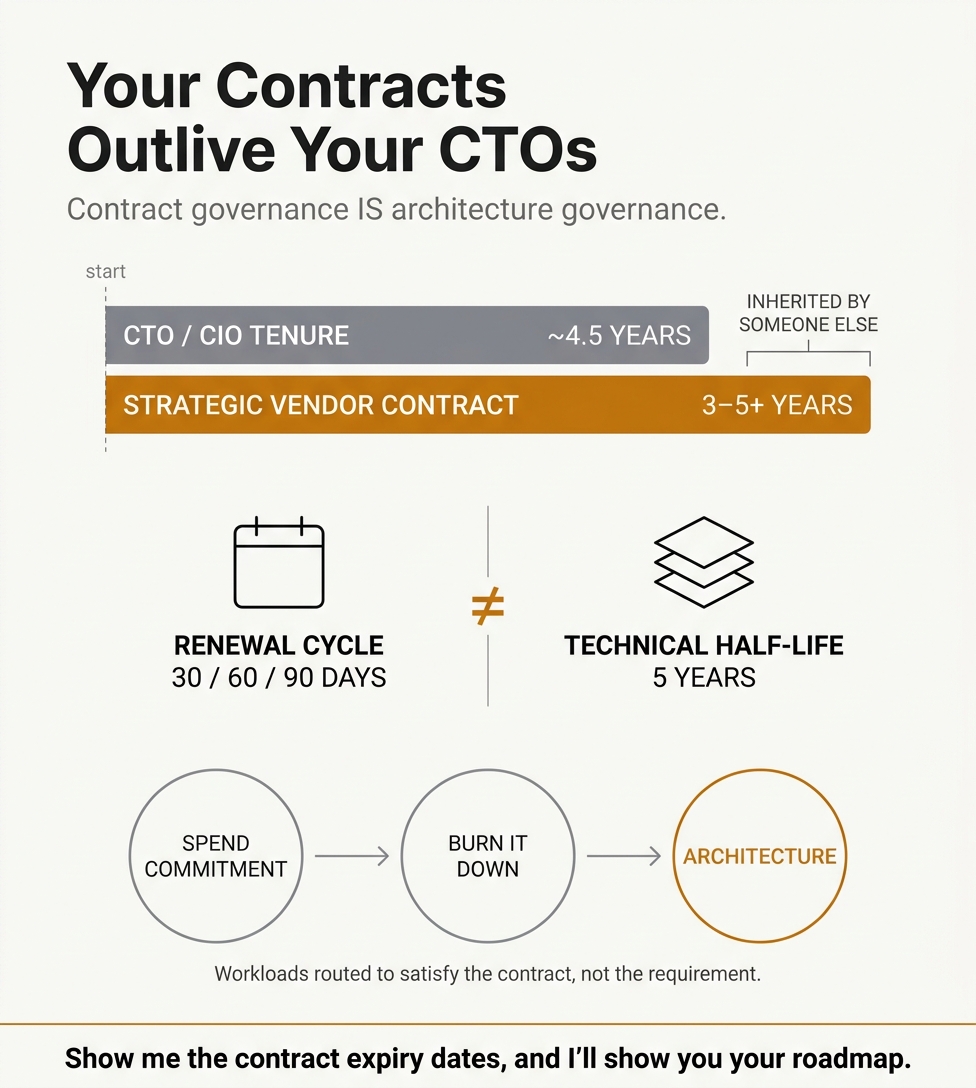
That experience changed how I read technical decisions. Look at the numbers. Korn Ferry put average CIO tenure at 4.6 years across the top 1,000 US companies. Vestd's 2025 FTSE100 report puts CTO tenure at about 4 years and 6 months. Meanwhile the agreements those people sign, cloud committed spend deals, ERP terms, the strategic platform contracts that actually determine what your systems look like, routinely run three to five years, and sometimes considerably longer. The math means a meaningful share of the most consequential technical commitments in any large organization will be lived with, renewed, or unwound by somebody who was not in the room for the trade-off.
The classic sunk cost story doesn't quite fit here, and the way it fails is the interesting part. Staw's work on escalating commitment found that people throw good money after bad mostly when they were personally responsible for the original choice. A new leader has none of that ego in the decision. What they have instead is worse, because the lock-in is structural rather than psychological. The discount tiers are real. The shortfall penalties are real. Microsoft's own documentation describes a MACC as a commitment to a specified level of spend over a defined period, and if you don't get there you pay the difference anyway. So a perfectly rational architect ends up routing new workloads toward vendor native services, not because they are the best fit, but because the commitment has to be burned down. Your FinOps team optimizes a workload, usage drops, and suddenly efficiency has created a liability.
Then there is the pace. Zylo reports that companies handle around 211 SaaS renewals a year, and renewal calendars are typically managed on a 30, 60, 90 day horizon. That is a procurement rhythm making decisions with a five year technical half life. The CMA found cloud customers switch providers under 1% annually. When 37signals left the cloud, the engineering was the easy part. They had to wait for contract commitments to expire before they saw a clean year of savings.
Every renewal is an architecture decision. Most organizations treat contract governance and architecture governance as separate functions with separate calendars and separate owners, and Gartner has been pointing at that seam for years without much changing.
The uncomfortable question I now ask new teams: show me the contract expiry dates, and I will show you your real roadmap.