The counterintuitive problem with engineering teams that are too good at working around platform limitations
BY STAVROS · AUGUST 11, 2026
The proof is indisputable.
THE INSIGHT
A few years ago I ran a group that never complained about our internal platform. Deploys were reliable, incidents rare, we hit our dates. I was quietly proud of that.
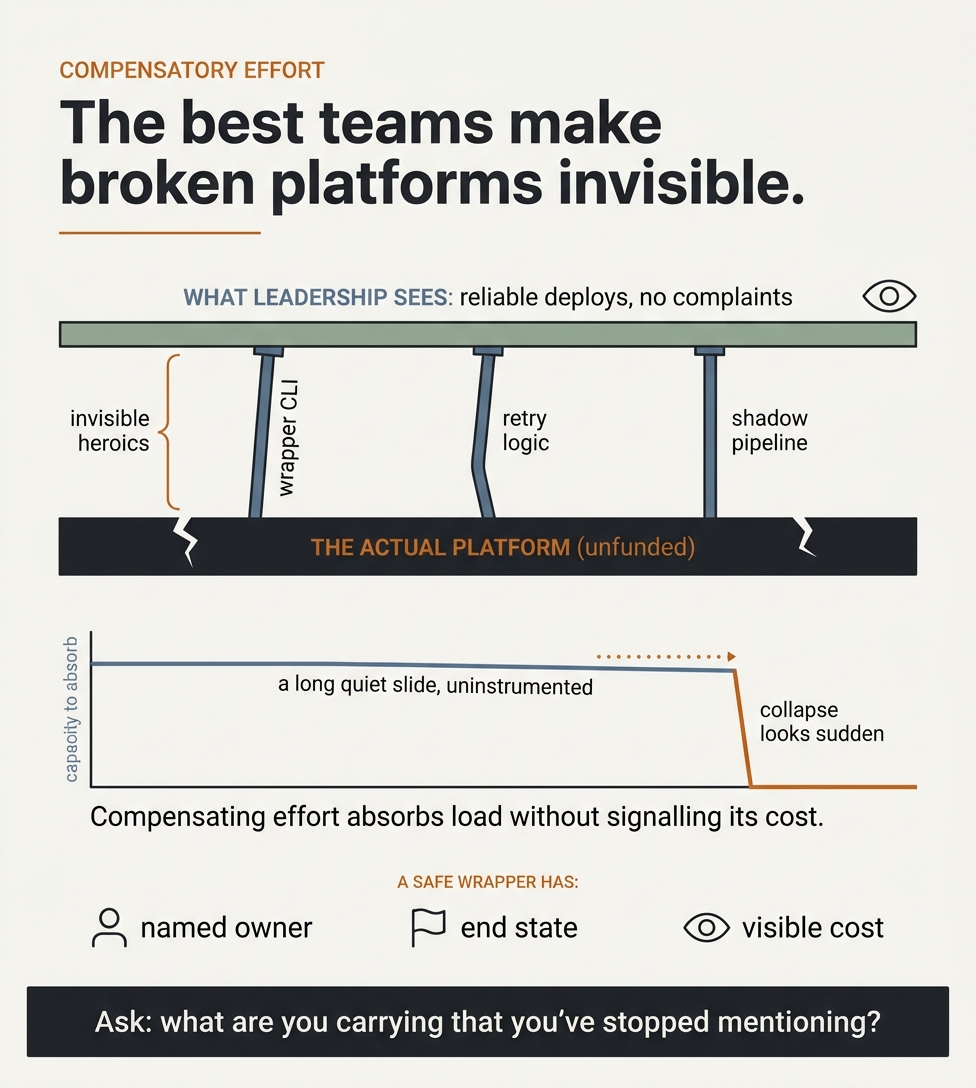
What I missed was why. The platform underneath was in rough shape, and my engineers had built a small private civilization on top of it: a wrapper CLI, retry logic around a flaky provisioning API, a shadow pipeline that bypassed the parts that broke on Fridays. Skilled work, all of it. When the platform team went looking for evidence of pain to justify funding, our name did not come up. We had made a real problem invisible by being good.
Richard Cook's point: practitioner adaptations create safety moment to moment, so the people papering over gaps are the mechanism keeping the system alive. The STELLA report from Woods, Cook and Allspaw is blunter: without continuous effort from engineers, modern platforms would stop working, many in days, most in weeks, all within a year. Management sees the result of the catching, almost never the catching itself.
What should worry anyone doing capacity planning is what Woods calls decompensation. A compensating element absorbs load without signalling what it costs, and when it runs out the collapse looks sudden. It was never sudden. It was a long quiet slide nobody had instrumented.
Tucker and Edmondson watched hospital nurses hit an operational failure roughly once an hour, resolve nearly all of them with a quick fix, and attempt the underlying cause only about 7% of the time. Not laziness. Time, plus a norm prizing self sufficiency, so a nurse who kept raising system failures risked being called a complainer. I have watched that norm in engineering orgs I ran. We promote the person who unblocks themselves quietly, then wonder why nothing gets escalated.
Senge named it shifting the burden: the symptomatic fix gives fast relief, the relief reduces pressure for the real fix, and dependence on the workaround deepens until the real fix is out of reach.
None of this argues against abstraction. Wrapping something ugly and moving on is often the right economic call. What matters is whether the wrapper has a named owner, an intended end state, and visibility into what it hides. A strangler fig has all three. A load bearing hack that three people understand has none.
The wrong conclusion is to let engineers suffer so leadership notices. That is cruelty with a strategy memo attached. The useful version is making compensating work land where decisions get made. Google's SRE practice caps toil at half an engineer's time and turns reliability into an error budget spent in public.
So I changed the question I ask in reviews. Instead of asking teams whether they are blocked, I ask what they are carrying that they have stopped bothering to mention. That is where the real risk lives, and the team with nothing to say is usually the one I should be most curious about.
THE EVIDENCE
Scope and the core thesis being tested
The thesis under test: high-performing engineering teams that build clever abstractions over broken or inadequate internal infrastructure can reduce organizational pressure to fix the underlying problem. Local competence masks systemic risk, and visible friction is sometimes more strategically valuable to an organization than invisible heroics.
Verdict from the research: the thesis is well-supported as a pattern by decades of safety science, resilience engineering, healthcare operations research, and organizational learning theory. It is strongest in the form "competent adaptation can hide the erosion of safety margin and suppress organizational learning." It is weakest, and should be hedged, where it implies that abstraction is generally bad or that deliberately withholding help is generally wise. The most rigorous single anchor is the safety-science finding that practitioners continuously create safety through adaptation, and that this adaptive work is largely invisible to management, which produces a distorted picture of system health.
A note on the phrase "compensatory effort." This exact two-word term is not a canonical named law the way "the law of stretched systems" or "normalization of deviance" are. The concept (people expending extra effort to compensate for inadequate systems, and that effort masking the problem) is pervasive and well-evidenced under several names: "compensatory adaptation," "extra work," "first-order problem solving," "workarounds," "SNAFU catching," and Woods' idea of "adaptive capacity" being consumed. Present "compensatory effort" as a descriptive umbrella term, not as a formal term coined by one author.
Section 1: Safety and resilience engineering foundations (strongest, most citable material)
Richard Cook, "How Complex Systems Fail" (1998, revised through 2018)
A two-page paper, 18 numbered points, widely treated in software as comparable in influence to Deming's 14 points. Directly relevant points:
- "People continuously create safety." Verbatim: "Failure free operations are the result of activities of people who work to keep the system within the boundaries of tolerable performance... human practitioner adaptations to changing conditions actually create safety from moment to moment."
- Complex systems "contain changing mixtures of failures latent within them," and "the complexity of these systems makes it impossible for them to run without multiple flaws being present." These latent flaws are individually insufficient to cause failure, so "they are regarded as minor factors during operations."
- Catastrophe requires multiple failures; there is no single root cause.
- Practitioners are "the adaptable element of complex systems"; they block most failure trajectories before they reach the operational level.
The relevance: the people papering over infrastructure gaps are literally the mechanism keeping the system alive, which is exactly why their work makes the underlying fragility invisible. Best primary source: adaptivecapacitylabs.com/HowComplexSystemsFail.pdf.
The STELLA Report / SNAFUcatchers (2017): Woods, Cook, Allspaw et al.
This is the single most on-point source for the software-specific version of the thesis. A consortium of Etsy, IBM, IEX, and Ohio State University. Key content:
- Executive summary, verbatim: "Current generation internet-facing technology platforms are complex and prone to brittle failure. Without the continuous effort of engineers to keep them running they would stop working: many in days, most in weeks, all within a year. These platforms remain alive and functioning because workers are able to detect anomalies, diagnose their sources, remediate their effect, and repair their flaws and do so ceaselessly: SNAFU Catching."
- "Above the line / below the line" framework: there is a "line of representation." Above it sit people, their mental models, and their tools; below it sits the actual technical system, which nobody sees directly, only through representations. Management sees the results of SNAFU catching but not the catching itself, which distorts its picture of system health.
- "Dark debt": introduced in this report by analogy to dark matter. Unlike technical debt, dark debt is not recognizable at creation, produces anomalies rather than slowdowns, exists in the interactions between components, and "is invisible until an anomaly reveals its presence." There is "no specific countermeasure" because you cannot see it in advance.
- "Woods' Theorem," quoted in the report: "As the complexity of a system increases, the accuracy of any single agent's own model of that system decreases rapidly."
Best primary source: snafucatchers.github.io. The dark debt excerpt is also on Medium via John Allspaw.
David Woods: law of stretched systems, adaptive capacity, decompensation, graceful extensibility
- Law of stretched systems (Woods and Hollnagel, 2006; Woods and Dekker, 2000). Widely quoted formulation: "Every system is stretched to operate at its capacity; as soon as there is some improvement, for example in the form of new technology, it will be exploited to achieve a new intensity and tempo of activity." The crucial corollary for this thesis: improvements are consumed by demands for higher performance rather than converted into slack. When a platform team makes something easier, the organization uses the freed capacity to demand more, not to build a buffer.
- Decompensation (Woods and Branlat, "Basic patterns in how adaptive systems fail," 2011). One of three basic failure patterns for adaptive systems: "when the system exhausts its capacity to adapt as disturbances/challenges cascade." Especially dangerous with a compensating element (human or automation) that "doesn't communicate that it's spending increasing resources in compensating, so when it is exhausted the decompensation becomes a surprise." This is the precise mechanism of the thesis: a team silently absorbing more and more load until it suddenly cannot, so the collapse looks abrupt only because the strain was invisible. The other two patterns are "working at cross-purposes" (locally adaptive, globally maladaptive) and "getting stuck in outdated behaviors" (over-relying on past successes).
- Theory of graceful extensibility (Woods, 2018, in the journal Environment Systems and Decisions). Introduces "graceful extensibility" as the opposite of brittleness: the ability to extend adaptive capacity as surprise approaches the boundary. Adaptive capacity is finite and can be consumed.
Best primary sources: the 2018 graceful extensibility paper (PDF on Woods' Squarespace site); the AAAI and Branlat-Woods papers on adaptive failure.
Erik Hollnagel: ETTO, Safety-I vs Safety-II
- ETTO principle (Hollnagel, "The ETTO Principle: Efficiency-Thoroughness Trade-Off: Why Things That Go Right Sometimes Go Wrong," Ashgate, 2009, ISBN 0-7546-7678-1). Definition: people and organizations routinely trade off thoroughness for efficiency; "demands for productivity tend to reduce thoroughness while demands for safety reduce efficiency." Usually people sacrifice thoroughness for efficiency, and this is normal, not aberrant. Workarounds are ETTO in action.
- Safety-II and "things go right and go wrong for the same reasons": the same everyday performance adjustments that make things go right most of the time are what occasionally make things go wrong, so studying only failures misses most of the picture. This underwrites the claim that competent adaptation and eventual failure are two faces of the same behavior.
- FRAM (Functional Resonance Analysis Method) is Hollnagel's method built on this, modeling how normal variability in functions can resonate into failure. Relevant but more a method than a quotable claim.
Jens Rasmussen: drift/migration to the boundary, dynamic safety model
- "Risk management in a dynamic society: a modelling problem" (Rasmussen, 1997, in Safety Science). The dynamic safety model: a system operates inside a safe envelope bounded by three limits: economic failure, unacceptable workload, and acceptable performance (the safety boundary). Two pressures, cost-efficiency and workload reduction, systematically push the operating point toward the safety boundary. Verbatim caption from the famous figure: "Under the presence of strong gradients behaviour will very likely migrate toward the boundary of acceptable performance." Rasmussen called this "drift to danger": "systemic migration of organizational behavior toward accident under the influence of pressure toward cost-effectiveness in an aggressive, competing environment." [1]
- Cook and Rasmussen, "Going solid: a model of system dynamics and consequences for patient safety" (Quality and Safety in Health Care, 2005). "Going solid" describes a system pushed to operate with no slack, tightly coupled, at the edge of its capacity, which raises the risk of catastrophic failure. Directly maps to platform teams keeping a fragile system running "hot" with no visible margin.
Diane Vaughan: normalization of deviance
- "The Challenger Launch Decision: Risky Technology, Culture, and Deviance at NASA" (University of Chicago Press, 1996, ISBN 9780226851754). Definition of normalization of deviance: "The gradual process through which unacceptable practice or standards become acceptable. As the deviant behaviour is repeated without catastrophic results, it becomes the social norm for the organization." Each successful launch with damaged O-rings made accepting the damage more normal. Applied to this thesis: every quarter a workaround holds, the underlying defect is reclassified from "urgent problem" to "just how it works here." Vaughan later served on the Columbia Accident Investigation Board (2003), which found the same pattern. [2][3]
Sidney Dekker: drift into failure
- "Drift into Failure" (2011) and "The Field Guide to Understanding 'Human Error'." Core relevant argument: accidents in complex systems arise from gradual drift, small adaptive steps each locally sensible, and operator adaptation routinely compensates for and thereby masks design flaws, so "human error" is usually a symptom of deeper system trouble, not a cause. Dekker's account of normalization notes it often starts from a belief that safety is assured "because of the presence of extraordinary competence." That is a direct statement that competence itself can contribute to risk-masking.
Nancy Leveson: STAMP/STPA and eroding safety constraints
- Leveson (MIT), "Engineering a Safer World" (2011). STAMP treats safety as a control problem: accidents happen when safety constraints are not enforced. Relevant argument: over time, under performance and efficiency pressure, safety controls and constraints degrade and systems migrate toward states of higher risk as controls erode. Local adaptations that are individually reasonable can collectively degrade the enforcement of system-level safety constraints. Useful as an engineering-formal framing of "the guardrails quietly rot."
Confidence for Section 1: high. These are named, citable, primary works. The one caution is not to overstate any single author as having coined "compensatory effort."
Section 2: Healthcare and nursing workaround literature (strongest empirical numbers)
This is the richest empirical evidence for the specific claim that workarounds resolve the immediate problem but prevent organizational learning.
Tucker and Edmondson, "Why Hospitals Don't Learn from Failures" (California Management Review, 45(2), 2003; also HBS working paper 03-059)
- Based on in-depth qualitative field observation of nurses across nine hospitals; a related study reports 197 hours observing 22 nurses at eight hospitals.
- Headline finding: nurses used "first-order problem solving" (a quick fix that resolves the immediate problem but does nothing about the cause) far more than "second-order problem solving" (addressing the cause, reporting, changing the system). The paper states verbatim that "only 7% of nurse responses met even these lenient [second-order problem-solving] criteria." Secondary summaries consistently render this as nurses taking the quick-fix route roughly 93% of the time, with the system altered to reduce recurrence in only one observed instance.
- The model in the paper describes "an illusory equilibrium in which small process failures actually erode organizational effectiveness rather than driving learning and change."
- Two social mechanisms that suppress reporting: lack of time, and norms that value self-sufficient quick fixes, so a nurse who repeatedly flags system failures risks being seen as a "complainer."
- Frequency data from this research lineage: nurses encounter roughly one operational/system failure per hour (about 6.5 per 8-hour shift). Follow-on work in the same lineage (Kalisch/Tucker-lineage, NCBI PMC5118534) states that "problems occur about once per hour per nurse on hospital units, and 95% of problems are managed through workarounds... rather than system corrections." One study found nurses spent about 15% of their time dealing with system failures; Tucker framed this as effectively "removing" about one in fifteen nurses from patient care to deal with failures.
- Related papers: Tucker, Edmondson and Spear, "When Problem Solving Prevents Organizational Learning" (Journal of Organizational Change Management, 15(2), 2002, pp. 122-137); Tucker, "The impact of operational failures on hospital nurses and their patients" (Journal of Operations Management, 22(2), 2004); Edmondson, "Learning from failure in healthcare" (Quality and Safety in Health Care, 2004).
Debono et al., "Nurses' workarounds in acute healthcare settings: a scoping review" (BMC Health Services Research, 2013, 13:175, DOI 10.1186/1472-6963-13-175)
- Scoping review across twelve databases. Key nuance to quote: workarounds "operate as a dichotomous trope. They enable yet potentially compromise patient care and safety. They provide and hide information about clinicians' work." That phrase, workarounds simultaneously providing and hiding information, is a precise statement of the thesis. [4]
- The review concluded the research on nursing workarounds is "heterogeneous" and "relatively underdeveloped," so treat individual numbers with care. [5]
Halbesleben, Wakefield and Wakefield, "Work-arounds in health care settings: literature review and research agenda" (Health Care Management Review, 33(1), 2008, pp. 2-12)
- Foundational review defining workarounds and arguing they create safety risks precisely because they hide the underlying "blocks" from view and prevent them being fixed.
- A general theory of workarounds in information systems, not just healthcare. Defines a workaround as a goal-driven adaptation to overcome or minimize the impact of obstacles created by a system. Useful because it generalizes the healthcare findings to IT systems.
Confidence for Section 2: high for the existence and thrust of the findings; the 7% second-order figure is verbatim from the primary paper; the "95% of problems managed through workarounds" figure comes from a follow-on paper in the same research lineage. Attribute to Tucker's observational work rather than a single exact table.
DORA 2024 (Accelerate State of DevOps Report 2024, Google Cloud)
The counterintuitive finding, verified against the primary report (platform engineering chapter, roughly pp. 47-56):
- 89% of respondents reported using an internal developer platform. [6]
- Internal developer platform users had 8% higher individual productivity and 10% higher team performance, and organizational software delivery and operations performance rose 6% with a platform. [6]
- But: throughput decreased about 8% and change stability decreased 14% for platform users versus non-users. Verbatim from the report: "Throughput and change stability saw decreases of 8% and 14%, respectively, which was a surprising result." And: "we observed a surprising 14% decrease in change stability. This indicates that the change failure rate and rate of rework are significantly increased when a platform is being used." [6][6]
- A separate nuance: teams required to use the platform exclusively for the whole app lifecycle saw a distinct 6% decrease in throughput.
- DORA frames the dip as a "J-curve": a transformation or platform typically produces early positive effects, a mid-term dip, then recovery as it matures. [6]
- IMPORTANT accuracy note: this DORA finding is about the tradeoffs of adopting a platform, not a direct measurement of "workarounds hiding risk." It supports the thesis indirectly: even good platform investment does not automatically produce stability, and gains do not automatically convert into slack. Do not overclaim it as proving the masking dynamic. Also keep it distinct from DORA's separate AI-adoption finding (a 25% increase in AI adoption was associated with roughly a 1.5% throughput reduction and a 7.2% stability reduction); secondary blogs sometimes conflate the two.
- 2024 edition ("The Evolution of Platform Engineering"): survey of around 500 individuals all working with or on a platform team, run online 24 August to 30 September 2023, spread across North America (38%), EMEA (27%), APAC (22%), and Other (13%), sponsored by the Continuous Delivery Foundation, Humanitec, and Women in DevOps. 43% of respondents said they had had a platform team for 3-5 years. 65% said the platform team is important/essential and will receive continued investment. [7]
- Perception gap directly relevant to the thesis, verbatim: "While senior management often champions investment in Platform Engineering, not all developers feel the same way." This is documented evidence of the gap between platform-team/management perception and developer experience. [8]
- Top reported benefits: increased productivity, better software quality, reduced lead time for deployment.
- Note the sponsor bias: Puppet sells automation tooling; treat its framing as vendor research, still useful for the perception-gap datapoint.
Stripe, "The Developer Coefficient" (September 2018)
- Conducted with Harris Poll: "More than 1,000 developers and more than 1,000 C-level executives in the United States, U.K., France, Germany, and Singapore."
- Headline: developers spend about 42% of a 41.1-hour work week on maintenance and "bad code" rather than new work: roughly 13.5 hours/week on technical debt plus 3.8 hours/week on bad code, totaling 17.3 hours/week.
- Stripe stated that "bad code" costs "nearly $85 billion worldwide in opportunity cost lost annually" and framed developers as able "to raise global GDP by $3 trillion over the next ten years." Treat the dollar figures as the report's own estimates.
- Relevance: quantifies the sheer volume of invisible compensating work, though it measures technical debt broadly, not specifically platform workarounds.
DevEx framework (Noda, Storey, Forsgren, Greiler)
- "DevEx: What Actually Drives Productivity," by Abi Noda (DX), Margaret-Anne Storey (University of Victoria), Nicole Forsgren (Microsoft Research), and Michaela Greiler (DX). NOTE: the fourth author is Michaela Greiler, not "Michael." Published in ACM Queue, Vol. 21 No. 2 (March-April 2023), and reprinted in Communications of the ACM, Vol. 66 No. 11, pp. 44-49 (published online 20 October 2023). [9][10]
- Three core dimensions, verbatim: "Our framework distills DevEx to its three core dimensions: feedback loops, cognitive load, and flow state." And: "Taken together, feedback loops, cognitive load, and flow state encapsulate the full range of friction types encountered by developers." [11][11]
- On making friction visible, verbatim: "DevEx should be measured by capturing developers' perceptions as well as their workflows in the various systems and processes that their work involves... organizations should collect data from both people and systems to gain full visibility into their software delivery processes." Also: "Measuring DevEx is critical for identifying opportunities for improvement, detecting trends, and understanding the impact of investments." [11][11]
- Relevance: this is the practical mechanism for Section 6b, turning invisible friction into a measured signal.
SPACE framework and DX Core 4
- SPACE (Forsgren, Storey, Maddila, Zimmermann, Butler, Houck, 2021, "The SPACE of Developer Productivity," ACM Queue): productivity is multidimensional: Satisfaction and well-being, Performance, Activity, Communication and collaboration, Efficiency and flow. Relevant because it argues that single-metric views of engineering hide real dynamics. [10][12]
- DX Core 4 (2024, from DX / Abi Noda and collaborators): a newer unifying framework consolidating DORA, SPACE and DevEx into four dimensions (speed, effectiveness, quality, business impact). Useful as a current practitioner reference.
Google SRE: error budgets and the toil cap (very strong for the "make it visible" takeaway)
- The 50% cap: Google's SRE organization has an advertised goal of keeping operational work (toil) below 50% of each SRE's time; at least 50% must go to engineering that reduces future toil. Verbatim rationale: "toil tends to expand if left unchecked and can quickly fill 100% of everyone's time." Operational overflow is directed back to the product development team. This is an explicit organizational refusal to let a team silently absorb operational load. [13]
- Error budgets: reliability is turned into a budgeted, spendable resource. When the error budget is exhausted, feature releases stop until reliability is restored. This is the cleanest real-world example of the thesis's prescription: it converts invisible heroics into a visible, negotiated, spendable quantity and forces the reliability conversation into the open. The SRE book explicitly treats defending an SLO "without Herculean effort, excessive toil, and burnout" as the goal, and treats silent absorption of toil as a failure mode.
- Source: Google SRE book and workbook, sre.google. Ben Treynor Sloss originated the SRE approach at Google.
Confidence for Section 3: high for DORA and SRE (primary sources), high for Stripe's 42% (primary PDF), medium for the Stripe dollar figures and Puppet numbers (vendor research).
Section 4: Economics and organizational theory analogues
Moral hazard
- Standard definition: a party insulated from risk behaves differently, taking more risk, than if it bore the full consequences. Maps onto the thesis: when a platform team absorbs the consequences of bad infrastructure, the people who own that infrastructure are insulated from the pain and have weaker incentives to fix it. Use this as an analogy, clearly labeled; it is a mapping, not a measured finding.
Peltzman effect / risk compensation / risk homeostasis
- Sam Peltzman, "The Effects of Automobile Safety Regulation," Journal of Political Economy, 1975. Argued that 1960s US auto safety mandates did not reduce highway death rates because drivers offset the added safety with riskier driving; occupant deaths fell but pedestrian and motorcyclist deaths rose.
- Risk homeostasis: Gerald Wilde (1982) proposed people have a target level of risk they return to.
- CRITICAL accuracy caution: these theories are contested. A reanalysis of Peltzman's original data "found numerous errors and his model failed to predict fatality rates before regulation." Hedlund (2000) concluded risk compensation happens in some contexts and not others, depending on visibility of the safety measure, its perceived effect, motivation, and personal control. The motorcycle-helmet-repeal natural experiment saw deaths soar, contradicting a strong version of risk compensation. Use Peltzman as a suggestive analogy for "added safety capacity gets partly consumed by riskier behavior," but flag explicitly that the strong version is disputed. Do not present it as settled science. [14]
Induced demand / Jevons paradox / Braess's paradox
- Jevons paradox (1865): efficiency improvements in resource use can increase total consumption rather than reduce it. Induced demand: adding road capacity generates more traffic. Braess's paradox: adding a road can worsen overall traffic. All three are clean analogues for "capacity improvements get consumed rather than banked as slack," which is the economic sibling of Woods' law of stretched systems. These are well-established (Jevons, induced demand) and mathematically proven (Braess), so they are safer to cite strongly than Peltzman.
Highly Optimized Tolerance (Carlson and Doyle)
- J.M. Carlson and John Doyle, HOT theory (Physical Review E, 1999, and PNAS in the early 2000s). Core claim: complex systems optimized for high performance and robustness against common perturbations become fragile to rare or unanticipated perturbations. This "robust-yet-fragile" property is a rigorous, engineering-grounded version of the thesis: a team optimizing hard to handle the everyday failure modes of bad infrastructure can make the whole system more fragile to the rare event nobody prepared for. Strong, citable, and more defensible than the risk-compensation literature.
Efficiency-resilience tradeoff
- General operations and supply-chain literature (and post-COVID commentary) argues that squeezing slack out of systems for efficiency reduces their ability to absorb shocks. A note on Cook's "How Complex Systems Fail" captures it: "There is a fundamental tradeoff between efficiency and resilience." Present the direction confidently and specific numbers cautiously.
Argyris and Schön: single- vs double-loop learning, skilled incompetence, defensive routines
- Single-loop learning: fixing the immediate error within existing assumptions. Double-loop learning: questioning and changing the governing assumptions themselves. Workarounds are pure single-loop learning; the thesis is essentially a call for double-loop learning.
- Defensive routines: "any policy, practice, or action that prevents embarrassment or threat to the players involved, and, at the same time, prevents learning" (Argyris, 1999). [15]
- Skilled incompetence: Argyris's paradox that the more skilled people are at protecting themselves from embarrassment and threat, the more incompetent they become at the genuine learning the organization needs. Maps neatly onto teams whose very skill at working around problems keeps the problems undiscussable.
- Sources: Argyris and Schön, Organizational Learning (1978), Organizational Learning II (1996); Argyris, "Teaching Smart People How to Learn." [16]
Senge, systems archetypes: Shifting the Burden and Fixes That Fail
- The Fifth Discipline (Senge, 1990). These two archetypes map almost exactly onto the thesis.
- Shifting the Burden: a problem symptom can be addressed by a symptomatic quick fix or a fundamental solution; the quick fix gives fast relief, which reduces the pressure to pursue the fundamental solution, and a side effect erodes the organization's ability to apply the fundamental solution over time, deepening dependence on the quick fix. Senge's own management principle: solutions that address only symptoms "tend to have short-term benefits at best" while "the underlying problem remains unaddressed and may worsen." There is a special case, "Shifting the Burden to the Intervenor," where an outside helper (read: the heroic platform team) becomes the quick fix and slowly erodes the internal capability to solve the problem. This is the closest named archetype to the user's thesis.
- Fixes That Fail: a quick fix works short-term but has unintended consequences that make the original problem worse, requiring more of the same fix.
Squeaky wheel resource allocation
- The intuition that organizations fund visible pain rather than measured need is embedded in the Shifting the Burden archetype (Senge explicitly calls the problem symptom the "squeaky wheel"). I did not find a single clean empirical study quantifying "orgs allocate to visible pain over measured need," so present this as a well-reasoned organizational-behavior claim supported by the archetype literature, not as an empirically measured law.
Section 5: Concrete case studies and examples
UK Post Office Horizon scandal (strongest real-world example of workarounds masking a software defect)
- The Fujitsu-built Horizon accounting system, piloted from 1996, rolled out across the Post Office network from 1999. It contained "bugs, errors and defects" that could create phantom shortfalls in branch accounts. [17]
- Per BBC coverage of the public inquiry (19 January 2024): "Between 1999 and 2015, the Post Office privately prosecuted hundreds of sub-postmasters and postmistresses based on Fujitsu's faulty Horizon computer software." Many were convicted; some imprisoned; some died before being cleared. It is described as the most widespread miscarriage of justice the UK Criminal Cases Review Commission had ever seen. As of that January 2024 reporting, 93 wrongful convictions had been overturned.
- The masking dynamic: subpostmasters made up shortfalls out of their own pockets and adjusted their working to cope, while the Post Office "consistently asserted that Horizon was robust and reliable" and "effectively steamrolled over any subpostmaster who sought to challenge its accuracy" (Court of Appeal, Lord Justice Holroyde, 2021). Individual compensating behavior (covering shortfalls, working around glitches) delayed recognition of the systemic defect for over a decade.
- In January 2024, Fujitsu's European director Paul Patterson told the inquiry there were "bugs, errors and defects" in Horizon "right from the very start" and that these were "well known to all parties." The 555-claimant group litigation (Bates v Post Office) settled in December 2019 for £58m (about £11m left after costs); dozens of convictions were quashed from December 2020 onward. [17]
- Caveat: the primary villain here is management and vendor concealment plus prosecution, not benign engineering heroics. Use it as the vivid extreme of "local compensation hid a systemic defect until enormous harm forced the truth," while being fair that it was compounded by deliberate cover-up.
Knight Capital (2012)
- On 1 August 2012, a deployment error at Knight Capital caused its SMARS trading system to fire orders uncontrollably: roughly 45 minutes and about $440 million in losses, wiping out the firm's capital (net capital had been about $365m). Rescued by a roughly $400m emergency capital injection days later; merged into what became KCG by December 2012. The SEC Order (Release 34-70694, 16 October 2013) confirms the $440M loss over about 45 minutes and imposed a $12M penalty.
- Root causes directly relevant: manual, unverified deployment across eight servers (one server missed); "dead code" (the old "Power Peg" routine) left in production for years; a repurposed feature flag; no automated kill switch or capital-threshold circuit breaker. Per the SEC order, 97 automated "Power Peg disabled" alert emails were generated pre-market and were not acted upon.
- Relevance: a long-tolerated set of fragile manual processes and latent dead code (dark debt) that "worked" until it catastrophically did not. A good example of latent flaws and missing visible guardrails.
NASA Challenger (1986) and Columbia (2003)
- Challenger: O-ring erosion in cold was observed on prior flights and repeatedly accepted (normalization of deviance, Vaughan). Columbia: foam strikes similarly normalized. Both are the canonical safety-science cases and pair naturally with Vaughan and Feynman ("Try playing Russian roulette that way..."). [2]
Other cited-in-literature cases (use with appropriate care)
- Three Mile Island (1979): the founding case for studying how operators cope with complex-system anomalies (referenced in the STELLA report).
- Boeing 737 MAX (MCAS): pilots were expected to compensate for a system behavior they were not fully told about; a case of design offloading onto human compensation. Verify specific claims before publishing, as the causal story is detailed and contested.
- Deepwater Horizon (2010), Therac-25 (1980s), Rogers Communications outage (2022), the 2021 Fastly and Facebook outages: all real, but not deep-researched for this brief. Use only the ones you can source precisely; Challenger/Columbia, Horizon, and Knight Capital are the safest, best-documented anchors.
Software-specific "load-bearing" phenomena
- The "load-bearing hack," "the one person who knows how to deploy," and "bus factor of one" are well-known industry concepts describing key-person risk created by invisible compensating work. Present them as illustrative vocabulary, not evidence. Wrapper scripts around bad CI, Terraform wrappers, internal forks of tooling, and "shadow platforms" (teams quietly building their own tools because the central platform is inadequate) are common and match the thesis, but there is no single hard survey number quantifying duplicated internal tooling. Present as pattern, not statistic.
Confidence for Section 5: high for Horizon, Knight Capital, Challenger/Columbia; lower for the cases not individually verified.
Section 6: Counterarguments and nuance (needed for credibility)
The case that abstraction over messy infrastructure is often correct
- Abstraction and encapsulation are foundational and usually good: they let teams ship without every engineer understanding every layer. Not every problem should be fixed at the root; sometimes wrapping and moving on is the economically right call.
- Strangler fig pattern (coined by Martin Fowler): deliberately wrapping an old system and incrementally replacing it is a recognized, healthy migration strategy, not risk-masking. The wrapper is a transition mechanism with an intended end state.
- The distinction that matters: an abstraction that hides complexity usefully has a known owner, a known end state, and visibility into what it hides; a dangerous one hides risk with no owner, no end state, and no visibility. The thesis should target the second, not abstraction in general.
Leaky abstractions (Joel Spolsky, 2002)
- The Law of Leaky Abstractions: "All non-trivial abstractions, to some degree, are leaky." Abstractions save you time working but not time learning; the underlying complexity eventually leaks through and you must understand it to debug. Relevant because it explains why a wrapper over broken infrastructure is never a permanent fix: the brokenness will eventually surface, usually at the worst time. Supports the thesis while being fair that leakiness is universal, not unique to bad workarounds. [18]
When deliberately allowing friction is harmful
- The developer-experience and technical-debt data cut both ways. Stripe's 42% figure, developer-attrition data, and burnout research all say that leaving friction in place has real human and productivity costs. DORA 2024 also found that unstable organizational priorities cause substantial increases in burnout that are "highly resistant to mitigation." So "let it hurt so leadership notices" is ethically and practically dangerous if the pain lands on individuals rather than on decision-makers. The honest version of the thesis is about making friction visible to decision-makers, not about deliberately inflicting pain on engineers.
Critiques of the resilience/workaround-suppresses-learning claims
- The Debono review itself calls the workaround research base "heterogeneous" and "relatively underdeveloped." [5]
- Risk compensation (Peltzman) is empirically contested, as noted above.
- The resilience engineering literature is sometimes criticized as descriptively rich but hard to operationalize or falsify (for example, "Woods' Theorem" and ETTO are framings more than testable laws). Present resilience engineering as a powerful lens with strong practitioner support, not as settled quantitative science.
Section 6b: Practical mechanisms that make compensatory effort visible
These are the concrete, citable mechanisms that support the takeaway ("make the heroics visible").
- Error budgets (Google SRE): convert reliability into a spendable resource; when spent, feature work stops. Turns invisible heroics into a negotiated, visible quantity.
- Toil accounting and the 50% cap (Google SRE): measure operational work and refuse to let a team absorb more than half its time in toil; overflow goes back to the product team.
- Developer experience measurement (DevEx: feedback loops, cognitive load, flow state; and SPACE; and DX Core 4): instrument friction and developer perception so platform pain shows up in data rather than only in private suffering. DevEx explicitly argues for collecting data "from both people and systems to gain full visibility."
- Blameless postmortems / learning reviews (Etsy, John Allspaw; the "Debriefing Facilitation Guide" by Allspaw, Cook et al.; the STELLA report's emphasis on postmortems as the way to surface below-the-line adaptive work). The point is to surface the compensating work that is otherwise invisible.
- Explicit tracking of workarounds as a metric ("workaround registers"), "papercuts" or "pain point" tracking, and internal NPS for platforms: these are real practitioner practices; there is no single authoritative study proving their effect, so present them as recommended practice supported by the DevEx/SRE logic, not as evidence-backed interventions.
- Chaos engineering and game days (Netflix's Chaos Monkey lineage): deliberately injecting failure to reveal hidden fragility and hidden compensating dependencies before they fail on their own. A form of deliberate, productive friction.
- "Productive friction" / "deliberate friction" as a design concept exists in UX and org-design writing; treat as a useful framing term rather than a rigorously evidenced construct.
Quick-reference: most quotable stats and most credible sources
Most quotable specific numbers:
- Nurses addressed the underlying cause only about 7% of the time: "only 7% of nurse responses met even these lenient [second-order problem-solving] criteria," and the system was altered to reduce recurrence in only one observed instance (Tucker and Edmondson, California Management Review, 2003). A follow-on paper in the same research lineage states "95% of problems are managed through workarounds... rather than system corrections."
- Nurses hit roughly one operational/system failure per hour (about 6.5 per 8-hour shift) (Tucker).
- DORA 2024: internal developer platforms gave +8% individual productivity and +10% team performance, but throughput fell about 8% and change stability fell 14%: "a surprising result" in the report's words; 89% of respondents used an internal developer platform.
- Google SRE caps toil at 50% of an SRE's time because "toil tends to expand if left unchecked and can quickly fill 100% of everyone's time."
- Stripe Developer Coefficient (2018): developers spend about 42% of a 41.1-hour week (about 17.3 hours) on maintenance and bad code; "bad code" costs "nearly $85 billion worldwide in opportunity cost lost annually."
- STELLA report: internet-facing platforms, without continuous engineer effort, "would stop working: many in days, most in weeks, all within a year."
- Post Office Horizon: bugs "right from the very start," "well known to all parties" (Fujitsu's Paul Patterson, January 2024 inquiry); hundreds prosecuted 1999-2015; 93 convictions overturned as of January 2024; £58m settlement (2019).
- Knight Capital: about $440 million lost in roughly 45 minutes (1 August 2012); 97 pre-market alert emails ignored; $12M SEC penalty (SEC Order 34-70694, 2013).
Most credible named sources (lead with these):
- Richard Cook, "How Complex Systems Fail" (1998).
- Woods, Cook, Allspaw et al., STELLA / SNAFUcatchers Report (2017), including "dark debt" and "above/below the line."
- David Woods, law of stretched systems and decompensation (Woods and Hollnagel 2006; Woods and Branlat 2011); theory of graceful extensibility (2018).
- Erik Hollnagel, ETTO principle (2009) and Safety-II.
- Jens Rasmussen, "Risk management in a dynamic society" (1997); Cook and Rasmussen, "Going solid" (2005).
- Diane Vaughan, The Challenger Launch Decision (1996), normalization of deviance.
- Tucker and Edmondson, "Why Hospitals Don't Learn from Failures" (2003); Tucker, Edmondson and Spear (2002).
- Debono et al. scoping review (2013); Halbesleben et al. (2008); Alter's Theory of Workarounds (2014).
- DORA Accelerate State of DevOps Report 2024 (Google Cloud).
- Google SRE book/workbook (error budgets, toil, 50% cap).
- Noda, Storey, Forsgren, Greiler, "DevEx: What Actually Drives Productivity" (ACM Queue / Communications of the ACM, 2023).
- Chris Argyris, defensive routines and skilled incompetence; Argyris and Schön, single/double-loop learning.
- Peter Senge, The Fifth Discipline (1990), Shifting the Burden and Fixes That Fail archetypes.
- Carlson and Doyle, Highly Optimized Tolerance (robust-yet-fragile).
- Joel Spolsky, Law of Leaky Abstractions (2002).
Accuracy flags to respect when publishing:
- "Compensatory effort" is a descriptive umbrella term, not a formally coined law; do not attribute it to one author.
- The Peltzman/risk-compensation analogy is contested; label it as a suggestive analogy, not proof.
- DORA's platform-engineering finding is about adoption tradeoffs and a J-curve, not a direct measurement of workarounds hiding risk; keep it separate from DORA's AI finding.
- Vendor research (Puppet, Stripe, DX) is useful but not neutral.
- The 7% / 95% nursing figures come from Tucker's observational research and a follow-on paper in the same lineage; attribute to that body of work rather than a single exact table.
- Horizon involved deliberate concealment, not just benign heroics; represent it fairly.
- Several Section 5 cases (737 MAX, Deepwater Horizon, Therac-25, Rogers, Fastly, Facebook) were not individually deep-researched here; verify before publishing.
- ResearchGate + 2 — https://www.researchgate.net/figure/Rasmussen-s-dynamic-safety-model-illustrating-how-a-system-can-operate-safely-inside_fig1_257350911
- Psych Safety — https://psychsafety.com/normalisation-of-deviance/
- Columbia Magazine — https://magazine.columbia.edu/article/challenger-disaster-normalization-deviance
- ResearchGate — https://www.researchgate.net/publication/236689234_Nurses'_workarounds_in_acute_healthcare_settings_A_scoping_review
- PSNet — https://psnet.ahrq.gov/resources/resource/26231/nurses-workarounds-in-acute-healthcare-settings-a-scoping-review
- dora — https://dora.dev/research/2024/dora-report/2024-dora-accelerate-state-of-devops-report.pdf
- PR Newswire — https://www.prnewswire.com/news-releases/puppets-2024-state-of-devops-report-reveals-security-is-strengthened-by-platform-engineering-302092299.html
- Puppet — https://www.puppet.com/blog/state-devops-report-2024
- ACM Digital Library — https://dl.acm.org/doi/pdf/10.1145/3595878
- ACM Digital Library — https://dl.acm.org/doi/10.1145/3610285
- acm — https://cacm.acm.org/practice/devex-what-actually-drives-productivity/
- dora — https://dora.dev/research/2024/dora-report/
- Google — https://sre.google/sre-book/eliminating-toil/
- Wikipedia — https://en.wikipedia.org/wiki/Risk_compensation
- Wiley Online Library — https://onlinelibrary.wiley.com/doi/10.1111/emre.12615
- Umbrex — https://umbrex.com/resources/frameworks/organization-frameworks/argyris-single-and-double-loop-learning-model/
- bbci — https://feeds.bbci.co.uk/news/live/uk-68007639?page=2
- Wikipedia — https://en.wikipedia.org/wiki/Leaky_abstraction
EDITORIAL BRIEF
Commissioned from our research desk. Subject to final editorial discretion.
The counterintuitive problem with engineering teams that are too good at working around platform limitations. Explore how high-performing teams building clever abstractions over broken infrastructure actually reduce organizational pressure to fix the underlying problem, creating a perverse dynamic where competence masks systemic risk. Draw on the concept of 'compensatory effort' from safety engineering and resilience literature. The takeaway is that visible friction is sometimes more strategically valuable than invisible heroics.