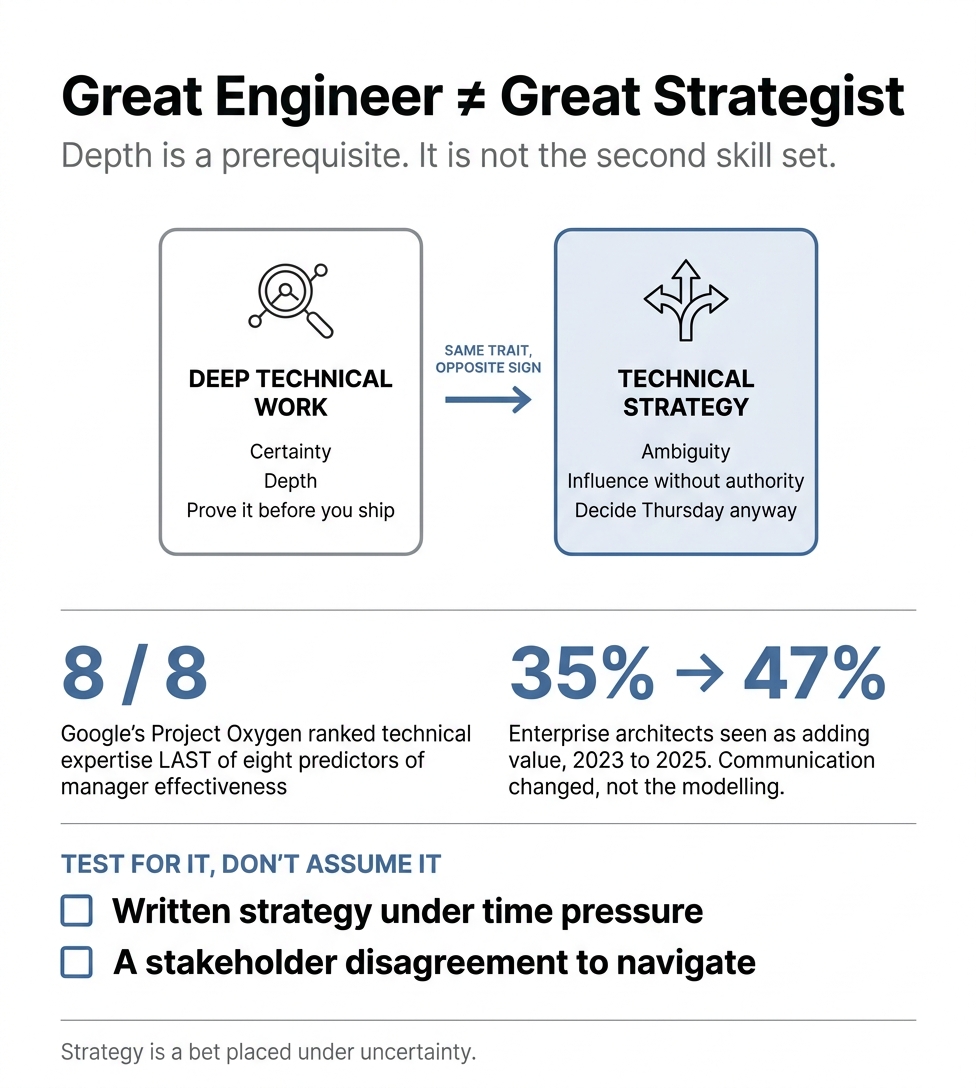
A few years ago I moved one of the strongest engineers I have ever worked with into a technical strategy role. She had spent four years untangling a distributed systems problem three teams had failed to solve, and she was right in a way that was almost uncomfortable to watch. Six months in she was miserable and the work was not landing. What she needed was for me to admit I had picked her for reasons that had little to do with the job.
The traits that made her extraordinary in deep technical work are the ones that get in the way of strategy.
Tolerance of ambiguity predicts better performance in leadership and entrepreneurial roles, and lower tolerance predicts higher performance in technical roles. The same trait flips sign depending on the job. Someone rewarded for a decade for chasing a bug until it is provably dead has been optimising for the exact disposition that hurts them in a role where the answer is never provable and the decision has to be made on Thursday anyway.
Benson, Li and Shue studied roughly 40,000 sales workers across 130 firms: companies promote on current role performance even though it predicts managerial quality worse than traits they could easily observe. The best individual performers became measurably worse managers. Sales data, so I hold it loosely, but the mechanism is familiar. Google's Project Oxygen put technical expertise dead last of eight predictors of managerial effectiveness, and that was people managers, so treat both as direction, not proof.
Forrester's data on enterprise architects should change how you evaluate your strategy function. The share of digital and IT professionals who said architects add value rose from 35% in 2023 to 47% in 2025, because architects started speaking the language of executives and focusing on measurable results. The value rose because the communication changed, not the modelling. If your strategy work is technically excellent and nobody is adopting it, you do not have an analysis problem.
None of this means technical people cannot do strategy. Depth is a real prerequisite. The failure is assuming the second skill set, sitting with ambiguity, trading influence when you have no authority, recommending the good enough thing, arrives automatically as a bonus for being deep.
So I changed two things. I no longer treat technical seniority as evidence of strategic capability, and I assess ambiguity tolerance, influence and executive communication as separate competencies, tested with work samples that mirror the job: a written strategy under time pressure, a stakeholder disagreement to navigate.
Strategy is a bet placed under uncertainty. Ask a great engineer to place a bet and some will love it. Many will spend six months trying to turn it into a proof, and that is not a character flaw. It is what you trained them to do.
Research Brief: Does Staff-Plus Engineering Excellence Predict Technical Strategy Success?
TL;DR
- The assumption that a great staff-plus engineer will naturally excel at technical strategy is not supported by the evidence. The traits selected for and reinforced in deep technical work (precision, high need for closure, maximising, low tolerance for ambiguity) are, in multiple named studies, the same traits that measurably impair performance in ambiguous, influence-based strategic roles — the clearest single finding being that tolerance of ambiguity flips sign between technical and leadership roles.
- The thesis is not absolute: technical depth is a genuine prerequisite for credible technical strategy. The failure mode is not "being technical" — it is the inability to add a second, orthogonal skill set (ambiguity tolerance, influence without authority, satisficing, executive communication) on top of depth. The winning profile is depth plus influence, not either alone.
- Multiple named frameworks and datasets converge: Google's Project Oxygen, the Benson–Li–Shue Peter Principle study, the curse-of-knowledge literature, Hogan derailers, Budner/Kruglanski/Schwartz cognitive-trait research, the O'Connor/Madzar ambiguity findings, and Forrester/Gartner enterprise-architecture data.
KEY FINDINGS AT A GLANCE
- Peter Principle (hard data): Firms promote on current-role performance even though it predicts managerial quality worse than other observable traits; the best individual performers become measurably worse managers (Benson, Li & Shue, QJE 2019).
- Project Oxygen (hard data): Across >10,000 manager observations, technical expertise ranked 8th of 8 — dead last — among predictors of managerial effectiveness.
- The crux cognitive finding: Higher tolerance of ambiguity predicts better performance in leadership/managerial/entrepreneurial roles but lower tolerance predicts higher performance in technical/engineering roles. The identical trait flips sign.
- Adoption is driven by communication, not rigour: Forrester's EA data shows perceived architect value rose (35%→47%, 2023→2025) because architects "started speaking the language of executives," not because they became more technically rigorous.
- Strategy is a bet, not a proof (Rumelt, Martin) — structurally at odds with the engineering instinct to be provably right.
- Selection heuristic "promote the best engineer" has low predictive validity for a different, ambiguous role (Schmidt–Hunter; Sackett et al.).
DETAILS
1. Staff-plus engineering literature and archetypes
Will Larson's four archetypes (Staff Engineer: Leadership Beyond the Management Track, 2021; staffeng.com / lethain.com). Larson identifies four archetypes — Tech Lead, Architect, Solver, Right Hand — from his own text:
- Tech Lead — "guides the approach and execution of a particular team," partnering with one to three managers. [1][2]
- Architect — "responsible for the direction, quality and approach within a critical area... both today and stretching into the multi-year future horizon," combining "deep knowledge of technical constraints, user needs, and organization level leadership." [2]
- Solver — "digs deep into arbitrarily complex problems and finds an appropriate path forward... a trusted agent of the organization who goes deep into knotty problems, continuing to work on them until they're resolved."
- Right Hand — "a partner and an extension of an executive-level manager, borrowing their scope and authority"; elsewhere described as a "strategic advisor to senior leadership, focusing on critical problems that blend technology, business, and organizational dynamics."
Crucial for the thesis: Larson notes the Solver and Right Hand "bounce from fire to fire, often having more transactional interactions," and warns that "for each archetype, you'll find folks who love it and find it deeply rewarding, along with folks who find the work despair-inspiring." The archetypes map differently onto strategy: the Architect and Right Hand are inherently strategy-facing, while the Solver — often the most visibly brilliant — is the least strategy-oriented, being defined by depth on discrete hard problems rather than by ambiguity navigation or stakeholder influence. This is the archetype most likely to be mistaken for "strategic" because of visible brilliance while being the worst structural fit. [2][2]
Larson on strategy itself. His guide "Writing engineering strategy" argues: "good engineering strategy is boring and... it's easier to write an effective strategy than a bad one. To write an engineering strategy, write five design documents, and pull the similarities out." In Crafting Engineering Strategy (2025) he explicitly builds on Rumelt (diagnosis → guiding policy → coherent action). He relabels failed strategies "inappropriate" rather than "bad," citing Digg's V4 rewrite as "the worst considered strategy I've personally participated in," which "ensured we died fast rather than having an opportunity to dig our way out." In his First Round Review interview he argues engineering execs must "wear three different, kind of opposing hats" and sometimes make decisions "bad for engineering overall," like reducing the engineering budget — a satisficing/trade-off mindset alien to pure technical optimisation. [3]
Tanya Reilly, The Staff Engineer's Path (O'Reilly, 2022). Reilly (Principal Engineer, Squarespace; ex-Google) frames staff work as three pillars: big-picture thinking, execution of cross-team projects, and levelling up others — all "supported by a foundation of technical knowledge." The book explicitly teaches "how to be a leader without direct authority" and how to "navigate ambiguity" as learned skills, not automatic byproducts of seniority. She warns that poorly-defined staff roles leave engineers to "either become shadow managers or retreat into isolated technical work, neither of which justifies the title." [4]
Reilly's "Being Glue" (noidea.dog/glue). Her central anecdote directly attacks the thesis that raw technical brilliance equals seniority: "The Awesome Coder only succeeded because someone else on the team went and talked to other people... He couldn't communicate well enough to ask another team for some data that he needed. The System Designer only succeeded because someone else... asked what the thing he was building was actually for. He didn't have the technical judgement to step back... Should they have been promoted? Are they really senior engineers? I don't think they are." The glue work (coordination, communication, stakeholder navigation) is precisely the strategy-adjacent skill set — and Reilly notes it is systematically under-credited and disproportionately done by women (linking to Babcock, Recalde & Vesterlund's HBR/AER work on non-promotable tasks). [5][6]
Practitioner critique of the archetypes. Sean Goedecke argues the Solver and Right Hand "both rely on having an enormous amount of trust and influence. You can't aim for those archetypes directly, because trust and influence accumulate over time" — reinforcing that influence, not technical depth, is the binding constraint on strategy-facing archetypes. [7]
2. The IC-to-leadership / IC-to-strategy transition and failure rates
The Peter Principle — Benson, Li & Shue (Quarterly Journal of Economics, 2019, vol. 134(4), pp. 2085–2134; NBER WP 24343, 2018). The strongest hard-data anchor. Using microdata on sales workers, the researchers found firms "prioritize current job performance in promotion decisions at the expense of other observable characteristics that better predict managerial performance." Specifics: [8]
- Sample: ~40,000 sales workers across 131 firms (QJE published version; the earlier NBER working paper cited 214 firms). [9]
- "A doubling of a worker's relative sales performance corresponds to a 0.030 percentage point increase in a worker's probability of being promoted, or a 14.3 percent increase relative to the base rate." [10]
- Core finding: the best individual performers were systematically promoted and became measurably worse managers. Collaboration/team metrics predicted managerial quality better than individual output, but firms weighted individual output. This is the empirical mechanism behind "your best engineer will not necessarily be your best strategist."
Google Project Oxygen. Google's people-analytics study (launched 2008–09; more than 10,000 observations about managers across more than 100 variables) produced eight attributes of effective managers. Technical expertise ranked eighth — dead last. Laszlo Bock (former SVP People Ops): "In the Google context, we'd always believed that to be a manager, particularly on the engineering side, you need to be as deep or deeper a technical expert than the people who work for you. It turns out that that's absolutely the least important thing." The seven higher-ranked attributes were relational/strategic (coaching, empowerment, communication, clear vision/strategy, career development). Caveat: Project Oxygen studied people managers, not IC staff-plus strategists — directional evidence, not a perfect analogue. [11]
Executive transition failure rates — HANDLE WITH CARE (contested provenance):
- "40% of executives fail within 18 months" — traced to Kevin Kelly, then-CEO of Heidrick & Struggles, quoted in the Financial Times (~2009): "We've found that 40% of executives hired at the senior level are pushed out, fail or quit within 18 months." This is a search-firm practitioner estimate, not a peer-reviewed study. [12]
- "50–70% of executives fail within 18 months" — attributed to the Corporate Executive Board (CEB, now Gartner). The most traceable CEB figure: based on data from nearly 30,000 leaders, roughly 50% fail within 18 months (≈3% fail outright, ≈47% underperform during transition). CEB/Gartner also report that a struggling transitioning leader's direct reports "perform 15% worse on average" and are "20% likelier to leave." [13][13]
- ~40% figure also attributed to the Center for Creative Leadership in some secondary sources.
- DDI Global Leadership Forecast — I was unable to verify a specific DDI transition-failure statistic within budget. Flag as not-yet-sourced rather than cite a number.
Bottom line: the "X% of executives fail" statistics are real in circulation but weak in provenance — mostly search-firm and consultancy estimates, not controlled studies. Use them only with attribution and a hedge. Benson–Li–Shue is the citation with genuine empirical weight.
3. The cognitive and personality dimension
Curse of knowledge — Camerer, Loewenstein & Weber (Journal of Political Economy, 1989, vol. 97, no. 5, pp. 1232–1254). The foundational study: "Better-informed agents are unable to ignore private information even when it is in their interest to do so; more information is not always better." Notably, they found market forces reduced the curse by approximately 50% but did not eliminate it. Popularised by Chip & Dan Heath (Made to Stick, 2007): "Once we know something, we find it hard to imagine what it was like not to know it. Our knowledge has 'cursed' us." Direct relevance: the deeper the technical expert, the more systematically they mispredict what non-experts (executives, stakeholders) understand — a structural handicap for "communicating at executive altitude." [14]
Need for cognitive closure — Kruglanski & Webster (Need for Closure Scale, Webster & Kruglanski 1994; review 1996). NFC is "the desire for a firm answer to a question and an aversion toward ambiguity," manifested via desire for predictability, preference for order, discomfort with ambiguity, decisiveness, and closed-mindedness. The mechanism is "seizing" (grabbing closure quickly) and "freezing" (refusing to revise): high-NFC individuals "seize on details that would provide quick answers and 'freeze' on that information, ignoring subsequent details that might challenge their conclusions," and show reduced risk-taking and reduced propensity to choose delayed rewards. This is the cognitive profile rewarded by "provably right" technical work — and precisely wrong for reversible decisions under incomplete information. [15]
Satisficing vs maximising — Simon; Schwartz; Parker, Bruine de Bruin & Fischhoff (Judgment and Decision Making, 2007, vol. 2(6), pp. 342–350). Schwartz's core finding: "maximizers might do better objectively than satisficers, but they tend to do worse subjectively." Maximisers show inverse correlations with happiness, optimism, self-esteem, and life satisfaction, and direct correlations with depression, perfectionism, and regret. The Parker/Bruine de Bruin/Fischhoff study found "self-reported maximizers are more likely to show problematic decision-making styles... less behavioral coping, greater dependence on others when making decisions, more avoidance of decision making, and greater tendency to experience regret." Strategy work requires satisficing ("good enough," reversible, coherent-action-over-perfect-analysis); the maximising instinct produces analysis paralysis. [16]
Hogan Development Survey (HDS) derailers. The HDS (introduced 1997) measures 11 "dark side" derailers that emerge under stress. Three are especially associated with the technical-expert profile:
- Diligent — "meticulous, precise, hard to please, tends to micromanage"; perfectionism that "struggles with delegation." [17]
- Skeptical — "suspicious, sensitive to criticism, expecting betrayal"; "distrustful... often questions others' motives." [18]
- Reserved — "aloof, uncommunicative, lacking empathy"; "independent but distant, often perceived as unapproachable."
Hogan notes that under pressure "drive becomes ruthless ambition, and attention to detail becomes micromanaging." Caveat: I did not find a published Hogan dataset quantifying derailer overrepresentation in engineers specifically; the linkage is a reasoned mapping from trait definitions, not a cited engineer-sample statistic. [18]
Budner's Intolerance of Ambiguity Scale — Budner, S. (1962), "Intolerance of ambiguity as a personality variable," Journal of Personality, 30(1), 29–50 (DOI 10.1111/j.1467-6494.1962.tb02303.x). Tolerance = "the tendency to perceive ambiguous situations as desirable"; intolerance = "the tendency to perceive ambiguous situations as sources of threat." 16-item scale; three categories of ambiguous situation (new, complex, contradictory). Psychometric caveat: widely criticised for weak reliability (Cronbach's alpha reported as low as 0.44–0.66); McLain later developed the MSTAT-I/MSTAT-II as refinements. [19][19]
The pivotal role-dependent finding — the single most important cognitive datapoint:
- In managerial/leadership/entrepreneurial roles, HIGHER tolerance of ambiguity predicts better performance. O'Connor, Becker & Fewster (2018): "Tolerance of Ambiguity is a well-established personality trait known to predict several adaptive outcomes in the workplace such as creativity and job performance." O'Connor et al. (2022, Journal of Applied Behavioral Science, 58(1), 65–96): leader tolerance of ambiguity is associated with better follower performance, especially when ambiguity is framed as a challenge rather than a hindrance. Mol, Born, Willemsen & van der Molen (2005) meta-analysis of expatriate performance found tolerance of ambiguity a notable correlate of job-performance ratings at r = .35. Note the contested, more conservative estimate: the later iGOES meta-analysis (Ones et al.) found only small positive true correlations (ρ ≈ .17 for management/supervision performance) — so treat .35 as an upper-range figure. [20]
- In technical/task-execution roles, LOWER tolerance of ambiguity was associated with HIGHER performance. Madzar (2001, engineers at a medical technology company) and Bennett et al. (1990, marketing employees at a public utility) both found "lower levels of tolerance of ambiguity to be significantly related to higher levels of performance" via feedback-seeking behaviour. [21]
This is the crux: the identical trait (ambiguity tolerance) flips sign between technical roles and strategic roles. The engineer optimised for low ambiguity tolerance in deep technical work is, by that very optimisation, carrying the trait that predicts worse performance in strategy/leadership. Caveat: the engineer-specific Madzar finding is reported second-hand via literature review; the original should be checked if it becomes central.
4. What technical strategy work actually requires
Rumelt, Good Strategy / Bad Strategy (2011). The "kernel": diagnosis ("What's going on here?" — identifying the crux/central challenge), guiding policy ("Like the guardrails on a highway, the guiding policy directs and constrains action without fully defining its content"), and coherent action. Rumelt: "If you fail to identify and analyze the obstacles, you don't have a strategy." The most common cause of bad strategy is a weak diagnosis; the second is confusing goals with strategy. Relevance: strategy demands hard choices and the willingness to say what you will NOT do — engineers habituated to "solve it correctly and completely" may resist the choice/sacrifice element. [22]
Roger Martin, Playing to Win (2013) / "A Plan Is Not a Strategy." Martin: "strategy is choice. Strategy is not a long planning document; it is a set of interrelated and powerful choices that positions the organization to win." Critically for the engineering mindset: "the reality is that strategy is about making choices under competition and uncertainty. No choice made today can make [the future certain]." He warns against the "terrible mistake" of guaranteeing outcomes: "making a guarantee in advance simply reinforces the mistaken belief that it is possible to be certain about any future outcome." Strategy "involves placing a bet on a desired outcome" with a "logical, testable theory." This directly conflicts with an engineering mindset that wants to be provably right — strategy is inherently a bet under uncertainty, not a proof. (Martin's HBR video "A Plan Is Not a Strategy," 9 min 31 sec, released June 29, 2022, earned over 1 million views in the back half of 2022 and 3.3 million by end of 2023, becoming the most-viewed HBR video ever, supplanting Michael Porter's Five Forces video — a marker of how widely this framing now circulates among executives the user will be speaking to.) [23]
Influence without authority — Cohen & Bradford. The model is built on "exchange and reciprocity — making trades for what you desire in return for what the other person desires," using "currencies" (inspiration-, task-, position-, relationship-, and personal-related). Central to strategy functions that lack resource authority: "assume all are potential allies," diagnose the other person's world, and identify relevant currencies. This is a learned political/relational skill, not a technical one — and it is the daily substance of technical strategy roles that have influence but no headcount authority. [24][25]
The architect role as social/political — Gregor Hohpe, The Software Architect Elevator (O'Reilly, 2020) and "The Architect Elevator" (martinfowler.com, 24 May 2017). Hohpe's metaphor: "The primary role of an architect is to ride the elevators between the penthouse [where business/digital strategy is set] and the engine room [where technologies are implemented]." Critically — and as counter-evidence — he insists architects must stay technically deep: "Architects are still needed in the engine room, given the architectural demands routinely placed on modern applications... Modern architects must therefore be well-versed in run-time architecture considerations." His thesis line (2026 keynote title): architects should be "not the smartest, but make others smarter."
Martin Fowler, "Who Needs an Architect?" (IEEE Software, July/August 2003). Fowler contrasts two archetypes:
- Architectus Reloadus — "the person who makes all the important decisions... because a single mind is needed to ensure a system's conceptual integrity" (the controlling bottleneck). [26]
- Architectus Oryzus — "must be very aware of what's going on in the project... the most noticeable part of the work is the intense collaboration." Fowler's rule of thumb: "an architect's value is inversely proportional to the number of decisions he or she makes." He argues "the most important activity of Architectus Oryzus is to mentor the development team."
Ralph Johnson (quoted by Fowler): architecture is "a social construct... because it doesn't just depend on the software, but on what part of the software is considered important by group consensus." Fowler's summary: "Architecture is about the important stuff. Whatever that is." The best architecture thinking treats the role as fundamentally social and political, not purely technical — the opposite of the "ivory tower" mental model. [26]
5. Failure modes and anti-patterns
The "ivory tower architect" and enterprise-architecture (EA) failure. The documented organisational instantiation of the thesis. Gartner ("Thirteen Worst Enterprise Architecture Practices") lists the "Ivory Tower Approach," "Lack of Open Communication," and "Technology Driving the Architecture" among top EA failure modes. Per Gartner's Saul Brand (via SD Times), EA "has been around since 1987, but crashed and burned in 2012 because it failed to provide business value... It became very engrossed in this idea of command and control, governance, assurance, standards and review boards" — technically rigorous but disconnected from stakeholders.
Forrester's hard data on the turnaround — the best adoption dataset. Forrester ("Enterprise Architects Have Stepped Out Of The Ivory Tower," 2025):
- In 2023, only 35% of digital and IT professionals said architects add value; by 2025 that rose to 47%.
- Agreement that architecture is essential rose from 67% to 77%.
- Architect roles are now in 68% of tech organizations (up from 60% in 2023), and 88% of large enterprises (>20,000 employees).
- Stated cause of improvement: "Architects started speaking the language of executives. Instead of talking about reference models and taxonomy, they focused on measurable results." The value gain came from relational/communication change, NOT increased technical rigour — strong support for the thesis that adoption is driven by framing and relationship, not technical correctness.
Gartner's 2025 Hype Cycle for EA similarly argues EAs "must evolve from being designers of systems to influencers of business and technology decisions," noting "most [CIOs] still consider their EA function ineffective." [27]
Technical debt as deliberate strategy — Ward Cunningham (1992 OOPSLA report; 2009 video clarification). Cunningham's original metaphor was about learning, not sloppiness: "Although immature code may work fine... Shipping first time code is like going into debt. A little debt speeds development, so long as it is paid back promptly with a rewrite." In 2009 he clarified: "I'm never in favor of writing code poorly, but I am in favor of writing code to reflect your current understanding of a problem, even if that understanding is partial." The "debt" is the gap between current understanding and the system's design — a deliberate, strategic, satisficing trade-off to gain feedback faster. Relevance: the strategic use of "good enough" (ship to learn) is the antithesis of the maximiser's "build it fully correct first" instinct — and it originates from within engineering's own canon, which is useful for persuading engineers. [28]
6. Hiring, selection, and evaluation implications
Predictive validity of selection methods — Schmidt & Hunter (Psychological Bulletin, 1998), updated by Sackett, Zhang, Berry & Lievens (Journal of Applied Psychology, 2022). Schmidt & Hunter's 1998 meta-analysis (85 years of research) ranked general mental ability (GMA) and structured interviews at the top (r ≈ .51 each), with work samples (.54 originally, later revised to ~.33) and integrity tests high; unstructured interviews, years of experience, and educational credentials near the bottom. The 2022 Sackett et al. correction pulled the top estimates down (GMA revised to ~.31 under more conservative range-restriction corrections) but left the relative ordering broadly intact. Practical implication: "promote the best engineer" (using current-role technical output as the selection signal) is a low-validity heuristic for a different, ambiguous role — exactly the Benson–Li–Shue mechanism. Structured interviews and work samples that simulate the target role (a written strategy exercise, a stakeholder-navigation simulation) have far higher predictive validity than track record in the prior role. [29]
Company practices that select for strategic judgement. Amazon's written "six-pager" narrative culture is the most-cited example of an evaluation mechanism that surfaces strategic reasoning and communication rather than pure technical output. Larson's own recommendation — "write five design documents and pull the similarities out," judging strategy by written artefacts — is a work-sample approach. Caveat: I could not verify within budget specific published details of Stripe/Shopify/Netflix strategy-selection exercises, or specific engineering-ladder language separating ambiguity tolerance from technical depth (progression.fyi, Rent the Runway, CircleCI, Dropbox, Square, Monzo, Medium). This remains a gap for the user to check directly. [3]
7. Counter-evidence and nuance (essential for objectivity)
Technical depth IS a prerequisite — the strongest case against the thesis. The evidence does not support "technical people can't do strategy"; it supports "technical excellence alone is insufficient and can actively interfere."
- Hohpe insists the architect must remain in the engine room; credibility to set direction comes from demonstrated technical judgement. An architect who only rides to the penthouse becomes exactly the disconnected "ivory tower" failure.
- Practitioner consensus (Grounded Architecture, Larson) holds that architects "rarely have formal power... they cannot force adoption"; influence comes from "gaining credibility through consistent and sound judgment" — and that judgement is technical. Technical credibility is necessary but not sufficient. [30][30]
- The reverse failure exists too: several practitioner sources note "the most technically brilliant architect in the room isn't always the most influential," implying the winning combination is depth PLUS influence, not either alone. [31]
T-shaped and Pi-shaped skills — depth and breadth as complementary, not opposed. The "T-shaped" concept originates with David Guest (The Independent, 1991) and was used internally at McKinsey in the 1980s; popularised by IDEO's Tim Brown (~2010). Brown: the vertical stroke is "a depth of skill that allows them to contribute"; the horizontal stroke is "the disposition for collaboration across disciplines... empathy." The model's whole point is that depth enables credible contribution while breadth enables collaboration — they are mutually reinforcing. "Pi-shaped" (deep in two areas; popularised by David Michels, Forbes, 2019) and "X-shaped" (depth-based leadership credibility) extend the idea. This is the optimistic frame: strategy skill is an additional bar layered on depth, not a replacement for it.
Ambiguity tolerance may be trainable — the traits are not necessarily fixed. Durrah et al. ("Is ambiguity tolerance malleable?", Frontiers in Psychology / PMC4434947, 2015): "These results suggest that TA may be malleable" and "If TA is malleable and can be increased in otherwise ambiguous situations, training could be designed for dealing with unexpected or unknown decisions at work." Supporting: some evidence that ambiguity tolerance rises with age/experience (O'Connor, Becker & Fewster 2018), though age-trend evidence is mixed. Caveat: the malleability evidence is the authors' own hedged conclusion from quasi-experimental student samples — promising but not settled. Implication: an engineer with strong technical depth and low ambiguity tolerance is not doomed; the second skill set can plausibly be developed with deliberate practice and role design. [32][33]
On base rates. I found no clean dataset on "what proportion of staff-plus engineers successfully transition to strategy roles" or whether that failure rate exceeds other role transitions. The Peter Principle study establishes the mechanism (promoting on current-role performance is costly) but was conducted on sales workers, not engineers. Treat any specific staff-plus transition failure rate as unavailable rather than assume one.
RECOMMENDATIONS (framed as research implications for the user's own judgement)
- Separate the two skill sets explicitly in ladders and promotion criteria. The Benson–Li–Shue mechanism and Project Oxygen both argue against using current-role technical output as the sole signal for a strategy-facing role. Define ambiguity tolerance, influence without authority, and executive communication as distinct, assessed competencies — not assumed byproducts of technical seniority. Threshold to revisit: if your ladder already scores these separately and your strategy hires still fail, the problem is development/support, not selection criteria.
- Select with work samples that simulate the target role, per Schmidt & Hunter / Sackett et al.: written strategy exercises (Rumelt kernel: diagnosis / guiding policy / coherent action), stakeholder-navigation simulations, and "disagree and commit" scenarios have higher predictive validity than track record. Judge the artefact and the persuasion, not the technical depth on display.
- Screen for derailers and the maximiser profile, and treat ambiguity tolerance as developable. Watch for the Diligent (perfectionism), Skeptical, and Reserved patterns and the maximiser instinct in candidates; but per Durrah et al., invest in coaching and staged exposure to ambiguity rather than assuming fixed fit. Threshold: candidates who can reframe ambiguity as a challenge (per O'Connor et al. 2022) are the ones most likely to develop.
- Benchmark adoption, not rigour. Forrester's EA data shows perceived value rose because architects changed how they communicate, not how rigorously they modelled. Measure whether strategy recommendations get adopted, and treat framing and relationship quality as first-class outcomes, not soft extras. Threshold to change course: if adoption is low despite high technical quality, the gap is communication/influence, not analysis.
CAVEATS AND WEAK/CONTESTED CLAIMS (read before quoting anything publicly)
- "X% of executives fail within 18 months" (40% / 50% / 50–70%) — weak provenance. The 40% figure is a Heidrick & Struggles search-firm estimate (Kevin Kelly, FT); the 50–70% figures trace to CEB/Gartner consultancy research, not peer-reviewed studies. Cite with attribution and a hedge; do not present as academic fact.
- DDI Global Leadership Forecast transition statistics — not verified within budget. Do not cite a specific number without checking DDI's primary report.
- Hogan derailers in engineers specifically — the mapping of Diligent/Skeptical/Reserved to technical experts is reasoned from trait definitions, not a cited engineer-sample dataset.
- Budner (1962) scale — psychometrically criticised (alpha as low as 0.44); prefer MSTAT-II framing where precision matters.
- Tolerance-of-ambiguity → performance r = .35 (Mol et al. 2005) is an upper-range estimate; the later iGOES meta-analysis (Ones et al.) found ρ ≈ .17 for management/supervision performance. Cite the range, not just the higher figure.
- Madzar (2001) engineer finding — reported second-hand via literature review; obtain the original before making it central.
- Project Oxygen — studied people managers, not IC staff-plus strategists; directional, not a perfect analogue.
- Peter Principle study — sales-force data, not engineers; establishes mechanism, not an engineering-specific rate.
- Base rate of staff-plus → strategy transition success — no clean data found; do not assert a failure rate.
- Ambiguity-tolerance malleability — authors' own hedged conclusion ("may be malleable") from student quasi-experiments.
- Evidence tiering — distinguish clearly:
Hard data / peer-reviewed or primary: Benson–Li–Shue (Peter Principle); Schmidt–Hunter & Sackett et al. (selection validity); Camerer/Loewenstein/Weber (curse of knowledge); Schwartz & Parker et al. (maximising); O'Connor et al. & Mol et al. (ambiguity tolerance); Budner (scale); Forrester & Gartner (EA numbers); Google Project Oxygen (people analytics).
Practitioner frameworks (authoritative but not empirical): Larson, Reilly, Hohpe, Fowler, Rumelt, Martin, Cohen–Bradford, Cunningham (technical debt).
Anecdote / opinion: individual blog cases (Goedecke, various Medium posts) — illustrative only.
- Hard data / peer-reviewed or primary: Benson–Li–Shue (Peter Principle); Schmidt–Hunter & Sackett et al. (selection validity); Camerer/Loewenstein/Weber (curse of knowledge); Schwartz & Parker et al. (maximising); O'Connor et al. & Mol et al. (ambiguity tolerance); Budner (scale); Forrester & Gartner (EA numbers); Google Project Oxygen (people analytics).
- Practitioner frameworks (authoritative but not empirical): Larson, Reilly, Hohpe, Fowler, Rumelt, Martin, Cohen–Bradford, Cunningham (technical debt).
- Anecdote / opinion: individual blog cases (Goedecke, various Medium posts) — illustrative only.
- teamblind — https://www.teamblind.com/post/what-type-of-staff-engineer-are-you-6ebbd7b2
- Lethain — https://lethain.com/staff-engineer-archetypes/
- Staff Engineer + 3 — https://staffeng.com/guides/engineering-strategy/
- Exploring Existence + 2 — https://rstraub.com/reading/the-staff-engineers-path/
- Roland Tanglao — http://rolandtanglao.com/2024/11/27/p0733-glue/
- Medium — https://medium.com/@granellacamila/a-few-months-ago-i-discovered-the-term-glue-work-8a003dbe7173
- Sean Goedecke — https://www.seangoedecke.com/staff-engineer-archetypes/
- SSRN — https://papers.ssrn.com/sol3/papers.cfm?abstract_id=3047193
- CEPR — https://cepr.org/voxeu/columns/promotions-and-peter-principle
- NBER — https://www.nber.org/system/files/working_papers/w24343/w24343.pdf
- Executivecoachcollege — https://www.executivecoachcollege.com/research-and-publications/what-does-google-project-oxygen-have-to-do-with-coaching.php
- LinkedIn — https://www.linkedin.com/pulse/3-massive-costs-failed-executive-onboarding-navid-nazemian-pcc
- LinkedIn — https://www.linkedin.com/pulse/why-60-new-managers-fail-how-avoid-lee-nallalingham
- cmu + 2 — https://www.cmu.edu/dietrich/sds/docs/loewenstein/CurseknowledgeEconSet.pdf
- ScienceDirect + 2 — https://www.sciencedirect.com/science/article/abs/pii/S0191886916311394
- Psychology Fanatic + 2 — https://psychologyfanatic.com/maximizers-and-sufficers/
- ImprovEdge — https://improvedge.com/understanding-your-derailers-how-the-hogan-assessment-helps-leaders-anticipate-responses/
- Peterberryconsultancy — https://peterberryconsultancy.com/wp-content/uploads/2024/11/Hogan_1Sheet_HDS_PBC_20241104.pdf
- QUT ePrints — https://eprints.qut.edu.au/120614/1/Tolerance%20of%20Ambiguity_2018.pdf
- QUT ePrints — https://eprints.qut.edu.au/120614/
- Northern Michigan University — https://commons.nmu.edu/cgi/viewcontent.cgi?article=1484&context=facwork_journalarticles
- Aydoo Services + 2 — https://aydoo.services/en/articles/good-strategy-bad-strategy/
- Rogerlmartin + 2 — https://rogerlmartin.com/docs/default-source/default-document-library/why-bother-doing-strategy.pdf?sfvrsn=1bd10282_0
- Medium — https://maa1.medium.com/book-review-influence-without-authority-b7a9a9dcca24
- Pm4dev — https://www.pm4dev.com/resources/documents-and-articles/102-influencing-without-authority-surinder-lamba/file.html
- martinfowler — https://martinfowler.com/ieeeSoftware/whoNeedsArchitect.pdf
- forrester + 2 — https://www.forrester.com/blogs/enterprise-architects-stepped-out-of-the-ivory-tower
- Praxent — https://praxent.com/blog/brief-history-technical-debt
- Cogn-IQ + 2 — https://www.cogn-iq.org/blog/what-predicts-job-performance/
- Grounded-architecture — https://grounded-architecture.io/skills
- Salesforce Ben — https://www.salesforceben.com/6-ways-salesforce-architects-can-build-credibility-without-the-cta-badge/
- nih — https://www.ncbi.nlm.nih.gov/pmc/articles/PMC4434947/
- PubMed Central — https://pmc.ncbi.nlm.nih.gov/articles/PMC4434947/
Commissioned from our research desk. Subject to final editorial discretion.