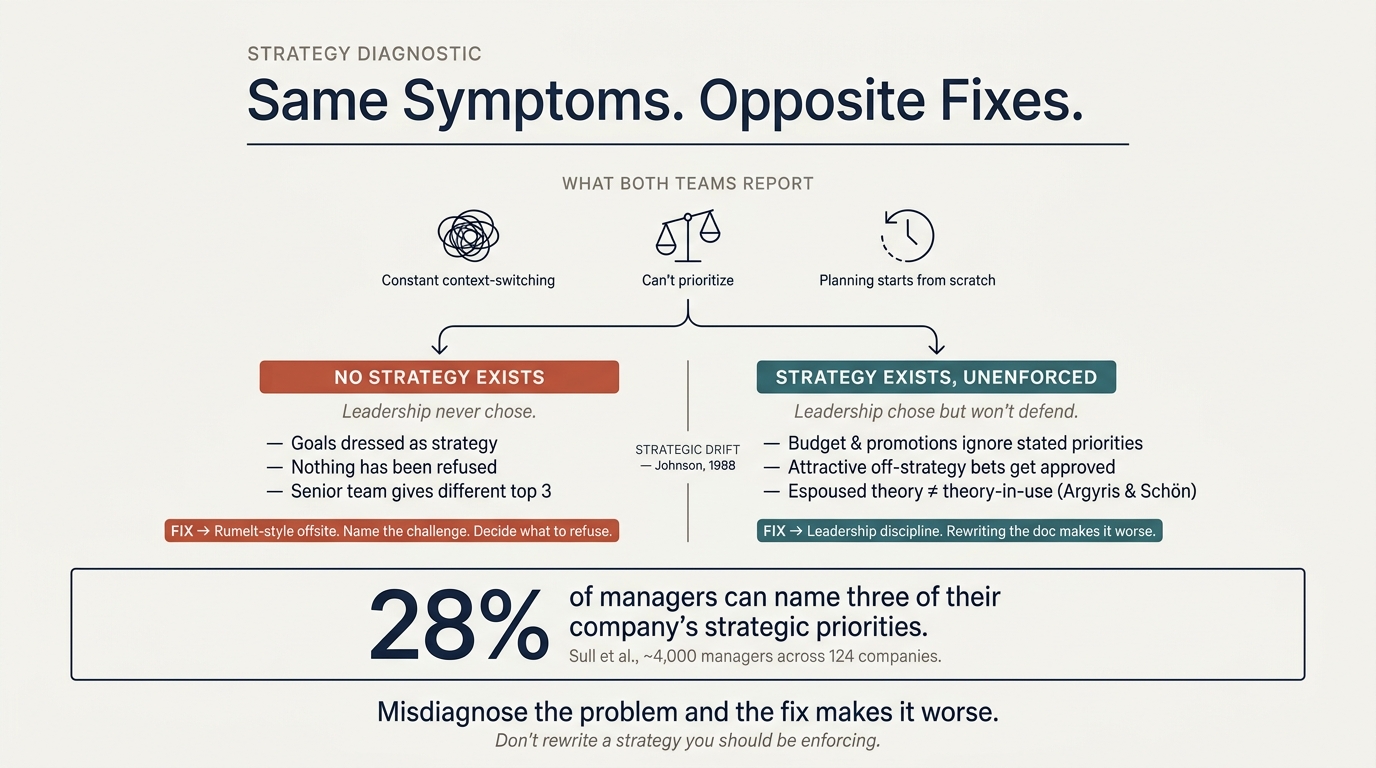
Research overview: two failure modes that look identical at the team level
This overview supports a LinkedIn post for senior engineering leaders on the distinction between two organizational failure modes: (1) the organization has no real strategy, and (2) the organization has a strategy that leadership does not protect or enforce. Both produce the same team-level symptoms [uncertainty, short-term thinking, prioritization breakdown, constant context-switching, resource fights], yet they require opposite interventions. The first calls for strategy work; the second calls for leadership discipline. The literature below is organized by concept; sources, quotes, and statistics are presented with reliability flags.
1. Strategic drift [Gerry Johnson]
Primary source and definition
Strategic drift was introduced by Gerry Johnson in "Rethinking incrementalism," Strategic Management Journal, 9(1), 1988, pp. 75 to 91 [DOI 10.1002/smj.4250090107]. The empirical foundation was Johnson's longitudinal study of Foster Brothers, a UK menswear retailer (Johnson, Strategic Change and the Management Process, Blackwell, 1987). The concept is the centerpiece of Chapter 5 ["Culture and Strategy"] in Johnson, Scholes and Whittington, Exploring Corporate Strategy, 8th edition, Pearson, 2008, pp. 179 to 184. [1]
Standard formulation reproduced across editions:
"Strategic drift is the tendency for strategies to develop incrementally on the basis of historical and cultural influences but fail to keep pace with a changing environment."
[Johnson, Scholes and Whittington, Exploring Corporate Strategy, 7th and 8th editions] [2]
A more developed phrasing from the textbook workbook: "the strategy of the organisation gradually drifts away from the realities of its environment and towards an internally determined view of the world of management."
The four phases
Johnson's classic diagram plots two curves against time: a smoothly rising line for environmental change, and a stepped, shallower line for the organization's actual strategic change. The widening gap between them is the drift. [3]
- Incremental change: strategies adjust in small, theme-consistent steps that broadly track the environment. The dominant paradigm is reinforced by apparent success. [4]
- Strategic drift: environmental change accelerates while the organization continues making incremental adjustments around its winning formula. The gap opens. Leaders typically believe they are still executing strategy effectively; the divergence is invisible from inside. [5]
- Flux: performance visibly deteriorates. Strategies become contradictory and short-lived; decisions get reversed; share prices fall. [6]
- Transformational change or death: either deep, paradigm-level change (often requiring outside leadership) or organizational failure.
Why drift happens even when a strategy is "in place"
Johnson's distinctive contribution is to ground drift in cognitive and cultural mechanisms, not environmental misreading. Two constructs do the explanatory work:
The organizational paradigm [Johnson 1988, 1992]: the set of assumptions held in common and taken for granted; "the way we see things around here" at a pre-conscious level. Managers respond to a paradigm-filtered version of the environment, so even strong external signals get screened out or reframed. [7][8]
The cultural web [Johnson, "Managing strategic change: strategy, culture and action," Long Range Planning, 25(1), 1992, pp. 28 to 36]: six mutually reinforcing elements (stories; symbols; rituals and routines; power structures; organizational structures; control systems) surrounding the paradigm. The mechanism of drift is that even when leaders set a new written strategy, the web continues to enact the old paradigm. Rewards still favor the old behavior; stories still celebrate the old heroes; structures still escalate the old decisions; control systems still measure the old metrics. Strategy on the page diverges from strategy in action. [7][9]
This is the central point for the user's argument: strategic drift is precisely a "strategy exists but is not being enacted" failure mode. Johnson is explicit (1988; reaffirmed in every edition) that during drift "strategies do develop incrementally." Phase 1 and Phase 2 organizations have very active strategy processes; those processes reinforce an internally consistent paradigm rather than tracking external reality.
Case studies
Marks & Spencer [Johnson's canonical case; in Exploring Corporate Strategy, 8th ed., p. 208, by Nardine Collier and Gerry Johnson]: Stated strategy through the 1980s and 1990s was quality British-made clothing under the St Michael brand with long-term suppliers. The cultural web reinforced this: stories about Simon Marks; insider promotion (every CEO before 1991 was a family member); central buying; low use of external market research. The UK clothing market moved to fast fashion, global sourcing, and value retail. Profits peaked in 1997/98 above £1 billion, then collapsed; share price halved by 1999; chairman Greenbury departed in 2000; the St Michael brand was phased out; transformational change came under Stuart Rose from 2004. [10]
Kodak: Steven Sasson invented the digital camera at Kodak in 1975. Written corporate strategy from the 1990s described Kodak as a digital imaging company. Resource allocation, reward systems, and senior promotions continued to favor film. Filed Chapter 11 in January 2012. Drift period roughly 1981 to mid-2000s; flux through filing. [11]
Nokia: Mid-2000s stated strategy was mobile leadership and "devices plus services." Cultural web (hardware-engineering identity, Symbian investment, hardware-shipment rewards) blocked the platform pivot. Stephen Elop's "burning platform" memo (February 2011) explicitly described phases 2 and 3. Mobile division sold to Microsoft in 2013. [12][12]
Blockbuster: Stated digital strategy from 2004 (Blockbuster Online; Total Access in 2006). Capital allocation, store-manager power, and late-fee revenue rituals kept the operating logic anchored to physical stores. Declined to acquire Netflix in 2000 for $50 million. Chapter 11 in September 2010.
Useful direct quotes
- "Cultural influences can be organisational, sectoral or national. Historical influences can create lock-in on particular strategic trajectories. The impact of these influences can be strategic drift, a failure to create necessary change." [Johnson, Scholes and Whittington, 2008, Chapter 1 summary, p. 14] [13]
- "Firms develop a way of comprehending their organisation, a paradigm or shared mindset, out of which they cannot think if it is particularly strong." [Johnson, 1992, Long Range Planning, 25(1)] [7]
- "The symptoms of strategic drift are a homogeneous mindset at managerial and board levels, preservation of the status quo, lack of focus on the external environment, and decline in performance." [Sammut-Bonnici, 2015, Wiley Encyclopedia of Management, vol. 12, summarizing Johnson]
2. Argyris and Schon: espoused theory and theory-in-use
Primary sources
- Argyris, C., and Schon, D. A. (1974), Theory in Practice: Increasing Professional Effectiveness, Jossey-Bass [foundational definition; key pages 6 to 7, 30]. [14]
- Argyris, C., and Schon, D. A. (1978), Organizational Learning: A Theory of Action Perspective, Addison-Wesley [introduces single-loop and double-loop learning, pp. 2 to 3]. [14]
- Argyris, C. (1985), Strategy, Change and Defensive Routines, Pitman [direct application to strategy].
- Argyris, C. (1986), "Skilled Incompetence," Harvard Business Review, September to October [HBR reprint 86501; centered on a strategic planning case].
- Argyris, C. (1990), Overcoming Organizational Defenses: Facilitating Organizational Learning, Allyn & Bacon.
- Argyris, C. (1991), "Teaching Smart People How to Learn," Harvard Business Review, May to June [HBR reprint 91301].
The core distinction
Foundational definition:
"When someone is asked how he would behave under certain circumstances, the answer he usually gives is his espoused theory of action for that situation. This is the theory of action to which he gives allegiance, and which, upon request, he communicates to others. However, the theory that actually governs his actions is this theory-in-use."
[Argyris and Schon, Theory in Practice, 1974, pp. 6 to 7] [14]
The 1991 HBR restatement in plainer language:
"Put simply, people consistently act inconsistently, unaware of the contradiction between their espoused theory and their theory-in-use, between the way they think they are acting and the way they really act."
[Argyris, 1991, p. 6 of reprint 91301] [15]
Argyris observed empirically that there is large variability in espoused theories across individuals and almost no variability in theories-in-use; most people default to the same protective operating model (Model I), governed by four values: remain in unilateral control; maximize winning and minimize losing; suppress negative feelings; be maximally "rational." "The purpose of all these values is to avoid embarrassment or threat, feeling vulnerable or incompetent." (1991, p. 6) [16]
Defensive routines and why the gap stays invisible
Argyris's definition:
"Organizational defensive routines [are] any action or policy designed to avoid surprise, embarrassment, or threat. But they also prevent learning and thereby prevent organizations from investigating or eliminating the underlying problems."
[Argyris, 1986, "Skilled Incompetence," HBR reprint 86501, p. 4] [17]
The "four easy steps to chaos" formulation (Argyris, 1986, sidebar) describes the protection mechanism:
- Design a clearly ambiguous message [e.g., "be innovative but be careful"]. [17]
- Ignore any inconsistencies in the message. [17]
- Make the ambiguity and inconsistency undiscussable. [17]
- Make the undiscussability itself undiscussable. [17]
Skilled incompetence: "managers use practiced routine behavior (skill) to produce what they do not intend (incompetence)." Closed-loop reasoning: "Because the attributions that go into defensive reasoning are never really tested, it is a closed loop, remarkably impervious to conflicting points of view." (1991, p. 6) [18][15]
Single-loop and double-loop learning
"When the error detected and corrected permits the organization to carry on its present policies or achieve its present objectives, then that error-and-correction process is single-loop learning. Single-loop learning is like a thermostat that learns when it is too hot or too cold and turns the heat on or off. ... Double-loop learning occurs when error is detected and corrected in ways that involve the modification of an organization's underlying norms, policies and objectives."
[Argyris and Schon, Organizational Learning, 1978, pp. 2 to 3] [1][1]
Plain language: single-loop is adjusting the dial; double-loop is asking whether the dial is set to the right number. Most organizations stay in single-loop because questioning the underlying assumptions [the strategy itself, the operating model, who has authority] triggers embarrassment, which activates defensive routines, which make those assumptions undiscussable.
Application to organizational strategy [the key angle]
This is where Argyris worked most directly with executive teams. His 1985 book Strategy, Change and Defensive Routines and his 1986 HBR article "Skilled Incompetence" are the canonical statements.
The mapping for the user's argument:
- The strategy document is the espoused theory of the organization.
- The theory-in-use can only be inferred from the pattern of decisions: where headcount and budget flow; what gets escalated; which projects get killed in QBRs versus protected; which behaviors lead to promotion; which customers get the senior people; what dominates Monday meetings; what is allowed to be undiscussable.
Argyris's foundational strategy-planning case from 1986:
"The entrepreneur-CEO of a fast-growing medium-sized company brought together his bright, dedicated, hardworking top managers to devise a new strategic plan. ... This is a group of executives who are at the top, who respect each other, who are highly committed, and who agree that developing a vision and strategy is critical. Yet whenever they meet, they fail to create the vision and the strategy they desire."
[Argyris, 1986, p. 2] [17]
His diagnosis: the espoused theory was "we want a clear strategy"; the theory-in-use was "preserve the peace between factions; keep the real disagreements off the table." He concludes: "Because the executives don't say what they really mean or test the assumptions they really hold, their skills inhibit a resolution of the important intellectual issues embedded in developing the strategy. Thus the meetings end with only lists and no decisions." (1986, p. 2) [17]
Argyris's CEO/decentralization example (1986, pp. 3 to 5): the CEO told division presidents "you run the show down there" while sending memos demanding information whenever something material happened. The espoused strategy of decentralization coexisted with a theory-in-use of recentralization-on-demand. From Argyris's perspective, the company did not have a strategy of decentralization; it had a strategy document about decentralization and a different operating logic. [17]
When teams say "we don't have a strategy," in Argyris's terms they often mean: the espoused strategy and the observable theory-in-use have drifted so far apart that the espoused version no longer predicts what gets funded, promoted, or killed; the contradictions have become undiscussable; and the defensive routines protecting the contradictions have become a senior-team operating norm.
Where change must start:
"The first step is for managers at the top to examine critically and change their own theories-in-use. Until senior managers become aware of how they reason defensively and the counterproductive consequences that result, there will be little real progress. Any change activity is likely to be just a fad."
[Argyris, 1991, p. 8] [15]
3. Data on strategy articulation and execution gaps
This section flags reliability tiers explicitly. Almost all of these statistics are perception-based rather than outcome-based; "strategy execution failure" is rarely measured against audited performance.
Primary, well-sourced
Sull, Sull, and Yoder, "No One Knows Your Strategy, Not Even Your Top Leaders," MIT Sloan Management Review, February 12, 2018.
- Headline finding: "Our analysis of 124 organizations revealed that only 28% of executives and middle managers responsible for executing strategy could list three of their company's strategic priorities." [19][20]
- In the anchor company example ("Generex"), only about 25% of surveyed managers could list three of the company's five strategic priorities; roughly one-third of leaders charged with implementing strategy could not list even one. Meanwhile, 97% of senior leaders self-reported a clear understanding of priorities before the test. [21]
- Methodology: 4,012 respondents across 124 companies, surveyed 2012 to July 2017. Respondents had up to five tries to list any three of the official priorities. Machine learning plus human coding compared answers to each company's official priorities. [19]
- Reliability: primary, methodology disclosed.
Sull, Homkes, and Sull, "Why Strategy Execution Unravels and What to Do About It," Harvard Business Review, March 2015, pp. 57 to 66 [reprint R1503C].
- "Only half of middle managers can name any of their company's top five priorities." [22]
- Less than one-third of managers say they can have open, honest discussions with their boss about difficult issues.
- Methodology: survey of "nearly 8,000 managers in more than 250 companies" plus 40+ in-company experiments. Mean company size 6,000 employees, median sales $430 million.
- Reliability: primary, methodology disclosed.
Mankins and Steele, "Turning Great Strategy into Great Performance," Harvard Business Review, July to August 2005, pp. 64 to 72 [reprint R0507E].
- Companies deliver only 63% of the financial performance their strategies promise on average; a 37% gap. [23]
- 76% of respondents said execution is more important than formulation in delivering financial results.
- 65% acknowledged they were worse at execution than at strategy development.
- Methodology: Economist Intelligence Unit survey of 197 senior executives at companies with sales of at least $500 million, conducted for Marakon Associates. [24]
- Reliability: primary; the standard caveat is that respondents self-rated their own performance against their own (possibly overambitious) plans.
Bridges Business Consultancy (Robin Speculand) Strategy Implementation Survey series, 2002 onward.
- 2016 survey: 67% of strategy implementations fail (defined as achieving less than 50% of stated goals in time); only 10% of organizations achieve at least two-thirds of their strategy objectives; 67% of leaders think their organization is good at crafting strategy, 47% think they are good at implementation.
- 2012 survey: leaders estimated only 5% of employees have a basic understanding of company strategy [leader estimate of employees, not direct test].
- Reliability: primary but with weak methodology; small samples (around 130 interviews), self-selected respondents, no peer review, and contested "failure" thresholds. [25]
Economist Intelligence Unit / Project Management Institute, "Why Good Strategies Fail" (2013), n = 587 senior executives: 61% of executives admit firms struggle to bridge formulation and implementation; 44% of strategic initiatives did not succeed in the prior three years. [26]
Secondary / consultancy-marketing tier [cite with provenance]
Kaplan and Norton, The Strategy-Focused Organization, Harvard Business School Press, 2001. The book opens with the famous bundle of "barriers to strategy execution":
- Only 5% of the workforce understands the strategy.
- Only 25% of managers have incentives linked to strategy.
- 60% of organizations do not link budgets to strategy.
- 85% of executive teams spend less than one hour per month discussing strategy. [27]
Provenance audit: These figures came from an internal survey conducted by Renaissance Worldwide [Kaplan and Norton's consulting firm] around 1996. Kaplan and Norton's The Execution Premium (2008) attributes them to that Renaissance survey on page 4. The original survey instrument, sample frame, and tabulation have not been published in peer-reviewed form. The 5% number is essentially a consultancy assertion repeated by Kaplan and Norton in book form, and should be treated as marketing-grade evidence, not as a verifiable survey result. The user's instinct on this is correct. [28]
The single primary measurement that does exist in Kaplan and Norton's work is the Mobil North America Marketing and Refining example: an annual HR survey reportedly found that 20% of the workforce understood Mobil's strategy in 1994, rising to above 80% by 1998 after balanced-scorecard implementation. That is a single-company before/after, not a benchmark. [29]
Folklore tier [should be flagged as not having a verifiable study]
- "Nine out of ten strategies fail" / "less than 10% of strategies are effectively executed": traces to Walter Kiechel III, "Corporate Strategists under Fire," Fortune, December 27, 1982, p. 38. Kiechel asserted that "fewer than 10 percent of effectively formulated strategies were successfully implemented." This was an editorial claim, not a study. [28]
- "70% of strategies fail due to execution": traces to Ram Charan and Geoffrey Colvin, "Why CEOs Fail," Fortune, June 21, 1999, an editorial estimate based on a biased sample of prominent failed CEOs.
- "70% of change initiatives fail" (attributed variously to McKinsey and Kotter): challenged by Mark Hughes, "Do 70 Per Cent of All Organizational Change Initiatives Really Fail?", Journal of Change Management, 11(4), 2011, who found the figure had no traceable empirical foundation. [30]
- Various aggregated numbers (78% of initiatives fail; 67% fail due to execution) recirculate without identifiable primary methodology. [31][24]
Longitudinal note
There is no convincing longitudinal evidence that strategy execution has improved. Sull's 2018 study finds the alignment gap persisting after decades of fix tools (balanced scorecards, OKRs, town halls). McKinsey transformation-odds surveys show roughly stable 70% failure rates over time. The persistence of the problem is supported even where the precise numerical level is contested.
4. Diagnosing which problem you have
Rumelt on bad strategy [Richard Rumelt, Good Strategy / Bad Strategy, Crown Business, 2011]
"Bad strategy is not simply the absence of good strategy. It grows out of specific misconceptions and leadership dysfunctions." [32]
"Bad strategy is long on goals and short on policy or action. It assumes that goals are all you need. It puts forward strategic objectives that are incoherent and, sometimes, totally impracticable." [33]
The four hallmarks of bad strategy (Chapter 3):
- Fluff: "a form of gibberish masquerading as strategic concepts ... It uses 'Sunday' words and apparently esoteric concepts to create the illusion of high-level thinking." Rumelt's example: a retail bank claiming "customer-centric intermediation" as its strategy [his translation: "our bank's fundamental strategy is being a bank"]. [33]
- Failure to face the challenge: "If you fail to identify and analyze the obstacles, you don't have a strategy. Instead, you have either a stretch goal, a budget, or a list of things you wish would happen." [33][34]
- Mistaking goals for strategy: "Many bad strategies are just statements of desire rather than plans for overcoming obstacles." Example: Chad Logan's "20/20 plan" [20% growth, 20% margin] which was "all results and no action." [33]
- Bad strategic objectives: "dog's dinner" laundry lists or "blue-sky" restatements of desire. A Pacific Northwest city had 47 "strategies" and 178 action items; item 122 was "create a strategic plan." Rumelt: "A long list of 'things to do,' often mislabeled as 'strategies' or 'objectives,' is not a strategy" (p. 53). [32][35]
Rumelt names three root causes of bad strategy: inability or unwillingness to choose [strategy is "scarcity's child"]; template-style strategy [vision-mission-values forms]; "New Thought" or positive wishful thinking. On templates: [32]
"The current fill-in-the-blanks template starts with a statement of 'vision,' then a 'mission statement' or a list of 'core values,' then a list of 'strategic goals,' then for each goal a list of 'strategies,' and then, finally, a list of 'initiatives.' ... Despite the fact that they are adorned with modern phrases and slogans, most of these strategic plans are as bad as International Harvester's. They do not identify and come to grips with the fundamental obstacles and problems that stand in the organization's way." [36][33]
The kernel of good strategy [Chapter 5, p. 77 area]: diagnosis, guiding policy, coherent action. "A great deal of strategy work is trying to figure out what is going on. Not just deciding what to do, but the more fundamental task of comprehending the situation and identifying the biggest barriers to forward progress." [37]
Also: "Good strategy requires leaders who are willing and able to say no to a wide variety of actions and interests. Strategy is at least as much about what an organization does not do as it is about what it does." [34]
Martin on planning versus strategy
Lafley and Martin, Playing to Win: How Strategy Really Works, HBR Press, 2013. The five-question choice cascade: winning aspiration; where to play; how to win; what capabilities; what management systems. [38][39]
"Strategy is an integrated set of choices that uniquely positions the firm in its industry so as to create sustainable advantage and superior value relative to the competition." [40]
"When a company sets out to participate, rather than win, it will inevitably fail to make the tough choices and the significant investments that would make winning even a remote possibility." [38]
Roger Martin, "The Big Lie of Strategic Planning," Harvard Business Review, January to February 2014 [reprint R1401F]:
"Strategic plans all tend to look pretty much the same. They usually have three major parts. The first is a vision or mission statement that sets out a relatively lofty and aspirational goal. The second is a list of initiatives ... The third element is the conversion of the initiatives into financials. ... This is a truly terrible way to make strategy." [41]
"If you are entirely comfortable with your strategy, there's a strong chance it isn't very good." [41]
"Planning typically isn't explicit about what the organization chooses not to do and why. It does not question assumptions. And its dominant logic is affordability; the plan consists of whichever initiatives fit the company's resources." [42][41]
Roger Martin, "A Plan Is Not a Strategy," HBR Quick Study video, June 29, 2022:
"Plans typically have to do with the resources you're going to spend. Those are more comfortable because you control them. A strategy, on the other hand, specifies a competitive outcome that you wish to achieve, which involves customers wanting your product or service. The tricky thing about that is that you don't control them." [43]
"If you plan, that's a way to guarantee losing. If you do strategy, it gives you the best possible chance of winning." [44]
Roger Martin, "Strategy vs. Planning: Complements not Substitutes," Medium, February 15, 2021: Martin reports that for "over 80% of strategic plans I am asked to assess, the set of initiatives doesn't add up to a strategy." Note that Martin explicitly invokes Argyris in his 2020 piece "Strategy is what you DO, not what you SAY," mapping the espoused-theory / theory-in-use distinction onto strategy documents versus realized decisions. [45][46]
Roger Martin, "Real Strategy or Corporate Theatre," 2016: Martin cites that only 11% of senior executives at companies with more than $1B in sales believe strategic planning is worth the effort. Symptoms of corporate theatre: detailed multi-year sales forecasts at the product level in fictional certainty; business unit managers sandbagging for resources; theoretical where-to-play discussions detached from how-to-win. [47][47]
Porter on trade-offs and the discipline of continuity
Michael Porter, "What Is Strategy?", Harvard Business Review, November to December 1996 [reprint 96608], pp. 61 to 78.
"The essence of strategy is choosing what not to do." [48]
"Operational effectiveness is not strategy." [49]
"The strategic agenda demands discipline and continuity; its enemies are distraction and compromise." [50]
"One of the leader's jobs is to teach others in the organization about strategy and to say no." [51]
On the drift mechanism specifically:
"Most companies start with a unique strategic position involving clear trade-offs. Nevertheless, with the passage of time and the pressures of growth, companies are led to make compromises ... Through a succession of incremental changes, which seemed sensible at the time, companies have compromised their way to homogeneity with their rivals." [51]
This is the leadership-discipline failure mode in Porter's own language: a strategy can exist in a document and still be eroded daily by incremental "sensible" compromises the leader fails to refuse.
Mintzberg on emergent vs deliberate strategy
Mintzberg and Waters, "Of Strategies, Deliberate and Emergent," Strategic Management Journal, 6, 1985, pp. 257 to 272; Mintzberg, The Rise and Fall of Strategic Planning, Free Press, 1994.
Deliberate strategy is intended in advance and realized as intended. Emergent strategy is "a realized pattern that was not expressly intended." Mintzberg's three "fallacies" of strategic planning: predetermination [the future cannot be precisely forecast]; detachment [strategy needs immersion, not isolation in a planning department]; formalization [creativity cannot be programmed]. [41]
Roger Martin warns in his 2014 HBR piece that Mintzberg's idea is now widely misused as "a handy excuse for avoiding difficult strategic choices, for replicating as a 'fast follower' the choices that appear to be succeeding for others." This is relevant to diagnosis: "emergent strategy" language can be deployed to legitimize an absence of strategic decision-making. [41]
Practical diagnostic framework
No single thinker has published a clean two-column diagnostic, but the literature supports the following synthesis.
Signals favoring a "missing strategy" diagnosis:
- The document fails Rumelt's hallmark test [fluff; no named challenge; goals dressed as strategy; laundry list].
- The document is indistinguishable from competitors' documents.
- The strategy is rewritten every 12 to 18 months with new vocabulary.
- Leaders give different answers when asked individually for the top three priorities.
- No trade-offs are visible; the strategy accepts all customer segments and all opportunities.
Signals favoring an "unfollowed strategy / leadership discipline" diagnosis:
- The written strategy passes Rumelt's hallmark test [it names a challenge, gives a guiding policy, lists coherent actions].
- Senior leaders individually can recite the same top three priorities [Sull's litmus test].
- The leader has visibly said no to attractive opportunities outside the chosen playing field in the last 12 months [Porter's discipline test].
- Resource allocation, hiring, and promotion patterns match the stated where-to-play / how-to-win choices.
- Quarterly pressure is absorbed without rewriting the strategy.
If symptoms are present but the document fails the hallmark test, the right intervention is strategy work [diagnosis, guiding policy, coherent action]. If symptoms are present but the document passes the hallmark test and leaders can recite it, the right intervention is leadership discipline, consistency, and removal of competing demands.
5. The intervention mismatch and strategy fatigue
The literature does not contain a single canonical treatment of the mismatch problem, but the implications can be drawn from multiple strands.
What happens when teams misdiagnose
If the true problem is a missing strategy, forcing accountability cascades on a vague document amplifies the wrong behavior. Disciplined execution at the bottom produces coherent action toward the wrong objective. Rumelt: "Decentralized decision making cannot do everything. In particular, it may fail when either the costs or benefits of actions are not borne by the decentralized actors." Martin's corporate-theatre critique describes the same pattern: business units sandbagging for resources within a planning ritual that never makes a real choice. [41]
If the true problem is an unfollowed strategy, rewriting the document is the dominant failure mode. It feels productive [it produces a fresh artifact] but reproduces the original abandonment pattern. The required intervention is leadership discipline: saying no, protecting trade-offs from quarterly pressure, aligning resource allocation, communicating the strategy until it is recited at level two of the organization.
Strategy fatigue and the credibility cost
Each rewritten strategy spends credibility. The next strategy starts from a lower trust base. By the third unfulfilled commitment, the rational employee assumption is that the strategy will not be enforced, and they revert to whatever they were doing.
This is consistent with Kotter's 1995 finding that "new behaviors are subject to degradation as soon as the pressure for change is removed." It also tracks the practitioner literature on initiative fatigue: AIM Business School's 2024 review finds 43% of employees with high change fatigue intend to stay at their organization, versus 74% of those with low fatigue. RSM US (2024 to 25) summarizes the trust dynamic: "Initiative fatigue erodes trust. When programs fail to land, credibility suffers. Morale drops. Teams disengage and stop investing in new efforts." [52][53]
The intervention mismatch is asymmetric. Rewriting a strategy you should have enforced costs you credibility you will need to enforce the next one. Enforcing a strategy you should have rewritten produces coherent failure rather than the absorbing kind.
6. Adjacent concepts that illuminate the gap
Decoupling [Meyer and Rowan]
John W. Meyer and Brian Rowan, "Institutionalized Organizations: Formal Structure as Myth and Ceremony," American Journal of Sociology, 83(2), September 1977, pp. 340 to 363.
Organizations adopt formal structures (including strategy documents) that conform to "rationalized institutional myths" in order to gain legitimacy from external stakeholders. Internal coordination is deliberately weakened so the legitimacy benefit is not jeopardized by operational reality. [54]
"Many formal organizational structures arise as reflections of rationalized institutional rules... Institutional rules function as myths which organizations incorporate, gaining legitimacy, resources, stability, and enhanced survival prospects." [55][56]
"Structures are decoupled from each other and from ongoing activities. In place of coordination, inspection, and evaluation, a logic of confidence and good faith is employed." [55][56]
"Decoupling enables organizations to maintain standardized, legitimating, formal structures while their activities vary in response to practical considerations." [57]
Plain language: a company writes a strategy partly because outside audiences expect organizations like this to have one; the document signals competence. Because the document exists to satisfy external expectations rather than to solve a concrete internal problem, the organization does not wire it into how decisions get made.
Bromley and Powell update [Academy of Management Annals, 6(1), 2012, pp. 483 to 530]: As transparency pressures have intensified, the classic policy-practice gap is harder to sustain. A second form has grown: means-ends decoupling, where the policy is implemented [OKRs, dashboards, quarterly reviews, strategy office] but the activities have weak or unknown causal links to the outcomes claimed. "The common understanding of decoupling [as a gap between policy and practice] obscures the rise of a more prevalent and consequential form of decoupling: a gap between means and ends." This is the typical modern strategy-execution pattern. [58]
Brunsson's organization of hypocrisy
Nils Brunsson, The Organization of Hypocrisy: Talk, Decisions, and Actions in Organizations, John Wiley & Sons, 1989; revised 2002. Follow-on: The Consequences of Decision-Making, Oxford University Press, 2007.
Organizations produce three distinct outputs: talk [statements, speeches, strategies, mission statements]; decisions [formal choices, resolutions, approved plans]; actions [what people actually do]. In a world of inconsistent external demands, these three outputs need not be consistent. Brunsson argues the inconsistency is functional: it lets the organization satisfy incompatible constituencies simultaneously.
Brunsson's distinctive claim is that talk, decisions, and actions are counter-coupled rather than simply decoupled. Talk and decisions in one direction compensate for actions in the opposite direction. From the SAGE International Encyclopedia of Organization Studies entry summarizing Brunsson: [59]
"Talk and decisions in one direction compensate for actions in the opposite direction and vice versa. Talk, decisions, and actions are not 'de-coupled' or 'loosely coupled' but 'counter-coupled,' although in a way other than is usually assumed. Hypocrisy may be used as a conscious strategy by managers for whom the legitimacy of an organization is important." [59]
"Legitimacy is secured by conflict rather than by unity, and by dealing with problems rather than by providing solutions." [Brunsson] [60][61]
Application: a strategy is a form of organizational talk and a form of organizational decision-making. The audience for strategy talk [board, analysts, employees who want to feel inspired, candidates] is often a different audience than the one that benefits from the actions [existing customers, incumbent business lines, internal coalitions, short-term P&L]. The strategy is not followed because it was never supposed to drive action; it was supposed to satisfy the audience for strategy talk while action continued to satisfy a different audience. A strategy that is "ignored" may be doing its job perfectly.
Kotter on the guiding coalition and sustained pressure
John P. Kotter, "Leading Change: Why Transformation Efforts Fail," Harvard Business Review, 73(2), March to April 1995, pp. 59 to 67; Leading Change, Harvard Business School Press, 1996.
The eight steps are familiar; the relevant failure modes for this analysis are step 2 [insufficient guiding coalition] and steps 7 and 8 [declaring victory too soon; failure to anchor in culture].
"Communication comes in both words and deeds, and the latter are often the most powerful form. Nothing undermines change more than behavior by important individuals that is inconsistent with their words." [62]
"Efforts that don't have a powerful enough guiding coalition can make apparent progress for a while. But, sooner or later, the opposition gathers itself together and stops the change." [63][62]
"Until changes sink deeply into a company's culture, a process that can take five to ten years, new approaches are fragile and subject to regression. ... New behaviors are subject to degradation as soon as the pressure for change is removed." [62]
"It is the premature victory celebration that kills momentum. And then the powerful forces associated with tradition take over." [62]
Plain language: strategies do not execute themselves. They execute only as long as a credible group of senior leaders is visibly and consistently demanding them, removing obstacles, and rewarding consistent behavior. The moment the coalition fragments or gets distracted, the organization snaps back to its prior equilibrium.
Stockdale paradox
Jim Collins, Good to Great: Why Some Companies Make the Leap... and Others Don't, HarperBusiness, 2001, Chapter 4, pp. 83 to 87.
The paradox, in Vice Admiral James Stockdale's words to Collins:
"You must never confuse faith that you will prevail in the end, which you can never afford to lose, with the discipline to confront the most brutal facts of your current reality, whatever they might be." (p. 85)
Stockdale on the optimists who died in captivity:
"Oh, they were the ones who said, 'We're going to be out by Christmas.' And Christmas would come, and Christmas would go. Then they'd say, 'We're going to be out by Easter.' And Easter would come, and Easter would go. ... And they died of a broken heart." (pp. 84 to 85) [64][64]
Application to the diagnosis question: the Stockdale paradox distinguishes healthy strategic discipline from two failure modes that look similar from outside.
- False-hope rigidity: leadership insists the strategy is working, refuses to look at evidence, attaches faith to specific milestones that keep slipping. The strategy is being followed in form; the strategy is wrong, and the organization is unwilling to confront that.
- Capitulation: leadership abandons the strategy at the first sign of difficulty, pivots to whatever feels fresh, loses the throughline.
The discipline is to hold long-term commitment as nonnegotiable while updating tactics aggressively in response to brutal facts. Strategy as direction is followed; strategy as a specific timeline is constantly revised. This is the prescription for leaders trying to protect a strategy from quarterly pressure without sliding into stubbornness.
Bartlett and Ghoshal: the smell of the place
Christopher A. Bartlett and Sumantra Ghoshal, "Rebuilding Behavioral Context," Sloan Management Review, Fall 1995. Behavior in large companies is shaped less by formal strategy and structure than by "behavioral context" managers create. Ghoshal contrasts the "four Cs" of stifling environments [constraint, compliance, contract, control] with the "four Ss" of energizing ones [stretch, self-discipline, support, trust].
"Changing people's behavior is not about changing people, but changing the context which they are in: the smell of the place." [Ghoshal] [65][66]
Implication: even a sound strategy will fail in a high-constraint, low-trust context, regardless of the strategy documents.
Pettigrew on context and continuity
Andrew M. Pettigrew, The Awakening Giant: Continuity and Change in ICI, Blackwell, 1985; "Context and Action in the Transformation of the Firm: A Reprise," Journal of Management Studies, 49(7), 2012, pp. 1304 to 1328. Strategic change is embedded in historical, political, and cultural context; any change effort that ignores context produces formal change without substantive change. Strategy formulation and implementation are interrelated processes, and imported strategies fail when the political and cultural conditions for them have not been built. [67][67]
Synthesizing facts for the user's argument
The two failure modes the user describes map cleanly onto distinct theoretical lineages:
"No strategy" failure mode: best diagnosed with Rumelt's four hallmarks of bad strategy and Martin's planning-versus-strategy distinction. The document is fluff, or it is a list of goals, or it is a list of initiatives, or it is indistinguishable from competitors' documents. Symptoms: leaders cannot articulate a coherent diagnosis or how-to-win; the strategy is rewritten frequently with new vocabulary; no trade-offs are visible. The intervention is the uncomfortable work of strategy: name the challenge, choose where to play, choose how to win, write the logic.
"Strategy not followed" failure mode: best diagnosed with Johnson's strategic drift, Argyris's espoused-theory / theory-in-use distinction, Meyer and Rowan's decoupling, Brunsson's counter-coupling of talk and action, Porter's compromise-by-incremental-decision, and Kotter's relaxation of leadership pressure. The document passes Rumelt's hallmark test; senior leaders can recite the priorities; but the cultural web (rewards, promotions, rituals, control systems) still enacts the prior paradigm, and the senior team has not visibly said no to any attractive opportunity outside the chosen playing field. The intervention is leadership discipline: consistency in saying no, alignment of resource allocation and incentives with the stated strategy, sustained pressure from a guiding coalition, and protection of the strategy from quarterly noise.
The two best-documented single statistics for the gap between articulation and execution are Mankins and Steele's 63% strategy-to-performance ratio [n = 197, HBR July to August 2005] and Sull, Sull, and Yoder's finding that only 28% of executives and middle managers can list three of their company's strategic priorities [n = 4,012 across 124 organizations, MIT Sloan Management Review, February 12, 2018]. Both of these are perception or recall measures rather than audited outcomes, but they are the most defensible numbers in the literature. [23]
The Kaplan and Norton bundle [5% of workforce understands strategy; 85% of executive teams spend less than an hour per month on it; 25% of managers have aligned incentives; 60% of organizations do not link budgets to strategy] traces to an unpublished 1996 internal survey by Renaissance Worldwide, Kaplan and Norton's consulting firm. It should be cited with that provenance, or avoided. [28]
The "nine out of ten strategies fail" figure traces to a single 1982 Fortune assertion by Walter Kiechel III with no underlying study and should be treated as folklore. [28]
- arcjournals — https://www.arcjournals.org/pdfs/ijmsr/v10-i1/7.pdf
- Bartleby — https://www.bartleby.com/essay/Strategic-Drift-P3C9ZXSDJK8Q
- Slideplayer — https://slideplayer.com/slide/5296561/
- PHD Essay — https://phdessay.com/strategic-drift/
- Empiraa — https://www.empiraa.com/blog/the-four-stages-of-strategic-drift
- Quizlet — https://quizlet.com/gb/499345036/strategic-drift-diagram/
- ResearchGate — https://www.researchgate.net/publication/227722886_Managing_Strategic_Change_The_Role_of_Symbolic_Action
- Mbaknol — https://mbaknol.com/strategic-management/johnson-and-scholes-cultural-web-model-of-an-organization/
- Mindtools — https://www.mindtools.com/a8im94b/the-cultural-web/
- Wikipedia + 3 — https://en.wikipedia.org/wiki/Marks_&_Spencer
- World Economic Forum + 3 — https://www.weforum.org/stories/2016/06/leading-innovation-through-the-chicanes/
- Studocu — https://www.studocu.com/row/document/bindura-university-of-science-education/strategic-management-bs443/strategic-drift-analysis-a-case-study-of-kodak-in-mohs-508/129196275
- wordpress — https://fouziyagm.wordpress.com/wp-content/uploads/2015/04/johnson-exploringcorporatestrategy8ed.pdf
- infed — https://infed.org/dir/welcome/chris-argyris-theories-of-action-double-loop-learning-and-organizational-learning/
- uga — https://www.libs.uga.edu/reserves/docs/main-archive/2022/main-fall2022/han-eadu8410e/w6_argyris-teaching-smart-people-how-to-learn.pdf
- Aral + 4 — https://aral.com.au/resources/argyris.html
- 6-30partners — http://6-30partners.com/wp-content/uploads/2015/12/Chris-Argyris-Skilled-Incompetence.pdf
- Harvard Business Review — https://hbr.org/1986/09/skilled-incompetence
- MIT Sloan Management Review — https://sloanreview.mit.edu/article/no-one-knows-your-strategy-not-even-your-top-leaders/
- Harvard Business Review — https://store.hbr.org/product/no-one-knows-your-strategy-not-even-your-top-leaders/SMR669
- Tradinginsider + 3 — https://www.tradinginsider.fr/2018/03/no-one-knows-your-strategy-not-even-your-top-leaders/
- Harvard Business Review — https://hbr.org/2015/03/why-strategy-execution-unravelsand-what-to-do-about-it
- The Case Centre — https://www.thecasecentre.org/products/view?id=63525
- JBOMS — https://jboms.com/consulting/why-90-of-strategies-fail-real-strategy-execution-failure-examples/
- Slideshare — https://www.slideshare.net/slideshow/strategy-implementation-survey-results-2012/15916530
- ProjectManagement.com — https://www.projectmanagement.com/blog-post/7112/time-to-kill-the-phantom-70--failure-rate-
- Blogging on Business — https://bobmorris.biz/the-strategy-focused-organization-a-book-review-by-bob-morris
- excitant — https://www.excitant.co.uk/do-9-out-of-10-strategies-fail/
- Harvard Business School — https://www.library.hbs.edu/working-knowledge/the-strategy-focused-organization
- SI Labs — https://www.si-labs.com/en/articles/why-transformations-fail/
- The Turbochargers — https://theturbochargers.com/strategy-implementation-process-why-70-of-strategic-initiatives-fail-and-how-to-be-in-the-30-that-succeed/
- Aydoo Services — https://aydoo.services/en/articles/good-strategy-bad-strategy/
- Manas J. Saloi — https://manassaloi.com/booksummaries/2022/10/20/good-bad-strategy-rumelt.html
- Elevate Society — https://elevatesociety.com/quotes-from-good-strategy-bad-strategy/
- Admired Leadership — https://admiredleadership.com/book-summaries/good-strategy-bad-strategy/
- Medium — https://t-ziegelbecker.medium.com/a-summary-of-good-strategy-bad-strategy-by-richard-p-rumelt-part-1-5d0bbf82f26a
- LinkedIn + 2 — https://www.linkedin.com/pulse/good-strategy-bad-richard-rumelt-juan-carlos-zambrano
- FS Blog — https://fs.blog/playing-to-win-how-strategy-really-works/
- LinkedIn — https://www.linkedin.com/pulse/playing-win-ag-lafley-roger-l-martin-juan-carlos-zambrano
- AfMA — https://afma.org.au/playing-to-win-how-strategy-really-works-by-a-g-lafley-and-roger-martin/
- todopmp — https://todopmp.com/wp-content/uploads/2018/12/The-Big-Lie-of-Strategic-Planning-1.pdf
- Designative — https://www.designative.info/2022/07/08/watch-a-plan-is-not-a-strategy-talk-with-roger-martin/
- Harvard Business Review — https://hbr.org/podcast/2023/05/the-difference-between-a-plan-and-a-strategy
- Cutting Edge PR — https://cuttingedgepr.com/articles/a-plan-is-not-a-strategy/
- Medium — https://rogermartin.medium.com/strategy-vs-planning-complements-not-substitutes-ea08e56809d6
- Medium — https://rogermartin.medium.com/strategy-is-what-you-do-not-what-you-say-a6e483840557
- Vdocuments — https://vdocuments.mx/real-strategy-or-corporate-theatre-with-roger-martin.html
- Goodreads — https://www.goodreads.com/quotes/76784-the-essence-of-strategy-is-choosing-what-not-to-do
- Lumsa — https://lumsa.it/sites/default/files/UTENTI/u95/LM51_ITA_What%20is%20Strategy%20-%20Porter.pdf
- SAGE Publications — https://uk.sagepub.com/sites/default/files/upm-assets/9497_book_item_9497.pdf
- LinkedIn — https://www.linkedin.com/pulse/porter-m-e-1996-what-strategy-harvard-business-review-salman-siddiqui
- Aimbusinessschool — https://www.aimbusinessschool.edu.au/why-abs/blog/why-70-of-change-management-initiatives-fail
- RSM US — https://rsmus.com/insights/services/business-strategy-operations/how-initiative-fatigue-erodes-leadership-focus.html
- Scribd — https://www.scribd.com/document/864972374/Meyer-and-Rowan-Institutionalized-Organizations-Formal-Structure-as-Myth-and-Ceremony
- Semantic Scholar — https://www.semanticscholar.org/paper/Institutionalized-Organizations:-Formal-Structure-Meyer-Rowan/bc4c52775dde0e372e440a85de2b6c19ed696bfc
- University of Chicago Press — https://www.journals.uchicago.edu/doi/10.1086/226550
- Studocu — https://www.studocu.com/sv/document/stockholms-universitet/organisation-ii/7-meyer-rowan-teoria-institucional/21024953
- Semantic Scholar — https://www.semanticscholar.org/paper/From-Smoke-and-Mirrors-to-Walking-the-Talk:-in-the-Bromley-Powell/8edae01e1fb98310aea0f53fe7ab5929e5e1f61c
- SAGE Publications — https://sk.sagepub.com/ency/edvol/download/organization/chpt/hypocrisy.pdf
- Google Books — https://books.google.com/books/about/The_Organization_of_Hypocrisy.html?id=uaCYQgAACAAJ
- Amazon — https://www.amazon.com/Organization-Hypocrisy-Decisions-Actions-Organizations/dp/8763001063
- academicpeds — https://www.academicpeds.org/wp-content/uploads/gravity_forms/66-cffe81f82d0c22a20931a4634aea2e41/2023/03/Leading-Change_Why-Transformation-Efforts-Fail.pdf
- Lighthouseconsultants — http://www.lighthouseconsultants.co.uk/wp-content/uploads/2010/08/Kotter-Leading-Change-Why-transformation-efforts-fail.pdf
- Jim Collins — https://www.jimcollins.com/concepts/Stockdale-Concept.html
- LinkedIn — https://www.linkedin.com/pulse/smell-place-mary-garden
- Scrum.org — https://www.scrum.org/resources/blog/9-smells-organization
- Wikipedia — https://en.wikipedia.org/wiki/Andrew_Pettigrew
Commissioned from our research desk. Subject to final editorial discretion.