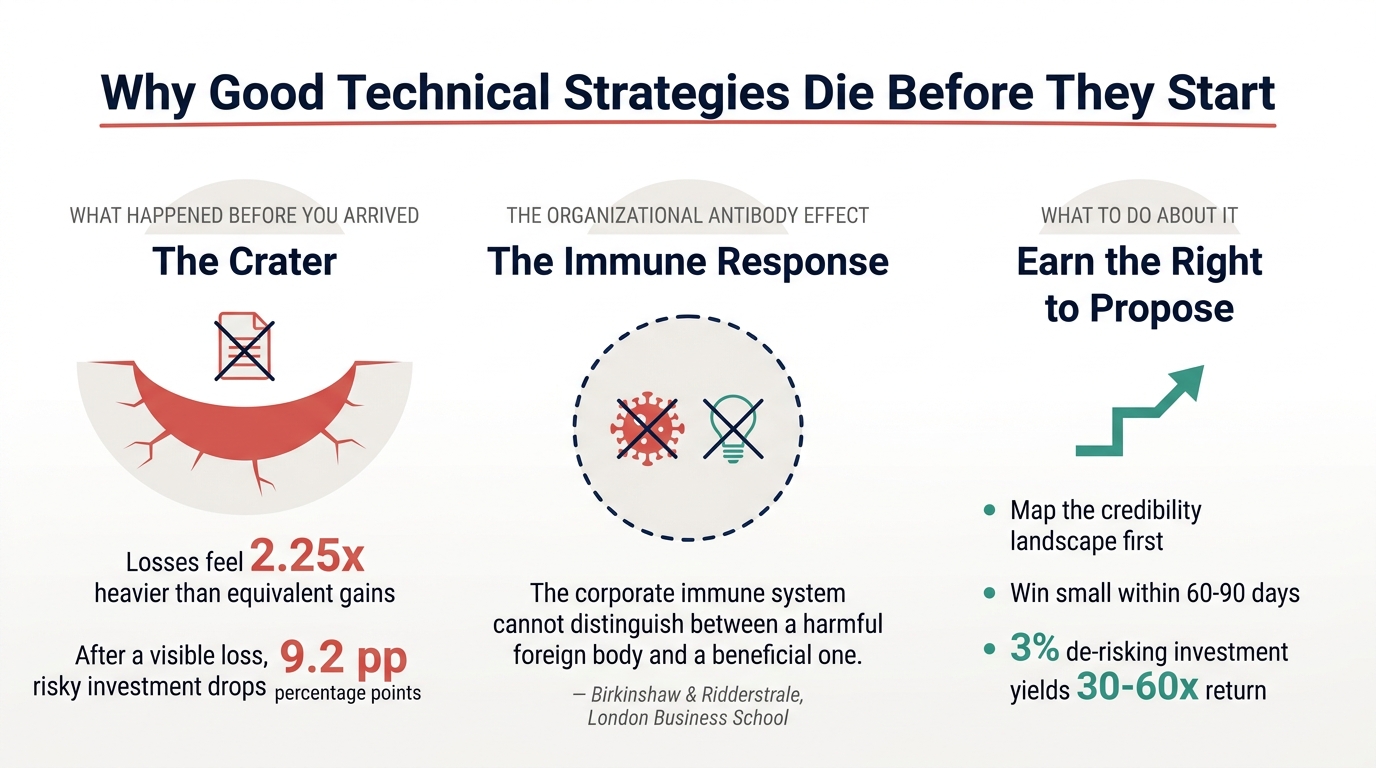
Every technical strategy lives or dies in the funding conversation. And that conversation has a memory.
I've watched excellent proposals get quietly suffocated in rooms where the PowerPoint was fine, the math was sound, and the architecture was genuinely right. They died anyway. Not because anyone found a flaw, but because three years earlier, a different team pitched something ambitious, got the budget, and cratered.
That crater changes everything.
Kahneman and Tversky's prospect theory puts a number on it: losses feel roughly 2.25x larger than equivalent gains. A McKinsey survey found that for a $100M investment with a potential $400M return, most managers would only accept an 18% chance of loss. A risk-neutral person would accept 75%. That gap gets worse after a visible failure. Researchers call it the "snake-bite effect." Firsthand experience of a loss reduced risky asset allocation by 9.2 percentage points.
Birkinshaw and Ridderstråle at London Business School studied 44 initiatives and described the "corporate immune system." Their key finding: it cannot distinguish between a harmful foreign body and a beneficial one. After a big failure, it attacks everything.
Jason Fried coined a related term: "organizational scar tissue." Policies become codified overreactions to situations unlikely to happen again. In technology, this shows up as death-by-procurement, vendor skepticism, and transformation fatigue.
You inherit this whether you caused it or not.
CIO tenure averages 4.6 years. About 60% are recruited externally. They walk into organizations carrying credibility debts they didn't incur, surrounded by antibodies they can't see. If the last big data project failed, your AI proposal gets judged through that lens regardless of your team or plan.
The paradox: organizations simultaneously forget why something failed and remember that it failed. They lose the lessons but keep the fear.
So what do you do?
Map the credibility landscape before you propose anything. Find out what failed, who championed it, what it cost, and how people felt about it. Not just executives. The directors, senior engineers, program managers who lived through the wreckage.
Then start absurdly small. BCG found that investing just 3% of program budget in de-risking yields a 30 to 60x return. You need a visible, unambiguous win within 60 to 90 days. Something everyone agrees is on fire, that you quietly put out.
Demonstrating that you genuinely understand the organization's past pain outweighs demonstrating technical brilliance. People don't need to know you're smart. They need to know you understand what happened to them.
The real work of technical strategy is earning the right to propose one. Every organization has a credibility balance sheet. If the account is overdrawn, no architectural elegance will get your proposal funded.
Small, boring, delivered deposits. One at a time.
When a good strategy starves because a bad one ate first
The phenomenon is real, measurable, and pervasive: a single failed technology initiative can suppress an organization's willingness to fund unrelated investments for years, sometimes decades. The mechanism operates through loss aversion, organizational antibody responses, inherited credibility deficits, and the vicious cycle of technical debt — each reinforcing the others. Below is the research evidence, organized by domain.
Loss aversion turns one burned hand into a permanently flinching organization
The psychological bedrock is Kahneman and Tversky's prospect theory (1979, Econometrica), [1] which established that losses loom approximately 2.25 times larger than equivalent gains (refined in Tversky & Kahneman, 1992, Journal of Risk and Uncertainty). [2] A 2023 global replication across 19 countries and 13 languages confirmed a 90% replication rate for the theory's core predictions. [3]
This ratio distorts corporate technology decisions at every level. A 2012 McKinsey survey of 1,500 managers offered a hypothetical $100M investment with a potential $400M return. A risk-neutral manager should accept up to a 75% chance of loss. Most managers would accept only an 18% chance of loss — extreme aversion relative to the math. Richard Thaler tested this with 22 magazine heads offered a coin-flip paying $2M on heads, losing $1M on tails. Only 3 of 22 accepted, despite a positive expected value and negligible risk to the parent company. [4] These findings appeared in the landmark HBR article "Your Company Is Too Risk-Averse" (Lovallo, Koller, Uhlaner, and Kahneman, March–April 2020), [5] which introduced the concept of the "Risk Aversion Tax" (RAT) — the hidden cost of excessive corporate risk aversion. For one high-performing company they assessed, the RAT was 32%, meaning the company could have improved performance by nearly a third just by eliminating self-imposed caution.
The behavioral finance literature labels the post-loss overcorrection the "snake-bite effect" — a combination of recency bias and loss aversion that makes decision-makers irrationally conservative after a negative experience. The formal academic version is Andersen, Hanspal, and Nielsen's "Once Bitten, Twice Shy: The Power of Personal Experiences in Risk Taking" (Journal of Financial Economics, 2019), which found that [6] first-hand experience of a loss reduced risky asset allocation by 9.2 percentage points [7] — and critically, this was a personal-experience effect, not a rational response to market conditions. [8][9] A separate study in Judgment and Decision Making found that nearly half of participants experiencing regret rejected an alternative they had previously identified as the best one, choosing a non-optimal path instead — pure inhibition of the prior decision, not rational recalibration. [10]
Two additional named biases compound the effect. Status quo bias (Samuelson & Zeckhauser, 1988, Journal of Risk and Uncertainty) causes disproportionate stickiness to existing systems after a failed change attempt. [11] Kim and Kankanhalli (2009) built the first measurement model of status quo bias in technology adoption, specifically in the context of ERP introductions, confirming it significantly impedes adoption. [12] Narrow framing (Kahneman & Tversky) describes the tendency to evaluate each investment in isolation rather than as part of a portfolio [1] — so one failed project isn't weighed against the portfolio's overall return; it becomes a standalone cautionary tale.
A Cornell Johnson School study estimated that cognitive bias-driven decision failures cost businesses up to 15% of revenue, while Harvard Business School's Max Bazerman found that firms implementing debiasing strategies saw an average 7% increase in return on assets. [13]
The corporate immune system attacks good ideas alongside bad ones
The academic foundation for the "organizational antibody" metaphor was laid by Julian Birkinshaw and Jonas Ridderstråle (London Business School) in their 1999 paper "Fighting the Corporate Immune System" (International Business Review). Studying 44 initiatives in multinational subsidiaries, they defined the corporate immune system as "the set of organizational forces that suppress the advancement of creation-oriented activities." Their key insight: like a biological immune system rejecting a beneficial organ transplant, the corporate immune system cannot distinguish between a harmful foreign body and a beneficial one. [14]
The specific term "corporate antibodies" was popularized by practitioners in the 2000s–2010s:
- Phil McKinney, former CTO of Hewlett-Packard, wrote in Beyond The Obvious (2012): "The antagonist of the innovator is the corporate antibody. Much like antibodies in our immune system attack and destroy foreign objects, 'antibodies' in your organization identify and neutralize forces that threaten to destabilize a company." [15]
- Mitra Best, U.S. Innovation Leader at PwC, defined the concept in Harvard Business Review (May 2012): "Corporate antibodies — the people and processes that extinguish a new idea as soon as it begins to course through the organization." [16][16]
- Tony Fadell (creator of iPod, iPhone, Nest) [17] described the phenomenon from inside Apple and Google in Build (2022): "There were times when the internal antibodies at Apple tried to expel us from the organization." At Google/Nest: "The natural antibodies detected something new, different, foreign and did everything they possibly could to avoid or ignore it." [18]
- Clayton Christensen's The Innovator's Dilemma (1997) described the same mechanism without the antibody metaphor: "There is something about the way decisions get made in successful organizations that sows the seeds of eventual failure." [19] Companies whose investment processes "demand quantification of market sizes and financial returns before they can enter a market get paralyzed or make serious mistakes when faced with disruptive technologies."
Gilley, Godek, and Gilley (2009, SAM Advanced Management Journal) formalized the immune-response stages: detection (employees seek information about a new initiative), initial response (rumors, fear, resources cut off), escalation (alliances form against the change), and full immune response (maximum resistance). They proposed three countermeasures: concealing (making change seem less threatening), modifying (behavioral change programs), and disarming (removing barriers directly). [20]
Nick Skillicorn (Idea to Value, 2022) identified eight types of corporate antibodies, including the one most relevant to post-failure investment suppression — the "Frustrated Elder": someone who says "that idea didn't work" with the unspoken subtext "We (and I in particular) couldn't make that work." The dual fear: "What makes you think you can do better?" and "If you succeed, it makes my failure visible." [21]
Gary Oster (2009, Review of International Comparative Management) added an important nuance: not all organizational antibodies are pathological. [22] Some serve as healthy sensemaking, filtering genuinely bad ideas. [22] The challenge is that after a major failure, the antibody response is amplified indiscriminately — attacking good and bad proposals alike.
A closely related concept is "organizational scar tissue," coined by Jason Fried (Basecamp/37signals): "Policies are organizational scar tissue. They are codified overreactions to situations that are unlikely to happen again. They are collective punishment for the misdeeds of an individual." [23] In the technology context, Crema.us documented how failed digital initiatives create "agency scar tissue" manifesting as fear-based decisions, death-by-procurement RFPs, vendor skepticism, and transformation fatigue where "employees roll their eyes at 'this time it's different' because it never is." [24]
Credibility debt is real but unnamed — and new leaders inherit it automatically
"Credibility debt" is not yet a formally defined term in management literature, but the phenomenon it describes is well-documented across several adjacent frameworks. The metaphor extends Ward Cunningham's "technical debt" (1992) to institutional trust — the accumulated deficit of confidence that compounds over time and must be "paid down" before new investments can be made.
The closest named construct is "Trust Deficit Syndrome," coined by Larry Light (former Global CMO of McDonald's): "a debilitating business disease" in which "Trust Capital" — the confidence stakeholders have that you will live up to promises — has been depleted. Trust Capital "accrues like money in the bank" and helps companies "bounce back after a crisis," [25] but once drained, the account balance can go deeply negative.
Gillespie and Dietz (2009, Academy of Management Review) built the formal academic framework for organizational trust repair, proposing a systemic, multilevel model distinguishing organizational-level trust repair from interpersonal trust repair. [26] Their four-stage process addresses the systemic roots of trust failure — culture, governance structures, and management practices — rather than just individual behavior.
The inheritance problem is acute. According to a PwC/Strategy+Business study, 70% of respondents say the failure of a major IT project is one of the primary reasons the tide turns against a CIO. [27] About 60% of CIOs are recruited externally, and one-third are forced out. [27] CIO tenure averages just 4.6 years [28] (Korn Ferry, 2020) — second-shortest in the C-suite after CMOs [29][30] — with an effective runway of only 2–3 years to demonstrate results [29] (CIO.com). A single major failure can consume an entire CIO's remaining credibility window, and the successor inherits the deficit. As CIO.com puts it: "It's not uncommon for a new CIO to inherit a major IT initiative... you will still be tainted if things go wrong." [31]
Academic research on "guilt by association" confirms the mechanism. A 2021 Organization Science paper from Kellogg School (Northwestern) found that "innocent organizations are penalized due to their similarity to offending organizations" through both inductive generalization (prototype-based) and deductive generalization (stereotype-based). [32] In practical terms: if the last big data project failed, the next AI proposal gets judged through that lens regardless of its technical merit or team composition. [33]
The paradox is that organizations simultaneously suffer from institutional amnesia (forgetting the specific lessons of why something failed) and institutional scar tissue (carrying the emotional aversion to trying again). As Paul Taylor (2024) wrote: "In any sufficiently long-lived organisation, all change initiatives will incur an increasingly significant overhead caused by unpicking the detritus accumulated through previous initiatives." [34] Synaply.io (2025) documented the dual failure: "Projects restart solutions that failed before, unaware of the documented reasons for prior failure" — while simultaneously, "new leaders purge the ideas and programs of their predecessors without evaluating their merit." [35]
The case studies: from nine-month hangovers to twenty-year winters
The most direct evidence comes from documented cases where failed technology initiatives created measurable, lasting suppression of subsequent investment.
NHS National Programme for IT (NPfIT), 2002–2011: The world's largest civilian IT programme, originally budgeted at £6.2B, [36] ultimately consumed £10–12.7 billion with only ~£2.6B in benefits delivered. [37] A BMJ-published study documented what researchers called "planning blight": NHS trusts halted local IT spending entirely while awaiting NPfIT details, and after its collapse, "few IT initiatives have been championed." [38] A 2020 National Audit Office report found the NHS was still not learning from NPfIT's mistakes nearly a decade later. [39] Academic research explicitly links the NHS's low digital health adoption to "a litany of failed IT programmes including the NHS National Programme for IT." [40] The hangover lasted well over a decade.
The AI Winters (1974–1993): After the 1973 Lighthill Report concluded AI had "failed to achieve its grandiose objectives," governments slashed funding [41] and university programs shrank. The hangover was so severe that the term "artificial intelligence" itself became toxic in funding proposals — researchers rebranded their work as "informatics" or "computational intelligence." As John Markoff reported in the New York Times (2005): "At its low point, some computer scientists avoided the term artificial intelligence for fear of being viewed as wild-eyed dreamers." The Economist (2007) noted investors "were put off by the term 'voice recognition' which, like 'artificial intelligence,' is associated with systems that have all too often failed." [42] The combined AI winters lasted approximately 20 years [43] and represent the clearest macro-level example of the antibody response starving an entire field.
GE Predix (2013–2019): GE invested $4–7 billion over six years building its own IIoT platform [44] and data centers to compete with AWS and Azure. [45] After the failure, GE announced it would split into three separate companies — partly to survive the financial damage. [46] The successor strategy was explicitly described as a "pivot from platform builder to expert applicator," partnering with Microsoft, AWS, and NVIDIA rather than building proprietary platforms. [47] The organizational response was a permanent, structural retreat from ambitious technology investment.
FoxMeyer Drug (1993–1996): A $5 billion pharmaceutical distributor invested $65M+ in SAP R/3 and was driven to bankruptcy, sold for just $80M. The trustee sued SAP and Andersen Consulting for $500M each. The case became an industry-wide cautionary tale: "This case is still fresh in the minds of CIOs around the world." One company's failed ERP effectively suppressed risk appetite across an entire industry.
Lidl eLWIS (2011–2018): After spending €500 million over seven years on a SAP implementation, Lidl abandoned the project and reverted to its legacy system — going backward technologically. [48][49] Panorama Consulting noted: "The company is still left with an outdated inventory management approach in dire need of modernization." The organization was left with a 7+ year technology gap and extreme caution about future enterprise software.
Nike i2 (2000): The $400M+ supply chain disaster prompted CEO Phil Knight's famous line: "This is what I get for $400 million, huh?" [50] Nike slowed its rollout pace dramatically, mandated 180 hours of training per employee, and switched to phased geographic deployment. CIO magazine reported analysts "didn't trust the company to properly deliver on promises again for nearly nine months." The originally 2–3 year implementation ultimately took 6 years and over $500M.
Hershey's SAP (1999): A $112M [51] triple rollout compressed into 30 months [52] caused $100–150M in missed Halloween orders, [53] a 19% profit decline, [54] and an 8–10% stock drop. Recovery took several years, [51] though notably Hershey's second attempt (mySAP.com, 2002) came in ahead of schedule [55] — the failure forced a more disciplined approach.
A current-era warning: MIT's 2025 report "The GenAI Divide" found a 95% failure rate for enterprise generative AI pilot projects (those not showing measurable financial returns within six months). [56][35] With $30–40 billion in enterprise AI investment, only 5% of pilots make it into production workflows. [57] OpenAI board chair Bret Taylor has acknowledged: "I think we're also in a bubble, and a lot of people will lose a lot of money." [58]
The budget data: how failure distorts the allocation math for years
The failure rates for technology investments are staggeringly high, creating fertile ground for the antibody response. The Standish Group's 2020 CHAOS report (50,000+ projects) found [59] 31% successful, 50% challenged, 19% outright failed [60][61] — with large projects succeeding less than 10% of the time. [59][62] The McKinsey-Oxford study of 5,400 large IT projects (budgets >$15M) found average overruns of 45% over budget and 7% over time, delivering 56% less value than predicted. [63] Most alarming: 17% are "black swans" that threaten the company's very existence, with overruns of 200–400%. [63] McKinsey's broader digital transformation research puts the failure rate at 70% [64][65] — meaning approximately $900 billion was wasted out of $1.3 trillion invested in 2018 alone. [66][67] Bain & Company (2024) reports 88% of business transformations fail to achieve their original ambitions. [65][68]
The budget aftermath is visible in the run/innovate split. Gartner consistently reports that 60–80% of IT budgets go to "keeping the lights on" — maintaining existing systems [69] — leaving only 20–40% for innovation. Deloitte's CIO survey shows "digital vanguards" allocate 26% to innovation while baseline organizations allocate just 18%. [70][71] Legacy systems can be 10x more expensive to maintain than modern equivalents over a decade (Gartner, 2023), [69] creating a vicious cycle: failed modernization increases technical debt, which makes subsequent modernization more expensive, which makes the business case harder to justify, which makes executives more cautious about approving it.
The "uncertainty pause" is Gartner's 2025 term for a newly documented pattern: enterprises strategically suspending net-new technology spending — not because budgets were cut, but as "a strategic decision to delay new expenditures." [72][73] This is organizational loss aversion made manifest in quarterly budget decisions.
PMI's Pulse of the Profession reports provide the per-dollar cost: organizations waste $135 million per $1 billion spent on failed projects [74] (2013 report), with an average 9.4–11.4% of total investment wasted due to poor project performance. [75] BCG (2024) found that investing just 3% of program budget in de-risking can yield a 30–60x return [76] — but post-failure organizations are often too cautious to invest even this.
Perhaps the most striking statistic comes from Oxford/McKinsey researchers Budzier and Flyvbjerg: "In the last four years, half of all public sector IT projects suffered an average budget cut of 75%." These "starved projects" [77] represent the antibody response in its purest form — not cancellation, but resource deprivation that guarantees the next initiative fails too.
Strategies researchers recommend for navigating inherited credibility debt
The expert consensus converges on a phased approach: demonstrate competence on small, visible wins, then build on that credibility to earn permission for larger investments.
The "First 100 Days" framework is the dominant model. Jason P. Hood, writing in CIO.com (August 2025), describes "The 4A Playbook": "The most critical objective in your first quarter as a technology executive is not to launch a revolution. It is to build credibility. Credibility is the political capital you'll draw on over the next three years. Earn enough of it early, and you'll buy yourself room to transform. Fall short, and even the best strategy will stall." [78] His prescription: "Find the one or two 'quick wins' that solve a real, recognized pain point. Don't invent a problem to solve. Find the 'burning platform' that everyone already agrees is on fire." [78] The target is "a small, visible, and unambiguous win within 60–90 days." [78] His quotable summary: "Real credibility isn't earned by rolling out a sweeping 18-month transformation plan. It's forged in the first 100 days, one deliberate and well-communicated victory at a time." [78]
McKinsey's "First 100 Days of a New CIO" (2012) aligns: "Find some quick wins. Killing off an ineffective sacred-cow project can be an effective way to rapidly demonstrate leadership." [79] They recommend making yourself visible, linking business success to IT success, and giving opinion formers personal attention. [79]
Frances Frei and Anne Morriss introduced the Trust Triangle in HBR ("Begin with Trust," May–June 2020), identifying three drivers of trust — authenticity (people believe they're interacting with the real you), logic (they have faith in your judgment and competence), and empathy (they believe you care about them). "When trust is lost, it can almost always be traced back to a breakdown in one of these three drivers." [80] Each leader has a "trust wobble" — the driver most likely to get shaky. The most common wobble is empathy. [81] For a new technology leader inheriting credibility debt, the implication is that demonstrating genuine understanding of the organization's past pain (empathy) may matter more than demonstrating technical competence (logic).
Charles H. Green's Trust Equation from The Trusted Advisor offers a complementary model: Trust = (Credibility + Reliability + Intimacy) / Self-Orientation. The denominator — self-orientation — means that reducing the perception that you're pursuing your own agenda is as powerful as building positive trust factors. [82]
The crawl-walk-run approach (applied to technology leadership by Jim Collins in Good to Great) maps directly: [83] crawl (prove competence on small operational improvements), walk (tackle medium-sized modernization with measurable business outcomes), run (earn the right to propose transformational investment). Nicus Software puts it bluntly: "Should a CIO be trusted to deliver on innovation promises when they haven't demonstrated good stewardship of existing operations? In the eyes of the business, the answer will always be a resounding 'no.'" [84]
PwC's practical advice reflects this: "Be prepared to prove your business case. Consider breaking up larger initiatives into more agile projects that enable you to demonstrate ROI along the way." [85] Deloitte found that CIOs of high-performance companies "differentiated themselves by building strong relationships with CFOs and business unit leaders" [84] — the political capital dimension. Former CIO Feryal Pirzada adds: "Create safe spaces for unlocking truth-telling. Your team knows where the bodies are buried, but they need to trust that sharing problems won't get them blamed." [86]
The meta-strategy is clear: the antidote to organizational antibodies isn't a better pitch deck — it's a portfolio of delivered promises that rewrites institutional memory one small win at a time.
Conclusion
The research reveals a self-reinforcing system with named components at every stage. Loss aversion (Kahneman & Tversky) makes the initial failure feel 2.25x worse than an equivalent success would feel good. [87] The snake-bite effect (behavioral finance) and status quo bias (Samuelson & Zeckhauser) [11] lock in conservative behavior. Corporate antibodies (Birkinshaw & Ridderstråle; [14][88] McKinney; Best) attack subsequent proposals regardless of merit. [89] Organizational scar tissue (Fried) codifies the overreaction into policy. [90] Guilt by association (Kellogg/Northwestern, Organization Science 2021) ensures unrelated initiatives are judged through the lens of past failures. [32] The vicious cycle of technical debt ensures that avoiding investment today makes tomorrow's investment case even harder. And CIO tenure averaging just 4.6 years [28][91] (Korn Ferry) means new leaders inherit the credibility deficit without the runway to pay it down. [29]
The hangover duration varies from months (Hershey's 9-month analyst skepticism) to decades (the 20-year AI winters, [43] the NHS's decade-plus planning blight). [38] The scale ranges from individual department suppression to organizational death (FoxMeyer) and structural dismemberment (GE's three-way split). [46] The one consistent finding across behavioral economics, organizational theory, and practitioner case studies: the antibody response is indiscriminate — it doesn't distinguish between the strategy that failed and the strategy that might save the company.
- Wikipedia — https://en.wikipedia.org/wiki/Prospect_theory
- Wiley Online Library — https://onlinelibrary.wiley.com/doi/10.1002/acp.70027?af=R
- Leadership IQ — https://www.leadershipiq.com/blogs/leadershipiq/the-sunk-cost-fallacy
- Mission Investors Exchange — https://missioninvestors.org/sites/default/files/resources/Your%20Company%20Is%20Too%20Risk-Averse.pdf
- Blogger — https://conversableeconomist.blogspot.com/2020/06/are-firms-too-risk-averse.html
- REPEC — https://ideas.repec.org/a/eee/jfinec/v132y2019i3p97-117.html
- Hkust — https://bm.hkust.edu.hk/bizinsight/2019/08/once-bitten-twice-shy-power-personal-experience-risk-taking
- ScienceDirect — https://www.sciencedirect.com/science/article/abs/pii/S0304405X18303088
- CEPR — https://cepr.org/publications/dp11504
- PubMed Central — https://pmc.ncbi.nlm.nih.gov/articles/PMC4476096/
- Springer — https://link.springer.com/article/10.1007/BF00055564
- Springer — https://link.springer.com/article/10.1007/s11301-022-00283-8
- C-Suite Strategy — https://www.c-suite-strategy.com/blog/unraveling-cognitive-bias-a-strategic-imperative-for-decision-making-excellence-in-business
- Wikipedia — https://en.wikipedia.org/wiki/Corporate_immune_system
- Killerinnovations — https://killerinnovations.com/fighting-the-corporate-antibodies/
- Harvard Business Review — https://hbr.org/2012/05/get-the-corporate-antibodies-o
- Apple Books — https://books.apple.com/us/book/build/id1579307220
- Pelayo Arbues — https://www.pelayoarbues.com/notes/Corporate-antibodies
- Goodreads — https://www.goodreads.com/book/show/2615.The_Innovator_s_Dilemma
- Gale — https://link.gale.com/apps/doc/A222313523/AONE?u=googlescholar&sid=AONE&xid=e1bfabaf
- ideatovalue — https://www.ideatovalue.com/inno/nickskillicorn/2022/01/8-types-of-corporate-antibodies/
- IDEAS/RePEc — https://ideas.repec.org/a/rom/rmcimn/v10y2009i4p647-667.html
- Medium +2 — https://medium.com/@pastorryanhayden/organizational-scar-tissue-24edcf304eec
- Crema — https://www.crema.us/blog/agency-scar-tissue-why-digital-transformations-fail-and-how-to-heal-the-wounds
- Chief Executive — https://chiefexecutive.net/4-guiding-principles-for-overcoming-the-trust-deficit-syndrome/
- Academy of Management Journal — https://journals.aom.org/doi/10.5465/amr.2009.35713319
- strategy+business — https://www.strategy-business.com/article/00230
- RetailWire — https://retailwire.com/discussion/why-is-the-turnover-rate-so-high-for-technology-leaders/
- CIO — https://www.cio.com/article/3839388/navigating-the-pressures-facing-cios.html
- CIO Dive — https://www.ciodive.com/news/cios-often-the-youngest-shortest-tenure-members-of-c-suite/436619/
- CIO — https://www.cio.com/article/219642/the-new-cio-playbook.html
- INFORMS — https://pubsonline.informs.org/doi/10.1287/orsc.2021.1440
- Wikipedia — https://simple.wikipedia.org/wiki/Guilt_by_association
- Paul Taylor — https://paulitaylor.com/2024/05/31/institutional-forgetting-and-the-failure-of-corporate-memory/
- Synaply — https://synaply.io/institutional-amnesia/
- PubMed — https://pubmed.ncbi.nlm.nih.gov/28166675/
- Panorama-consulting — https://panorama-consulting.com/nhs-it-system-failure/
- PubMed Central — https://pmc.ncbi.nlm.nih.gov/articles/PMC1183135/
- The Register — https://www.theregister.com/2020/05/18/latest_nhs_it_revolution_is/
- ResearchGate — https://www.researchgate.net/publication/310472449_The_UK's_National_Programme_for_IT_Why_was_it_dismantled
- TechTarget — https://www.techtarget.com/searchenterpriseai/definition/AI-winter
- Wikipedia — https://en.wikipedia.org/wiki/AI_winter
- History of Data Science — https://www.historyofdatascience.com/ai-winter-the-highs-and-lows-of-artificial-intelligence/
- Platform9 — https://platform9.com/blog/what-we-can-learn-from-ge-and-why-digital-transformations-fail/
- TechTarget — https://www.techtarget.com/searcherp/feature/Predix-platform-may-benefit-from-GE-Digital-spinoff
- Intelligentautomation — https://www.intelligentautomation.network/resiliency/articles/lessons-learned-from-ges-digital-transformation-failure
- Klover — https://www.klover.ai/ge-ai-strategy-industrial-ai-dominance-from-ashes-of-predix/
- Thirdstage-consulting — https://www.thirdstage-consulting.com/lidls-600-million-sap-disaster/
- Monday.com — https://monday.com/blog/project-management/common-causes-of-project-failure-and-how-to-avoid-them/
- Henricodolfing — https://www.henricodolfing.com/2022/10/case-study-nike-i2-supply-chain-management.html
- Supply Chain Today — https://www.supplychaintoday.com/hersheys-erp-implementation-failure-supply-chain-issues-mba-case-study/
- Panorama-consulting — https://www.panorama-consulting.com/hersheys-erp-failure/
- Pemeco Consulting — https://pemeco.com/a-case-study-on-hersheys-erp-implementation-failure-the-importance-of-testing-and-scheduling/
- Panorama-consulting — https://panorama-consulting.com/nestles-vs-hersheys-erp-failure/
- Academia.edu — https://www.academia.edu/4630187/ERP_Implementation_Failure_Hershey_Foods_Corporation
- CIO — https://www.cio.com/article/4077457/why-it-projects-still-fail-2.html
- Fair Observer — https://www.fairobserver.com/business/technology/why-95-of-enterprise-ai-projects-fail-the-pattern-were-not-breaking-part-1/
- Chrishood — https://chrishood.com/the-ai-winter-road-historys-lessons-warn-of-todays-bubble/
- Faeth Coaching — https://faethcoaching.com/it-project-failure-rates-facts-and-reasons/
- The Story — https://thestory.is/en/journal/chaos-report/
- ACM Queue — https://queue.acm.org/detail.cfm?id=3687999
- Medium — https://medium.com/@marc.bara.iniesta/the-missing-data-why-we-dont-really-know-if-big-companies-fail-more-at-tech-projects-311349cadbb9
- McKinsey & Company — https://www.mckinsey.com/capabilities/tech-and-ai/our-insights/delivering-large-scale-it-projects-on-time-on-budget-and-on-value
- Integrate.io — https://www.integrate.io/blog/data-transformation-challenge-statistics/
- Mavim — https://blog.mavim.com/why-70-of-digital-transformations-fail-insights-and-solutions
- TinyMCE — https://www.tiny.cloud/blog/digital-transformation-challenges/
- Medium — https://medium.com/@tomlinsonroland/digitally-transformed-and-still-broken-ee0b374a160a
- MeltingSpot Blog — https://blog.meltingspot.io/why-digital-transformation-projects-fail/
- STEP Software — https://www.stepsoftware.com/innovation-drag-how-legacy-systems-hold-back-it-teams-budgets-and-modernization/
- Deloitte Insights — https://www.deloitte.com/us/en/insights/topics/operations/tech-finance-technology-investment-budgeting-processes.html
- Leapfrog Services — https://leapfrogservices.com/run-grow-and-transform-it-budgets-for-2023/
- ITPro Today — https://www.itprotoday.com/it-management/gartner-forecast-it-spending-surges-7-9-amid-infrastructure-revolution
- Gartner — https://www.gartner.com/en/newsroom/press-releases/2025-07-15-gartner-forecasts-worldwide-it-spending-to-grow-7-point-9-percent-in-2025
- Project Management Institute — https://www.pmi.org/-/media/pmi/documents/public/pdf/learning/thought-leadership/pulse/pulse-of-the-profession-2013.pdf
- Project Management Institute — https://www.pmi.org/-/media/pmi/documents/public/pdf/learning/thought-leadership/pulse/pmi_pulse_2021.pdf
- Boston Consulting Group — https://www.bcg.com/en-us/capabilities/digital-technology-data/de-risking-large-programs
- arXiv — https://arxiv.org/pdf/1304.4525
- CIO — https://www.cio.com/article/4033687/your-first-100-days-a-playbook-for-building-credibility-fast.html
- McKinsey & Company — https://www.mckinsey.com/capabilities/tech-and-ai/our-insights/the-first-100-days-of-a-new-cio-nine-steps-for-wiring-in-success
- Harvard Business Review — https://hbr.org/2020/05/begin-with-trust
- TED — https://blog.ted.com/how-to-rebuild-trust-frances-frei-speaks-at-ted2018/
- Atkissontraininggroup — https://www.atkissontraininggroup.com/blog/three-ways-of-looking-at-the-trust-triangle
- Shortform — https://www.shortform.com/blog/crawl-walk-run-approach/
- Nicus Software — https://www.nicus.com/blog/3-simple-credibility-tips-for-new-cios/
- PwC — https://www.pwc.com/us/en/library/pulse-survey/business-growth-through-recession-uncertainty/technology-leaders.html
- Information Week — https://www.informationweek.com/it-leadership/how-a-new-cio-can-fix-the-mess-left-by-their-predecessor
- Wall Street Prep — https://www.wallstreetprep.com/knowledge/loss-aversion/
- ResearchGate — https://www.researchgate.net/publication/371478005_The_Immune_System_and_Corporate_Vulnerability
- Homepage — https://optimityadvisors.com/insights/blog/breakthrough-innovation-and-corporate-antibodies
- John D. Cook +2 — https://www.johndcook.com/blog/2009/07/30/organizational-scar-tissue/
- E-janco — https://e-janco.com/articles/2019/2019-12-04-cio-tenure.html
Commissioned from our research desk. Subject to final editorial discretion.