I've watched four Centers of Excellence get stood up. Three quietly stopped mattering inside eighteen months. The fourth was killed on purpose, probably the kindest outcome for it.
The pattern repeats reliably. Leadership decides the organization needs more rigor around some domain: cloud, data, AI, security, architecture. They pull in the most senior practitioners around. Those people produce genuinely good thinking. Standards documents, reference architectures, decision frameworks. Often the best work they've ever done.
And then nothing happens.
Delivery teams under deadline pressure read the guidance, nod respectfully, and ship what they were going to ship anyway. The CoE measures itself on documents published and consultations held, all going up and to the right while actual practice in the codebase drifts further from the published ideal every quarter. Everyone can feel something is wrong, but the metrics say things are fine, so nobody pulls the alarm.
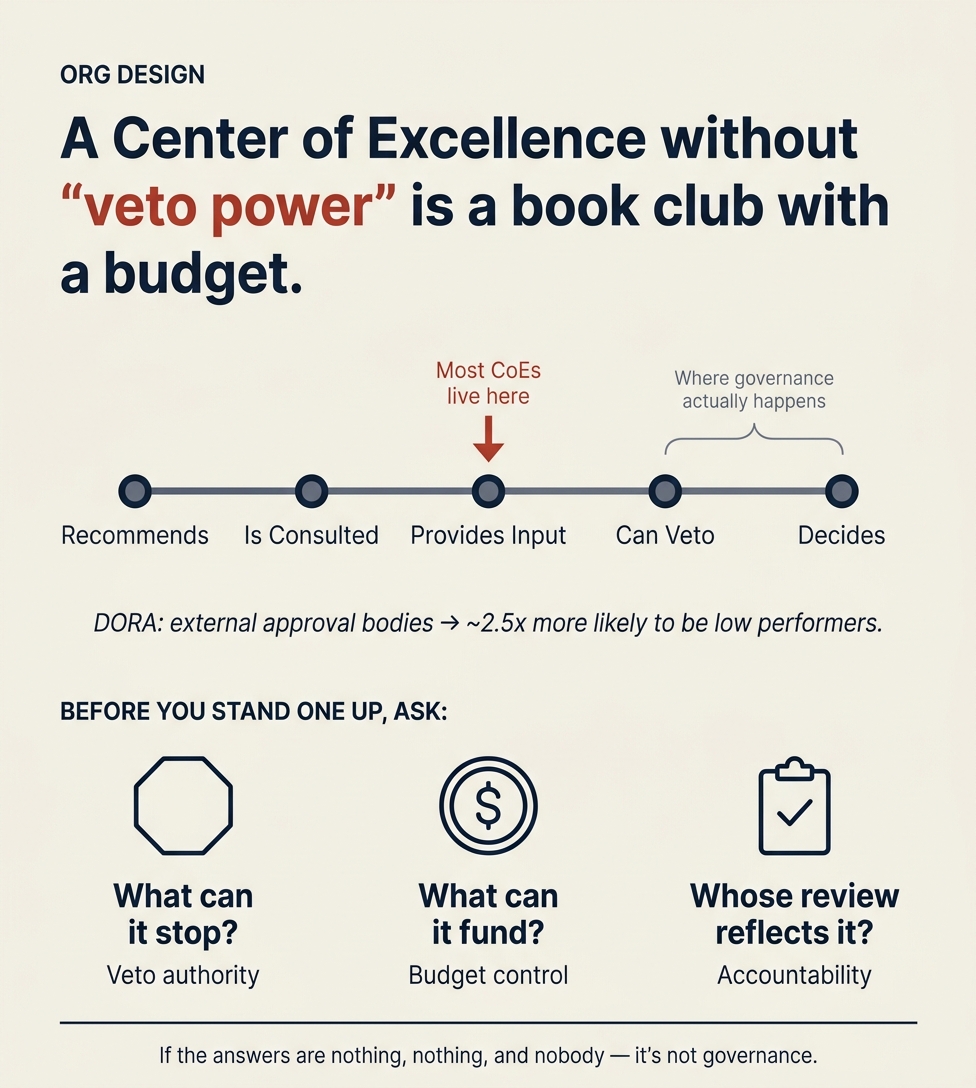
The mistake is treating "Center of Excellence" as a statement about competence when it is really about decision rights. Putting senior people in a room tells you who is talking, not what they are allowed to decide. Bain's RAPID framework forces honesty. There is a difference between someone who can recommend, who must be consulted, who can veto, and who actually decides. Most CoEs are stuck in "provides input". Input that can be skipped Thursday afternoon when the release is Friday morning.
DORA has published data on this for years. Organizations that route changes through external approval bodies (CABs, ARBs, senior sign-offs) are roughly 2.5x more likely to be low performers on delivery, and change failure rate does not improve to compensate. Slower without safer. The governance is doing emotional work, not operational work.
What actually moves the needle is three things. Experts get embedded inside delivery teams where they carry a pager and feel the consequences of their own advice. Standards get encoded as something a pipeline can enforce, so guidance travels with the code instead of living in a wiki. And someone with real budget authority owns the outcome. Charity Majors puts it sharply: authority without responsibility for the consequences does not work.
The hardest conversation is with the senior people staffed into the CoE. They are smart. They know their stuff. They are also often quietly wasted, parked in a high-prestige role engineered to produce no friction. Bad deal for them and the company. The best of them leave for somewhere their judgment changes what gets built.
So when someone proposes a new CoE, ask: what can this group stop? What can it fund? Whose performance review reflects whether its guidance was followed? If the answers are nothing, nothing, and nobody, what you are proposing is a book club with a budget. Book clubs are lovely. They are not governance.
Centers of excellence as decorative governance
Bottom line: The evidence converges sharply on one finding: Centers of Excellence (CoEs) that lack enumerated decision rights, budget control, or hard gates in the delivery process predictably devolve into advisory bodies whose guidance is ignored under deadline pressure. The pattern is documented across consulting research (McKinsey, BCG, Bain, Deloitte, Gartner, Forrester), engineering leadership literature (Skelton & Pais, Larson, Majors, Hohpe, Fournier, Reilly), and quantitative org studies (DORA/Accelerate, RAND, MIT NANDA, Wavestone). The strongest single empirical anchor: DORA found formal external approval bodies (CABs, ARBs, senior-manager sign-off) make organizations 2.6× more likely to be low performers with no correlation to change failure rates — i.e., advisory-gate governance slows delivery without making it safer. The strongest single rhetorical anchor: Bain's RAPID framework formally separates "Recommend" from "Decide" and explicitly notes that Input-role participants have "the right to provide input to a recommendation but not to veto it." A typical CoE is locked permanently into Input. The rest of this report develops the evidence, frameworks, named cases, and direct quotes a sharp argument can lean on. [1][2]
1. Failure rate and adoption data
The quantitative picture in 2024–2026 is bleak in any domain where CoEs are commonly created.
AI and GenAI. RAND Corporation's 2024 study The Root Causes of Failure for AI Projects (Ryseff, De Bruhl, Newberry; based on 65 interviews with experienced data scientists/engineers): "By some estimates, more than 80 percent of AI projects fail. This is twice the already-high rate of failure in corporate information technology (IT) projects that do not involve AI." MIT's NANDA report The GenAI Divide: State of AI in Business 2025 (Aug 2025) found 95% of enterprise GenAI pilots delivered zero measurable P&L impact; methodology has been critiqued (52 interviews, narrow six-month P&L window) but the directional finding is consistent with S&P Global Market Intelligence's 2025 finding that 42% of companies abandoned most of their AI initiatives in 2025, up from 17% in 2024. Gartner forecasted that 30% of GenAI projects would be abandoned after PoC by end of 2025, with only 48% making it past pilot. The NANDA report also flagged that internally built tools succeed about 33% of the time vs. ~67% for vendor-built tools — a direct empirical strike against the "we'll build our own CoE platform" pattern. [3]
RPA. The widely cited industry consensus figure (originally attributable to EY-era research, then re-cited by Gartner) is that 30–50% of initial RPA implementations fail to deliver expected value. Gartner data shows RPA market growth decelerating sharply (63% in 2020 → 22% in 2022 → 21% in 2023), and roughly 74% of business leaders report having an automation CoE active, yet failure-to-scale dominates. [4]
Data and analytics. Wavestone's 2024 Data and AI Leadership Executive Survey (Fortune 1000 CDOs): 78% of respondents say human factors — culture, people, process, organization — not technology, remain the barrier to becoming data-driven. Only 37% report data quality has improved; 63% still cite poor data quality as a barrier. MIT Sloan / IBM research found top-performing organizations use analytics 5× more than lower performers; "transformed" organizations are 63% more likely than "aspirational" ones to use a centralized enterprise analytics unit — but the top two barriers to analytics value were "lack of understanding of how to use analytics to improve the business" and "lack of management bandwidth," not data. The proxy for analytics-CoE leadership instability is average Chief Data Officer tenure: about 2.5 years (Davenport & Bean, HBR 2021 and 2023), vs. ~7 years for CEOs and ~4.5 years for CFOs/CIOs. The June 2023 HBR title is itself the headline: "Why Chief Data and AI Officers Are Set Up to Fail." [5]
Cloud CoEs. Industry observation (CloudQuery, AWS Executive Strategy) suggests that CCoEs that don't actively federate themselves out of the critical path commonly dissolve within ~18 months. WWT's 2024 framing: "Most enterprises either lack a CCoE entirely or have one that exists in name only while being under-resourced, advisory-focused and disconnected from operational outcomes." [6][7]
Engineering governance directly. DORA's Accelerate State of DevOps Report (originally 2019, replicated through subsequent years) found that organizations with formal external approval processes — CABs, ARBs, senior-manager sign-off — were 2.6× more likely to be low performers across the four DORA metrics (deployment frequency, lead time, change failure rate, MTTR). The report concluded: "External approvals were negatively correlated with lead time, deployment frequency, and restore time, and had no correlation with change fail rate." Gartner (cited via Protiviti, 2026): 93% of CIOs admit their organizations are not equipped to make fast and well-informed technology decisions. [8]
The single most useful soundbite from consulting research is BCG's 10-20-70 rule (from BCG's AI@Scale capability publications): roughly 10% of AI value comes from algorithms, 20% from technology and data infrastructure, 70% from people and process — workflow change, governance, adoption. A CoE that owns the 10% and isn't structurally connected to the 70% is mathematically guaranteed to underperform. [9]
2. The credibility trap: senior expertise without adoption
The pattern is documented in both classical and contemporary engineering literature. Scott Ambler's enterprise-modeling anti-pattern catalog (agilemodeling.com) formally lists "Ivory Tower Architecture": architects make "pronouncements (which most of the time no one listens to)." Adjacent entries include "Brain Trust Parking Lot" and "Real-World Disconnect." Gregor Hohpe (former Allianz Chief Architect, The Software Architect Elevator, O'Reilly 2020) wrote: "As there is little feedback back into the ivory tower, this undesirable state often remains undetected by the ivory tower residents who revel in the purported beauty of their designs while the developers start building workarounds or ignore the guidelines altogether." His sharper formulation: "It's authority without responsibility — authority to make decisions without the responsibility for their consequences. This doesn't work." [10]
The empirical compliance-gap evidence supports the rhetoric. VDC Research (~539 embedded/IoT engineers) found projects in full compliance with coding standards are 8× more likely to be ahead of schedule — and that most teams don't reach full compliance. The SoftWipe study (Zapletal et al., Scientific Reports, 2021) benchmarked 48 scientific tools and found non-optimal comment density in 75% of cases, insufficient modularity in 88%, and absence of test suites in 72%. The pattern is consistent across studies: organizations publish standards; teams do not adopt them. [11]
Phil Le-Brun's widely cited AWS Executive Strategy post (Sept 2020) opens with Drucker's "In most organizations, the bottleneck is at the top of the bottle" and names four CoE anti-patterns: (1) CoE on the Critical Path — "the COE becomes a permanent fixture… In response, they demand internal customers wait for the COE. The last thing an agile organisation wants to do is wait for anything"; (2) Wrong Scope — drift into gatekeeper-auditor; (3) Wrong Decision-Makers — "The COE slips from being an enabling function to attempting to become the decision-maker, disempowering and antagonising the very people it is meant to be helping. Delusions of speed through ownership quickly unravel"; (4) Wrong Team Composition — staffed on technical credentials alone, missing influence/teaching skills. [12]
Orbus Software's characterization of enterprise architecture governance failure is precise: review processes become "essentially a formality. No meaningful discussions or challenges take place… requisite meetings are postponed indefinitely or canceled altogether… enterprise architecture team is not empowered or lacks the requisite authority to implement standards." A canonical practitioner story from Bo Vincent Thomsen (LinkedIn): "I once had a Software Architecture Design document in review three times without approval, but without any consequences to the program. The document just grew larger and larger and failed the last time because it had become too long and verbose. ARBs don't really work well with traditional project management as architects are routinely overruled by Project Managers." [13][14]
The TDWI practitioner guide Ten Mistakes to Avoid When Creating a Center of Excellence (Loftis, Imhoff, Geiger) lists "Failing to Establish Authority and Governance" as mistake #1: "Failing to provide strong governance and establish clear authority procedures prior to building the center of excellence can render the group rudderless and ineffective." [15]
3. Decision rights frameworks: the recommend/decide distinction
The rigorous organizational-design literature is unusually clear here.
Bain's RAPID® (Paul Rogers and Marcia W. Blenko; first popularized in "Who Has the D? How Clear Decision Roles Enhance Organizational Performance," HBR, January 2006; expanded in Decide & Deliver, Blenko/Mankins/Rogers, HBR Press 2010) separates five roles: Recommend, Agree, Perform, Input, Decide. "Input" participants have, in Bain's own words, "the right to provide input to a recommendation but not to veto it." *Veto power is reserved for the "Agree" role and "only a few should have such veto power: legal counsel, for certain decisions, or the head of an affected unit." The "Decide" role is "the single point of accountability who commits the organization to action." The framework was designed precisely for the four organizational interfaces where decision rights become ambiguous, including center vs. business unit — i.e., CoE vs. delivery. A CoE that has never had its authority enumerated in RAPID terms is, by default, in Input or at best Recommend. [16]
RACI/RASCI is the most-used framework but has a known structural flaw: it has no explicit "Decide" role; "Accountable" conflates ownership with deciding authority. The "Consulted" bucket is precisely the trap where CoEs land — input rights, no veto, easily skipped under deadline pressure. Triaster summarized: "consulted and informed are very often ignored." [17]
Atlassian's DACI (Driver/Approver/Contributors/Informed; originating at Intuit) makes the sharpest practitioner formulation in its own playbook: Contributors "have a voice, but not a vote." That is the precise structural condition of an advisory CoE. [18]
Henry Mintzberg's The Structuring of Organizations (1979) defines line vs. staff by position in formal authority flow, not by advisory-vs-operational role. His technostructure (analysts who standardize processes) achieves influence only when management has empowered standardization as work procedure — not when it's published as recommendation. Jay Galbraith's Star Model insists that strategy, structure, processes, rewards, and people must be aligned: a CoE with structure but no rewards aligned to compliance is, in Galbraith's terms, a guaranteed antipattern. His direct quote: "Most design efforts invest far too much time drawing the organization chart and far too little on processes and rewards." [19]
4. Governance theory: why mechanisms without teeth fail
Three theoretical lenses give the argument its hardest spine.
Goodhart's Law (Charles Goodhart, UK monetary policy, 1975: "Any observed statistical regularity will tend to collapse once pressure is placed upon it for control purposes") was popularized by anthropologist Marilyn Strathern ("'Improving ratings': audit in the British University system," European Review 5, 1997) as: "When a measure becomes a target, it ceases to be a good measure." The companion principle is Steven Kerr's "On the Folly of Rewarding A, While Hoping for B" (Academy of Management Journal 18:4, 1975): "Most organisms seek information concerning what activities are rewarded, and then seek to do (or at least pretend to do) those things, often to the virtual exclusion of activities not rewarded." The CoE corollary: a body measured on "standards published," "trainings delivered," or "consultations held" will produce artifacts; it will not produce adoption. Jerry Muller's The Tyranny of Metrics (Princeton, 2018) generalizes the failure mode: measurement substituting for judgment, especially when measurers lack authority over the measured. [20]
Conway's Law (Melvin E. Conway, "How Do Committees Invent?" Datamation 14(4), April 1968 — which HBR famously rejected) is normally cited via the slogan "organizations design systems that mirror their communication structures." The under-quoted passage matters more for CoE design: "Given any team organization, there is a class of design alternatives which cannot be effectively pursued by such an organization because the necessary communication paths do not exist." If your CoE sits outside the delivery org chart, the design alternatives it advocates literally cannot be pursued by the teams that ship. The Inverse Conway Maneuver (Skelton & Pais, Team Topologies, 2019, drawing on DORA) inverts this: evolve team structure to achieve the desired architecture. The CoE implication is unambiguous — if you want delivery teams to embody a standard, embed people with decision rights inside them, do not put them in a separate advisory body. [21]
Bruce Schneier coined "security theater" in Beyond Fear (Copernicus Books, 2003, p. 38): "Some countermeasures provide the feeling of security instead of the reality. These are nothing more than security theater. They're palliative at best." The same construct now appears as "compliance theater" (Craig Davies, Security Magazine: "superficial processes that create an illusion of governance, risk management and compliance without actually safeguarding the organization") and "governance theater" (Internal Audit 360: "the appearance of control takes priority over its consistent execution"). The acid test from Rock Lambros (Zenity): "The first question I ask about any AI policy is simple: can you show me where it lives in your control framework and who was disciplined for violating it last quarter? Silence is the answer most of the time. That's compliance theater." [22]
The standards-body comparison strengthens this hard. Bodies with market gating or revocation power produce compliance: FDA (market entry approval), FAA (type certification, airworthiness directives, the power to ground aircraft), UL (listing — manufacturers cannot sell at major retailers without it), ISO 9001 and SOC 2 (third-party certification audits with pass/fail outcomes), PCI DSS (bank-enforced; non-compliance = inability to process card payments). Bodies that only publish — W3C, IETF — achieve adoption only when the standard solves a problem teams already want solved (cf. XHTML 2.0's irrelevance). Internal CoEs that publish without budget, gates, or revocation authority are in the publishing-only camp. Compliance scales with the cost of non-compliance to the team being governed.
5. Named cases: successes, failures, and self-federations
Failures.
GE Predix / GE Digital is the canonical analytics-CoE-as-empire failure. Launched 2013; GE Digital business unit formed 2015; ~1,500 employees in San Ramon by 2016; estimated $5B–$7B spent before the platform was sold off and GE split in 2021 (post-mortems in WSJ, Inc., Applico, platformengineering.org). Jeff Immelt's directive: "We're going to sunset all our other analytics-based software initiatives and put everybody on Predix." Per Applico: "Resources were spread too thin, project objectives were ill-matched to expertise, and timelines were rushed… GE set up a huge organization that wasn't quite needed yet." Standardization mandate without honest user-validation pathway. [23]
Shadow AI as bypass indicator. MIT NANDA 2025: only about 40% of companies have official LLM subscriptions, but ~90% of workers use personal AI tools for work. A manufacturing COO in the report: "The hype on LinkedIn says everything has changed, but in our operations, nothing fundamental has shifted." Joanna Schloss (Dell): "Shadow IT takes place so overtly that vendors now unabashedly market directly to these supposedly clandestine teams, often touting the ability to bypass corporate IT as their key selling point." [24]
Successes — note the pattern: real authority, embedded staff, or planned self-dissolution.
Procter & Gamble's analytics CoE. Run under CIO Filippo Passerini's Global Business Services under CEO Bob McDonald's "digitize end-to-end" mandate (2008–2015). Quadrupled analytics headcount during cost cuts elsewhere; 50+ Business Spheres deployed; 50,000+ employees on Decision Cockpit; supply chain Business Sufficiency model reduced inventory 25% and saved "tens of millions of dollars" (Henschen, InformationWeek). MIT Sloan's 2025 update on P&G AI: Jeff Goldman now leads "several hundred data scientists, most embedded in business units" — i.e., evolved from central CoE to hub-and-spoke. The CoE worked because it had CEO mandate, dedicated budget, and embedded analysts at decision points. [25]
JPMorgan Chase. AI is treated, per CIO Lori Beer, as "core infrastructure, comparable to payment systems or cybersecurity." Tech spend FY26 ~$19.8B; 2,000+ AI/analytics specialists; Manuela Veloso heads a 200+ researcher AI Research Lab. Governance has direct C-suite authority and budget control, not advisory standing.
Capital One. Explicitly retired its centralized data governance CoE upon cloud migration. CIO Sanjeev Gurram (CIO.com, Oct 2024): "In our legacy world, we had a finite set of infrastructure, a finite set of data, and a finite set of users. And we used to manage our data governance centrally… But there has been this whole explosion of data." Replaced with federated computational governance (data mesh) — central policy and tooling; line-of-business ownership of data products; five global standards (ownership, metadata, quality, lineage, protection). [26][27]
Dow Jones CCoE. Milin Patel, then Head of DevOps, on the AWS Executive Strategy blog: "We were a little late to find out that the COE had become a bottleneck for the rest of the organization to adopt cloud and DevOps practices. Eventually, we built federated teams and DevOps capabilities within each application team to scale out the COE's function." The success was planned self-dissolution. [28]
Netflix as the deliberate anti-CoE. No enforced development methodology; teams own code from inception to deployment to operations; concept of a "paved road" of well-supported tools/languages but no obligation to use it; one engineering level for first 25 years (levels introduced 2023); no traditional performance reviews. CTO Elizabeth Stone (2024): "context, not control"; "informed captains" for major decisions. Netflix Operations Engineering (Agile Alliance): "It's more important to us that engineers are empowered to make decisions than that they consistently make the right decision." The counter-archetype to the CoE entirely. [29]
McKinsey's most striking 2025 finding in The state of AI: How organizations are rewiring to capture value: CEO oversight of AI governance is the single attribute most correlated with higher self-reported bottom-line GenAI impact (Johnson's Relative Weights regression, R² = 0.20). About 28% of organizations assign AI governance to the CEO; this is the highest-correlated structural variable for EBIT impact. Authority structure beats methodology. [30][31]
6. Resource and decision control as design choices
The consulting literature converges on three CoE operating models: centralized (single hub owns everything), hub-and-spoke / center-led (hub sets strategy, standards, platforms, and runs scarce expertise; spokes execute within guardrails), and federated (domain owns its own CoE; central coordination is nominal). Hub-and-spoke with enumerated decision rights is the documented sweet spot at most mid-to-large org maturities (Deloitte, Tredence, Umbrex, Monte Carlo Data, McKinsey). [32]
The four authority levers consistently named in the literature:
- Budget authority over tools, training, and hires in the domain.
- Hiring authority for specific roles — architects, data scientists, principals.
- Architecture-review veto / hard gates in delivery (release, security, production deployment).
- Embedded staff in delivery teams (federation, hub-and-spoke, rotational embeds).
DORA's finding cited above complicates lever #3: external approval gates correlate with low performance and have no effect on change failure rate. The resolution in the modern literature is standards-as-code — encoding the standards a CoE would otherwise enforce as policy in the pipeline (terraform validators, OPA/Rego policies, secure-by-default templates, automated SAST/SCA gates), so the standards travel with the code rather than relying on document compliance. Thoughtworks' April 2025 Technology Radar added "Architecture Advice Process" in Trial: "Centralized ARB impedes workflow and correlates with low performance." It advocates a decentralized model where "anyone can decide, but advice is sought from influencers and experts." Decisions are recorded as ADRs (Michael Nygard, 2011); the Architecture Advisory Forum exists for conversation, not approval. Andrew Harmel-Law (Thoughtworks): "I stopped making architectural decisions." [33]
The picture this paints for CoE design: hard external gates are corrosive; advisory-only is decorative; the working pattern is encoded standards plus embedded experts plus enumerated, narrow decision rights.
7. Alternative organizational models
Team Topologies (Matthew Skelton & Manuel Pais, IT Revolution Press, 2019) provides the clearest contrast. The four team types are stream-aligned, enabling, complicated-subsystem, and platform. The "enabling team" is the deliberate alternative to a CoE: "a temporary, capability-boosting team of experts (e.g., security, data, UX, reliability) that coaches stream-aligned teams to adopt new practices and technologies. It 'pairs and teaches,' then steps back, avoiding permanent dependency." The book explicitly warns enabling teams should not degrade into "purely educational functions — doing only training and explaining cold theory with no significant impact on other teams' well-being." The defining feature versus a CoE is temporal: enabling teams have an end state by design; CoEs do not. [34]
Platform engineering is the 2022–2026 successor narrative to architecture CoEs. Camille Fournier & Ian Nowland (Platform Engineering, O'Reilly Nov 2024) frame it precisely as the third way: "As software teams grow increasingly complex, they face a critical challenge: the traditional solution of centralized infrastructure teams creates bureaucratic bottlenecks, while fully decentralized teams generate a swamp of integration code and custom tooling — what we call 'glue'." Fournier's critique of operations-heavy teams maps cleanly to CoEs: "Faced with the flaws of a system they can't change, they reach for rules and processes, often cataloged in meticulous wikis. Of course, users constantly run afoul of these rules, to the eternal frustration of both sides." Gartner's first dedicated Hype Cycle for Platform Engineering appeared in 2024; its prediction: "By 2026, 80% of large software engineering organizations will establish platform engineering teams." Platform engineering wins not through governance but through paved-road product appeal. [35]
Communities of Practice / Guilds. Etienne Wenger's original CoP framing emphasized voluntary peer learning around a shared domain. The Spotify model (Kniberg & Ivarsson, 2012) — Squads, Tribes, Chapters, Guilds — became the most-imitated version, but the definitive practitioner critique is Jeremiah Lee's "Failed #SquadGoals" (April 2020): "Spotify doesn't use 'the Spotify model' and neither should you. The Spotify squad model failed Spotify and it will fail your company too." Joakim Sundén, agile coach at Spotify 2011–2017, quoted in Lee's piece: "Even at the time we wrote it, we weren't doing it. It was part ambition, part approximation. People have really struggled to copy something that didn't really exist." The implication for CoE design: voluntary peer networks work for knowledge sharing, not for governance. [36][36]
Embedded-expert / Principal models at hyperscalers. Amazon's Principal Engineering Community publishes explicit tenets that are essentially an anti-CoE manifesto. The first tenet, "Exemplary Practitioner": "Principal Engineers are hands-on and lead by example. We deliver artifacts that set the standard for engineering excellence, from designs to algorithms to implementations. Only by being close to the details can we earn the respect needed to be effective technical leaders." Google has no central architecture team; L5+ engineers ("TLs") lead component, system, and cross-PA architecture decisions in the codebase. Microsoft's Technical Fellow track is similarly small and selective; Eric Charran has framed architects as "part-time civil servants and part-time community organisers." [37]
SRE. Google's SRE model gains authority not through governance committees but through measurable contracts — SLOs and error budgets. SREs can be embedded into a development team temporarily: per the SRE Book, "the SRE focuses on improving the team's practices instead of simply helping the team empty the ticket queue." Structurally identical to a Team Topologies enabling team, and explicitly not advisory. [38]
8. Why senior people end up parked in toothless CoEs
The dynamic Charity Majors describes is the sharpest articulation in print. From her widely circulated 2023 essay "Architects, Anti-Patterns, and Organizational Fuckery" (charity.wtf):
"A lot of companies are using some of their best, most brilliant senior engineers as glorified project manager/politicians to paper over a huge amount of organizational dysfunction, while bribing them with money and prestige." [39]
"The architect role tends to be the locus of a whole mess of antipatterns and organizational fuckery." [39][39]
"Most of the pathologies associated with architects seem to flow from one of two originating causes: (1) unbundling decision-making authority from responsibility for results, and (2) design becoming too untethered from execution (the 'Frank Gehry' syndrome)." [39]
"I believe that only the people building software systems get to have opinions on how those systems get built… if I'm not carrying a pager for you, you should probably just smile politely and move along." [40][39]
Her "pigeon architects who swoop and poop" metaphor and her QA analogy — "once-upon-a-time QA departments tested all code; eventually we realized that we wrote better software when engineers were held responsible for writing their own tests" — translate directly to the CoE failure pattern. [39][39]
Will Larson's Staff Engineer archetypes (lethain.com, staffeng.com) identify Architect as the role most at risk of irrelevance: "There is a toxic preconception that Architects design systems in isolation and then pass their designs to others to implement." The synthesis is sometimes paraphrased as "Architect's decisions degrade the further they get from doing real work on real code in real process." [41]
Tanya Reilly's The Staff Engineer's Path (O'Reilly, 2022) is structured entirely around the premise that staff engineers must "lead without direct authority" — influence earned through credibility loops, not granted by title. Her warning: "Vision or strategy that not everyone knows is of little value." [42][43]
Alex Ewerlöf (blog.alexewerlof.com): "Tech translator and tech governor are career dead-ends (unless you're planning to spend all your career in broken organizations). Pairing a technical Staff with a non-technical engineering manager is an anti-pattern." And on the parking dynamic specifically: "Ivory tower architects put up a show and engage in high visibility low value work (also known as preening). They're often insecure in their technical abilities and towards the end of their tech skill shelf life so they resort to politics to stay in power, instead of upskilling to stay relevant." [40]
A useful term emerging in 2026 governance literature is the "responsibility vacuum": a state in which decisions occur, yet responsibility cannot be meaningfully attributed because authority and verification capacity do not coincide. The decision is formally approved but not substantively owned. Originally about AI deployment in healthcare; generalizes cleanly to advisory CoEs. [44]
The motivational dimension lands via Dan Pink's Drive (2009): intrinsic motivation depends on autonomy, mastery, purpose. CoEs that strip senior staff of decision authority remove autonomy (no control over outcomes) and frequently purpose (no clear link from guidance to shipped product), leaving only nominal mastery. The HBR/Bain literature describes the mirror dynamic as a "control paradigm" — slow decisions, frustration, disengagement. [45]
9. The "book club with a budget" critique
The exact phrase "book club with a budget" does not appear traceable to a named published author in the indexed sources reviewed. It is consistent with the published critique and reads as accurate vernacular — the user should consider it their own coinage rather than a citation. Adjacent published formulations with similar bite:
- Gregor Hohpe: "ivory tower residents who revel in the purported beauty of their designs while the developers start building workarounds or ignore the guidelines altogether." [46]
- Charity Majors: "glorified project manager/politicians to paper over a huge amount of organizational dysfunction." [39]
- Mohammed Brückner (Medium, "The Architecture Review Board Paradox"): ARBs labeled "high-paid leeches" and "bureaucratic nightmares." [47]
- Trilogy AI CoE Substack: ARBs end up as "a logjam, a political arena, or a box-checking ritual that delivers neither speed nor quality." [48]
- Salesforce CoE practice piece: "the curse of the Center of Excellence." [49]
- Management 3.0: "Probably nobody has ever been inspired by the term center of excellence." [50]
- Allison Pollard: organizations create CoEs because "self-organizing communities are unpredictable and rely on some experimentation. And that's precisely where the goodness lives." [51][51]
The closest formal anti-pattern is "PowerPoint engineering" (Scott Lowther, aerospace-adjacent critique), and "shelfware standards" is widespread practitioner vernacular without a clean published attribution.
10. Synthesis: the structural argument the evidence supports
Pull the threads together and a single, sharp argument emerges that is well-supported across consulting, academic, and practitioner literature.
A CoE is, at its core, a decision-rights design choice masquerading as a competence claim. "Center of Excellence" describes who is in the room; it says nothing about what they can decide. The evidence — RAND, MIT NANDA, DORA, Wavestone, McKinsey, Forrester, Gartner — is that the variable predicting outcomes is not the seniority of the experts but the structural alignment of authority, budget, embeddedness, and rewards with delivery accountability. CEO oversight (McKinsey), embedded principals (Amazon), error budgets (Google SRE), self-dissolving cloud CoEs (Dow Jones), federated data governance (Capital One), and standards-as-code (Thoughtworks) are the documented patterns that work. Advisory bodies, central ARBs, and CoEs measured on artifacts produced are the documented patterns that fail.
Two findings are especially valuable for a pointed argument:
- DORA's 2.6× low-performer penalty for external approval bodies with no compensating reduction in change failure rate. This is the rare quantitative finding that directly impugns the safety claim made on behalf of advisory governance.
- BCG's 10-20-70. If 70% of value comes from people and process, a CoE that owns 10% of the value (algorithms / standards documents) and is structurally disconnected from the 70% cannot succeed regardless of how senior its staff is. [9]
The Goodhart/Strathern/Kerr triad explains why the pattern persists despite the evidence: CoE metrics — standards published, trainings delivered, consultations held — are easy to produce, decoupled from delivery outcomes, and reward production of artifacts. Once those metrics become targets, the body optimizes for them. Conway's Law explains why a body separated from delivery cannot produce delivery outcomes; the necessary communication paths do not exist. Schneier's security-theater construct, ported as "compliance theater" or "governance theater," names the phenomenon: countermeasures that produce the feeling of governance without the reality of compliance. The Bain RAPID frame names the structural fix: enumerate decision rights, separate Input from Decide, and reserve veto power narrowly.
The terminal observation in the literature, from a practitioner cited in The Analytic Insurer: "Centers of excellence — are those even real?" That question — and the silence that often follows — is the user's argument. [52]
Caveats on source quality
The MIT NANDA "95% GenAI failure" figure is widely quoted but methodology-disputed (52 executive interviews; narrow six-month P&L definition); use directionally. The "30–50% RPA failure" figure is industry consensus rather than a peer-reviewed number. BCG's 10-20-70 is from proprietary engagement data, not publicly auditable. RAND's 80% AI failure figure is the best-sourced quantitative anchor. DORA's 2.6× finding has been replicated across multiple annual reports. The HBR Davenport/Bean CDO-tenure 2.5-year figure is consistent across multiple HBR pieces and Wavestone surveys. The Inverse Conway Maneuver phrase has no clean coinage attribution; safest is to attribute the concept to Skelton & Pais's elaboration in Team Topologies. "Compliance theater" and "governance theater" are well-established in practitioner/trade press but less so in peer-reviewed literature; the academic anchor remains Schneier 2003 plus the Abdul Samad et al. International Journal of Financial Research paper. The Intuit-origin story for DACI is widely repeated but not authoritatively documented (one source attributes it to Intel); treat as folkloric. "Book club with a budget" is not traceable to a named published author and should be treated as the user's own coinage. [53]
- Project Management — https://project-management.com/understanding-responsibility-assignment-matrix-raci-matrix/
- Bain & Company — https://www.bain.com/insights/decision-insights-3-make-decisions-work/
- Salesforcedevops + 5 — https://salesforcedevops.net/index.php/2024/08/19/ai-apocalypse/
- VSoft Consulting + 2 — https://blog.vsoftconsulting.com/blog/why-40-of-rpa-implementations-fail-6-ways-to-succeed
- LinkedIn + 5 — https://www.linkedin.com/pulse/data-ai-executive-leadership-survey-2024-juan-pablo-palma-msc-9ft5f
- CloudQuery — https://www.cloudquery.io/blog/cloud-centers-of-excellence-part-4-implementation-best-practices-pitfalls
- World Wide Technology — https://www.wwt.com/article/ccoe-the-missing-engine-behind-scalable-governance-and-enterprise-cloud-success
- Team Topologies + 4 — https://teamtopologies.com/news-blogs-newsletters/when-dora-metrics-meet-governance-in-banking
- BCG — https://www.bcg.com/capabilities/artificial-intelligence
- Softwarearchitecturezen + 3 — https://softwarearchitecturezen.blog/tag/anti-pattern/
- LinkedIn + 2 — https://www.linkedin.com/pulse/five-reasons-why-enforcing-coding-standards-accelerates-chris-fenn
- amazon + 2 — https://aws.amazon.com/blogs/enterprise-strategy/centres-of-excellence-untangling-desires-from-reality/
- Orbus Software — https://www.orbussoftware.com/resources/blog/detail/avoid-ivory-tower-enterprise-architecture-apply-governance
- LinkedIn — https://www.linkedin.com/pulse/more-architecture-review-boards-please-bo-vincent-thomsen
- TDWI — https://tdwi.org/articles/2006/12/27/ten-mistakes-to-avoid-when-creating-a-center-of-excellence.aspx
- Umbrex + 4 — https://umbrex.com/resources/frameworks/organization-frameworks/bain-rapid-decision-framework/
- Triaster — https://blog.triaster.co.uk/blog/responsible-accountable-consulted-informed-raci-matrix
- Atlassian — https://www.atlassian.com/team-playbook/plays/daci
- Umbrex + 2 — https://umbrex.com/resources/frameworks/organization-frameworks/mintzberg-organizational-configurations/
- ModelThinkers + 3 — https://modelthinkers.com/mental-model/goodharts-law
- ACM Queue + 6 — https://queue.acm.org/detail.cfm?id=3395214
- Barry Popik + 3 — https://barrypopik.com/blog/security_theater
- Applico + 3 — https://www.applicoinc.com/blog/ge-digital-failed/
- Legal.io + 2 — https://www.legal.io/articles/5719519/MIT-Report-Finds-95-of-AI-Pilots-Fail-to-Deliver-ROI-Exposing-GenAI-Divide
- Wordpress + 5 — https://practicalanalytics.wordpress.com/2012/02/28/proctor-gamble-quadrupling-analytics-expertise/
- CIO — https://www.cio.com/article/481439/how-capital-one-delivers-data-governance-at-scale.html
- Capital One — https://www.capitalone.com/software/blog/data-governance-strategy/
- AWS — https://aws.amazon.com/blogs/enterprise-strategy/using-a-cloud-center-of-excellence-ccoe-to-transform-the-entire-enterprise/
- Agile Alliance + 8 — https://agilealliance.org/resources/sessions/netflix-organizational-structure-freedom-responsibility-impact-and-agility/
- McKinsey & Company — https://www.mckinsey.com/capabilities/quantumblack/our-insights/the-state-of-ai-how-organizations-are-rewiring-to-capture-value
- Ideas2IT — https://www.ideas2it.com/blogs/establish-ai-center-excellence
- LinkedIn + 2 — https://www.linkedin.com/pulse/understanding-center-excellence-coe-operating-models-mannoj-batra-4jfqc
- Scrums + 3 — https://www.scrums.com/blog/deployment-frequency-benchmarks
- Pink Elephants + 3 — https://pinkelephants.de/en/methodenwissen/team-topologies/
- Refactoring + 3 — https://refactoring.fm/p/creating-a-platform-engineering-team
- Jeremiahlee — https://www.jeremiahlee.com/posts/failed-squad-goals/
- Medium + 2 — https://mukteshkrmishra.medium.com/amazon-principal-engineering-tenets-947a00cc7233
- Google — https://sre.google/sre-book/operational-overload/
- charity — https://charity.wtf/2023/03/09/architects-anti-patterns-and-organizational-fuckery/
- Alexewerlof — https://blog.alexewerlof.com/p/ivory-tower-architect
- Staff Engineer — https://staffeng.com/guides/staff-archetypes/
- Amazon — https://www.amazon.com/Staff-Engineers-Path-Individual-Contributors/dp/1098118731
- Danlebrero — https://danlebrero.com/2024/01/24/the-staff-engineers-path-summary/
- arxiv — https://arxiv.org/pdf/2601.15059
- Stand Together — https://standtogether.org/stories/insights/pbm-101-4-most-common-misconceptions-about-decision-rights
- LinkedIn — https://www.linkedin.com/pulse/keeping-architecture-out-ivory-tower-gregor-hohpe
- Medium — https://medium.com/micromusings/the-architecture-review-board-paradox-d007b94f6d6b
- Substack — https://trilogyai.substack.com/p/how-to-why-most-architecture-review
- Salesforce — https://www.salesforce.com/blog/center-of-excellence-curse/
- Management 3.0 — https://management30.com/practice/business-guilds/
- Allison Pollard — https://www.allisonpollard.com/blog/2014/7/30/the-differences-between-a-community-of-practice-and-a-center-of-excellence
- analyticinsurer — https://analyticinsurer.wordpress.com/2011/02/28/center-of-excellence-three-little-words-too-much-meaning/
- Marketing AI Institute + 2 — https://www.marketingaiinstitute.com/blog/mit-study-ai-pilots
Commissioned from our research desk. Subject to final editorial discretion.