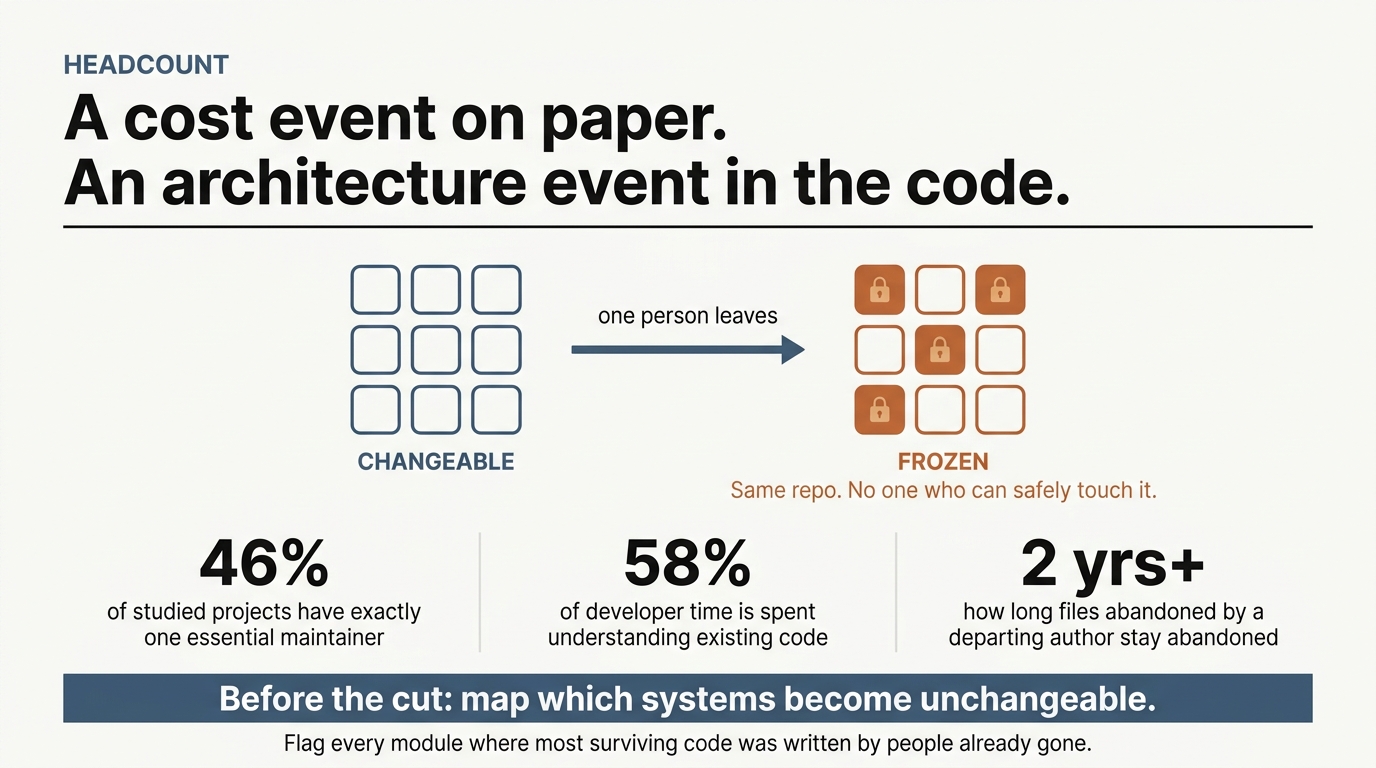
A headcount number usually arrives before anyone asks which systems it touches. It gets discussed as money, defended as money, approved as money, and somewhere in there, decisions get made about your architecture that nobody in the room recognises as architectural.
Code does not forget, but organisations do. When someone leaves, the repository stays exactly where it was, every file intact, and what you lost was the ability to change it safely. Nassif and Robillard found that files abandoned by departing authors tend to stay abandoned, many for two years or more. The system quietly moves from things you can modify into things you work around.
The concentration is worse than most people assume. Avelino and colleagues studied 133 popular open source projects and found 65% had a truck factor of two or less, 46% exactly one. Treat those numbers as direction rather than law, but I have never audited an enterprise portfolio and found it healthier. There is always a payments adapter, a batch job, and one person whose name is on nearly every meaningful commit.
The counterargument is real. Concentrated ownership is often good while the expert is still there. Microsoft's ownership work found strong single owners correlate with fewer defects, and heroes studies across a thousand plus projects found hero commits carry fewer bugs. The risk is not the concentration itself. A cut converts latent risk into realised risk, on a date chosen by finance.
The cost lands on whoever inherits the code, who has to reconstruct what the departed person simply knew. Xia and colleagues tracked 78 professionals over 3,148 hours: 58% of developer time goes to understanding existing code. DORA's 2024 data adds the uncomfortable part: damage from organisational instability is highly resistant to mitigation, persisting even where documentation is good and leadership is strong. You cannot write your way out of it after the fact.
Meanwhile the savings are less certain than the damage. Cascio tracked S&P 500 firms for eighteen years: downsizers as a group never outperform non-downsizers long term.
So the practical ask: before an efficiency mandate lands, map which systems become unchangeable if specific named people leave. Flag every module where more than half the surviving code was written by people who have already gone. Cross reference it against the on call roster and the honest answer to "who do we call at three in the morning." Google's SRE guidance sets a floor of eight to nine engineers for a single site rotation, the ninth explicitly as insurance against staff reduction. Bring that hard stop into the room.
Then you can still make the cut, knowing which parts of your architecture you are choosing to freeze, rather than discovering it two quarters later when change failure rates rise and nobody can say why.
Research brief: headcount reduction as an architecture event, not just a cost event
TL;DR
- The thesis largely holds, but with one important qualification: the peer-reviewed evidence supports the idea that cutting headcount concentrates and then loses system knowledge, that abandoned code tends to stay abandoned (a notable share for two years or more, per Nassif and Robillard, ICSME 2017), and that org instability durably hurts delivery (DORA 2024, more than 39,000 respondents). The qualification is that concentrated ownership is not itself a defect problem while the expert is present; the risk crystallises on departure, so frame it as latent risk that a cut converts into realised risk.
- The single strongest, cleanest anchor facts: in one study of 133 popular GitHub projects, 65% had a "truck factor" of 2 or less and 46% of 1 (Avelino et al., ICPC 2016); professional developers spend about 58% of their time just understanding existing code (Xia et al., IEEE TSE 2018); and Google's own SRE rule sets a single-site on-call minimum of eight engineers, with the SRE Workbook adding a ninth explicitly as insurance against staff reduction.
- The practical takeaway the user wants is well supported: before an efficiency mandate lands, map which systems would lose their last knowledgeable owner and become effectively frozen, because that map is the real balance-sheet impact. Tooling exists to do this (CodeScene off-boarding simulation, truck-factor tools, CODEOWNERS audits). Several widely repeated statistics (survivor-syndrome percentages, "X% of services have no owner," a "12 minutes per incident" MTTR figure) are too weakly sourced to state as fact in public and are flagged below.
Key findings
The mechanism is real and measured. Three independent bodies of research line up behind the core claim. Ownership research (Bird et al., FSE 2011) shows defects track with how many low-expertise hands touch a component. Truck-factor research (Avelino et al., 2016 and 2019) shows knowledge is already extremely concentrated in most projects. Turnover research (Rigby/Mockus, ICSE 2016; Nassif/Robillard, ICSME 2017; Mockus, FSE 2010) shows that when people leave, their files get "abandoned," productivity on that code falls, defects rise, and the abandonment persists.
The comprehension tax is the money quantity. Developers spend roughly 58% of their working time understanding existing code (Xia et al., 78 professionals, 3,148 hours, IEEE TSE 2018). When the person who understood a system leaves, that cost lands on everyone else. This is the concrete reason a "frozen" system is expensive even when nobody is actively changing it.
There is genuine counter-evidence you must pre-empt. The "heroes" research (Agrawal et al., ICSE SEIP 2018; Majumder et al., 2019, 1,100+ projects) found that concentrated contribution is normal (about 85% of projects have "heroes") and that hero commits carry fewer bugs, not more. This does not refute the thesis; it refines it. Concentration is fine while the expert is active and becomes dangerous only on departure. Say this explicitly so a commenter cannot use it against the post.
The economics back the framing. Wayne Cascio's roughly 18-year S&P 500 work found downsizers as a group never outperform non-downsizers over the long run. So "we cut to save money" and "we quietly froze part of our architecture" are not offsetting; the savings are often illusory while the architectural damage is real.
Details
1. Code ownership and quality (supports thesis via the low-expertise mechanism)
The anchor is Bird, Nagappan, Murphy, Gall, and Devanbu, "Don't Touch My Code! Examining the Effects of Ownership on Software Quality" (ESEC/FSE 2011), studying Windows Vista and Windows 7. Finding: ownership measures, specifically the number of low-expertise ("minor") contributors and the proportion of ownership held by the top contributor, have a consistent relationship with both pre-release faults and post-release failures. More minor contributors to a component meant more defects. A replication across four Microsoft products (Greiler, Herzig, Czerwonka, MSR 2015) confirmed the link, predicting buggy files at a median precision of 0.74.
The nuance for the thesis: this literature says a strong expert owner is good for quality, while fragmentation across many low-expertise hands is bad. A cut can produce both harms at once: it removes the expert owner, and it forces the surviving code into the hands of newcomers with low expertise on that file. So the ownership research supports the "knowledge at risk" thesis mainly through the forcing-into-low-expertise-hands mechanism.
2. Truck factor / bus factor: how concentrated knowledge already is
Avelino, Passos, Hora, and Valente, "A Novel Approach for Estimating Truck Factors" (ICPC 2016, arXiv:1604.06766), analysed 133 popular GitHub systems across six languages using a Degree-of-Authorship metric. The paper states: "we find that the majority of our target systems (65%) have TF <= 2." The associated PeerJ preprint dataset breaks this down as 46% with truck factor 1 and 28% with truck factor 2. They validated by surveying developers from 67 of the systems; in 84% of valid answers, developers agreed with the estimate. This is the strongest single anchor stat: roughly two-thirds of widely used projects would be in serious trouble if one or two people left.
A larger follow-up, Avelino, Constantinou, Valente, Serebrenik, "On the abandonment and survival of open source projects" (ESEM 2019), analysed 1,932 projects and found an even more concentrated picture: 57% had a truck factor of 1, and fewer than 6% had a truck factor above 5. The highest was 26 (the edX platform).
State the caveat plainly: truck factor is measured on open-source repositories, not internal enterprise systems, and different algorithms give different numbers (Cosentino, Cánovas Izquierdo, Cabot, 2015; Ferreira, Valente, Ferreira, ICPC 2017, comparing three algorithms). The direction is robust; the exact percentage should be cited as "in one widely cited study," not as a universal law.
3. Turnover-induced knowledge loss and "abandoned" code (the frozen-system core)
Rigby, Zhu, Donadelli, and Mockus, "Quantifying and Mitigating Turnover-Induced Knowledge Loss: Case Studies of Chrome and a project at Avaya" (ICSE 2016), is the most directly relevant paper. They treat knowledge loss like financial risk, defining "Knowledge at Risk" (KaR) and adapting Value at Risk and Expected Shortfall from finance, measuring loss as source files "abandoned" when their authors leave. Quantified findings: projects are susceptible to losses more than three times larger than the expected loss, and over five times larger in historical simulations; simplistic truck-factor estimates exaggerate the worst case; their successor-recommendation mitigation was correct 34% to 48% of the time and reduced expected loss by as much as 15%. The Avaya project was over 5M lines and about 20 years old; Chrome was around 3M lines.
Nassif and Robillard, "Revisiting Turnover-Induced Knowledge Loss in Software Projects" (ICSME 2017), replicated the abandoned-file idea and found abandoned files often persist, with a notable share remaining abandoned for at least two years. This is the empirical backbone of the "frozen system" claim: knowledge does not automatically get re-absorbed when someone leaves.
Mockus, "Organizational Volatility and Its Effects on Software Defects" (FSE 2010), studied a large Avaya project during a period of outsourcing and layoffs and found that proximity to an organisational change was significantly associated with reductions in software quality (higher customer-reported defects). Earlier, Mockus, "Succession: Measuring Transfer of Code and Developer Productivity" (ICSE 2009), studied ten offshoring successions and modelled the productivity hit when code changes hands. The consistent theme: newcomers taking over code are less productive and more defect-prone than the originators.
4. The cost of touching code you did not write
Xia, Bao, Lo, Xing, Hassan, and Li, "Measuring Program Comprehension: A Large-Scale Field Study with Professionals" (IEEE TSE 2018), tracked 78 professional developers across seven projects for 3,148 working hours and state: "Our study finds that on average developers spend ~58% of their time on program comprehension activities," and senior developers spend a smaller share than juniors. Minelli, Mocci, and Lanza, "I Know What You Did Last Summer" (ICPC 2015), using IDE data from 18 developers over roughly 700 hours, put program understanding at about 70% of activity. These quantify the comprehension tax that lands when the person who understood a system leaves.
5. The counter-evidence: heroes sometimes help (include this to be bulletproof)
Agrawal, Rahman, Krishna, Sobran, and Menzies, "We Don't Need Another Hero? The Impact of 'Heroes' on Software Development" (ICSE SEIP 2018), and Majumder, Chakraborty, Agrawal, Menzies, "Why Software Projects Need Heroes (Lessons Learned from 1100+ Projects)" (2019), analysed over 1,100 open-source GitHub projects. A "hero" project is one where 80% or more of contributions come from about 20% of developers. Findings against the simple framing: about 85% of projects contained heroes, and hero-developer commits were associated with far fewer bugs than non-hero commits.
Reconcile it honestly: concentration is not automatically a quality problem while the expert is present and active (the ownership work agrees a strong single owner is good for quality). The hero research measures quality with the hero present; the turnover research measures what happens after the hero leaves. The thesis should be framed as a risk that crystallises on departure, not a claim that concentrated ownership is bad in steady state.
6. Delivery metrics, reorgs, and instability
DORA / Accelerate State of DevOps is the largest ongoing dataset; the 2024 report drew on more than 39,000 professionals. Its four key metrics are change lead time, deployment frequency, change failure rate, and failed-deployment recovery time. The most relevant 2024 finding: unstable organisational priorities cause meaningful decreases in productivity and substantial increases in burnout, and this impact is "highly resistant to mitigation" and persists even where there are strong leaders and high-quality documentation. That is a direct statement that org churn hurts and that documentation does not fully rescue it. DORA also found requiring exclusive use of an internal platform was associated with an 8% throughput decrease and a 14% change-stability decrease, and that a 25% increase in AI adoption was associated with a 1.5% decrease in delivery throughput and a 7.2% decrease in delivery stability. Caveat: DORA is survey-based and correlational and does not study layoffs directly; "unstable priorities" is the closest proxy.
MacCormack, Baldwin, and Rusnak, "Exploring the Duality Between Product and Organizational Architectures: A Test of the Mirroring Hypothesis" (Research Policy 2012), found strong support for mirroring: products tend to mirror the communication structure of the organisation that built them, and loosely coupled organisations produced significantly more modular products, with the coupling difference as large as a factor of eight in how far a design change could propagate. Relevance: reorging or shrinking the org while leaving the architecture untouched breaks the mirror; the code still encodes the old communication structure while the people who mirrored it are gone. That is a structural reason abandoned systems become hard to change. [1]
7. How concentrated maintenance actually is in the wild
The Linux Foundation and Harvard's Laboratory for Innovation Science, "Census II of Free and Open Source Software: Application Libraries" (2022), catalogued more than 1,000 of the most widely deployed open-source libraries and named contributor abandonment and "supercoders" (a few developers doing a large share of the work) as structural risks.
The Tidelift 2024 State of the Open Source Maintainer Report (437 respondents who maintain at least one project) found: 60% of maintainers are unpaid; 60% have quit or considered quitting a project (up about two points from the prior survey; the 58% figure people sometimes cite is from the 2022 survey); 61% of unpaid maintainers work solo; and paid maintainers were 55% more likely to implement key security and maintenance practices. This is the human version of the truck factor: much critical infrastructure sits on one unpaid person who is halfway out the door. [2]
Single-maintainer incidents (factual, dated):
- OpenSSL before Heartbleed (April 2014): OpenSSL was running on about 66% of all web servers, yet before April 2014 it had two primary developers, both volunteers, with no formal decision process, and the OpenSSL Software Foundation "typically received about $2,000 a year in donations" (foundation president Steve Marquess); donations jumped to almost $9,000 when Heartbleed broke. The Linux Foundation's Core Infrastructure Initiative then funded two full-time developers. The canonical "critical infrastructure held up by two people" story. [3]
- left-pad (22 March 2016): developer Azer Koçulu unpublished all 273 of his npm modules, including the 11-line left-pad, after a trademark dispute with Kik; the removal broke builds across the JavaScript ecosystem and npm took the unprecedented step of restoring the package. A clean illustration of concentration plus a single decision point.
- xz Utils backdoor (CVE-2024-3094, disclosed 29 March 2024): the strongest modern case. xz Utils was maintained essentially by one volunteer, Lasse Collin, who had publicly discussed burnout. An attacker using the persona "Jia Tan" spent roughly 2.5 to 3 years (first commit January 2022) building trust with legitimate contributions, aided by sock-puppet accounts ("Jigar Kumar," "Dennis Ens") that pressured Collin to add a co-maintainer. Jia Tan became co-maintainer and inserted a backdoor into releases 5.6.0 and 5.6.1 (February to March 2024) targeting sshd. It was caught by chance by Microsoft engineer Andres Freund investigating a performance anomaly. The point for the thesis: single-maintainer burnout is not only a bus-factor problem, it is an attack surface. [4]
The xkcd 2347 "Dependency" cartoon (all modern infrastructure balanced on a project "some random person in Nebraska has been thanklessly maintaining since 2003") is the popular shorthand; use it as a cultural touchstone, not as evidence.
Internal enterprise equivalents (weaker data, flag clearly): There is no rigorous, independent statistic for "what percentage of internal enterprise services have no owner." The available numbers are vendor surveys with small, self-selected samples. Cortex, "2024 State of Software Production Readiness" (n=50 engineering leaders at companies over 500 employees), found 36% cited unclear ownership as a blocker to production readiness (tied for the top pain among the most confident teams). Port, "2025 State of Internal Developer Portals" (n=300), found only 3% of engineers fully trust their service metadata's data quality and 50% have doubts about its accuracy. Cite these as "engineering leaders repeatedly cite unclear ownership as a top blocker," not as prevalence rates. On ownership ambiguity and MTTR, no rigorous independent figure exists; the incident.io claim that teams lose about 12 minutes per P1 incident just coordinating responders is vendor marketing with undisclosed methodology and should not be presented as data, though Datadog and others list unclear ownership as a qualitative driver of longer resolution.
8. The economics and second-order effects of layoffs
Cascio's work (summarised in "Responsible Restructuring" and related articles) tracked S&P 500 firms over roughly 18 years, some for as long as nine years after a downsizing. Core finding: as a group, downsizers never outperform non-downsizers, and firms that simply cut headcount without other changes rarely achieve lasting gains; Cascio and Young found no significant, consistent evidence that downsizing improved return on assets versus stable employers. Cascio also estimated the direct cost of a single layoff of a highly paid tech worker at around $100,000. Well sourced; use it as the "layoffs rarely pay off" anchor.
Survivor effects: a widely circulated set of figures (via an HBR-linked source, repeated by BetterUp and others) claims roughly a 20% decline in survivor job performance, 41% decline in satisfaction, 36% decline in organisational commitment, and 31% increase in voluntary turnover. Flag: these exact percentages circulate through secondary sources; attribute carefully or soften to "surveys report significant declines." The better-sourced points are University of Wisconsin research indicating people are markedly more likely to quit after experiencing a layoff and academic work on "turnover contagion" showing layoff announcements boost voluntary turnover among survivors, with high performers (who hold the most institutional knowledge) leaving first. The direction is well supported; the precise 31% figure is weakly sourced.
Tech layoff totals (per layoffs.fyi via secondary reporting): roughly 165,000 in 2022, a peak of about 263,000 in 2023, about 152,000 in 2024, and roughly 122,000 to 124,000 in 2025. Trackers disagree at the margins and revise totals; use round numbers and attribute to layoffs.fyi. [5]
Cases where reductions or underinvestment met legacy systems:
- Twitter/X (from October 2022): Musk cut roughly half the workforce (about 3,700 initially) and, per reporting, around 80% of the infrastructure engineering team. Engineers warned publicly that the institutional knowledge to fix issues quickly was gone and technical debt was accumulating fast; X had repeated outages through 2023 into 2024 to 2026. Balance: the platform did not immediately collapse, and some argued the cuts showed much staffing was redundant. Honest read: reduced staffing coincided with more frequent and longer outages and slower recovery, consistent with the thesis, but causation is contested and the site stayed up. Use as suggestive, not proof.
- Southwest Airlines (December 2022): a winter storm cascaded into about 16,900 cancelled flights, stranding over 2 million passengers, because the legacy crew-scheduling system (SkySolver) could not reassign crews at scale and schedulers reverted to manual matching. The US DOT levied a $140 million civil penalty in December 2023, its largest-ever consumer penalty (roughly 30 times any prior one), and Southwest's total costs exceeded $750M. Internal audits had reportedly flagged aging-systems risk for years while modernisation was deferred. This is the cleanest "a changeable system quietly became frozen and nobody modernised it until it broke" case.
- Boeing 787 software outsourcing, TSB 2018 migration failure, and British Airways May 2017 outage: directionally useful but each has contested or unverified specifics. For BA 2017, unions attributed the outage partly to prior IT outsourcing and redundancies while BA denied the link; present both sides. Verify exact figures for Boeing and TSB before publishing.
- UK Post Office Horizon: the extreme example of a system nobody could safely challenge or change, with catastrophic human consequences over two decades. It is really about institutional faith in an unchallengeable system rather than a layoff, but it is the strongest cultural example of "the organisation kept the system but lost the capacity to question it." Use carefully and with respect.
9. Frameworks and mitigations for the takeaway
- Bus-factor and knowledge-mapping tooling: Adam Tornhill's CodeScene operationalises this. Its "Knowledge Loss" metric flags any module where at least 50% of the code was written by people who have left, and its off-boarding simulation lets you model, before someone leaves, which modules would lose their main owner and turn high-risk. Tornhill's related data point (from "Your Code as a Crime Scene," "Software Design X-Rays," and CodeScene analyses) is that roughly 1 to 2% of a codebase often accounts for up to 70% of development activity, so knowledge risk is really about a small set of hotspots, not the whole repo. Other tooling: the aserg-ufmg Truck-Factor tool and git-based bus-factor analysers. [6]
- Google SRE staffing rules (authoritative primary source): the SRE Book sets a single-site on-call minimum of eight engineers (assuming primary and secondary on-call). The SRE Workbook is directly on point for this brief: it recommends a bare minimum of eight per site single-site (five per site multisite) and then adds one extra engineer per site as explicit protection against staff reduction, giving nine single-site or six per site multisite. Google also caps SRE operational load at about 25% of time and targets a maximum of about two incidents per on-call shift. Quotable rule: if a cut takes an on-call rotation below roughly eight to nine engineers, you have crossed a known reliability threshold.
- Team Topologies (Skelton and Pais, 2019): a team should own only as much software as it can hold in its head (its cognitive load). Quantified guidance: an effective maximum team size of seven to nine engineers, and a heuristic that a team should own at most two to three "simple" domains or a single "complicated" domain (a team owning a complex domain should own nothing else). The framework for saying "if you cut the team but not its systems, you have overloaded the survivors past a known limit."
- Practical mapping approaches to list: contribution-concentration analysis from git history (who wrote what, and who is still here); ownership heatmaps; a single-point-of-knowledge audit; a "who would we call at 3am" exercise per critical service; CODEOWNERS files with a required minimum number of owners; and dependency mapping to see which frozen systems everything else leans on.
Recommendations
Stage 1: reframe the mandate before the cut lands. Present headcount reduction to leadership as an architecture decision with a balance-sheet consequence, not only a cost decision. Lead with three well-sourced facts: 65% of studied projects have a truck factor of 2 or less (Avelino et al. 2016); developers already spend about 58% of their time understanding code (Xia et al. 2018); and downsizers as a group do not outperform non-downsizers over the long run (Cascio). Ask for one deliverable before any list is finalised: a knowledge-risk map.
Stage 2: build the knowledge-risk map. Run a contribution-concentration analysis over git history for every critical system to find modules where a single current employee wrote most of the surviving code, or where more than half the code was written by people who have already left (CodeScene's Knowledge Loss threshold, or an equivalent truck-factor tool). Cross-reference with the on-call roster and a "who do we call at 3am" list per service. The output is a ranked list of systems that would become effectively unchangeable if named individuals depart. This list, not the org chart, is what should shape any reduction.
Stage 3: protect or de-risk the top of that list before cutting. For each system with a truck factor of 1 that is business-critical, do one of: exempt the owner from the cut; run a deliberate succession (Rigby's data shows a named successor can cut expected knowledge loss by up to about 15%, and the receiver should be an experienced developer, not a newcomer); or consciously accept the freeze and document that the system is now change-frozen so nobody is surprised later. Do not let a critical single-owner system be cut by accident.
Stage 4: set floors and monitor. Adopt the Google SRE floor: no on-call rotation for a critical system should drop below roughly eight to nine engineers. Adopt the Team Topologies limit: do not leave a shrunken team owning more domains than it can hold in its head (at most two to three simple or one complicated). After any reduction, watch DORA metrics (change failure rate and failed-deployment recovery time especially) on the affected systems for two to three quarters; a sustained rise is the early signal that a system has crossed from changeable to frozen.
Benchmarks that should change the plan: if the knowledge-risk map shows any business-critical system with a truck factor of 1 held by someone on the cut list, pull them off it. If a proposed cut takes a critical on-call rotation below eight engineers, treat that as a hard stop. If post-cut change failure rate or recovery time on a system rises and stays elevated for two quarters, that system has likely frozen and needs deliberate re-staffing or a rewrite decision, not a wait-and-see.
Caveats
- Frame concentration as a departure risk, not a steady-state defect. The heroes research (Agrawal et al. 2018; Majumder et al. 2019, 1,100+ projects) shows concentrated ownership often correlates with better code quality while the expert is present. The thesis is about what happens when they leave. State this in the post so a commenter cannot use the hero finding against you.
- Truck-factor percentages come from open-source studies and specific algorithms. Cite as "in these studies" (Avelino et al.), not as a law of all software; enterprise codebases may differ and different algorithms give different numbers.
- The exact survivor-syndrome percentages (20% / 41% / 36% / 31%) are weakly sourced. They circulate through secondary sources. Attribute loosely or avoid the precise figures; the well-supported claim is that voluntary attrition rises after layoffs and high performers leave first.
- There is no rigorous number for "X% of internal services have no owner" or for an MTTR increase from unclear ownership. The honest version is that engineering-leader surveys repeatedly cite unclear ownership as a top blocker (Cortex 2024, n=50). Do not cite the incident.io "12 minutes per incident" figure as data; it is vendor marketing with undisclosed methodology.
- Contested and unverified cases: British Airways 2017 as caused by outsourcing/redundancies is disputed (BA denied it). The Twitter/X outage narrative is suggestive, not proof; the platform stayed up. Boeing 787, TSB 2018, and the precise left-pad details are directionally real but verify specific figures and dates before publishing (left-pad is confirmed: 22 March 2016, Azer Koçulu, 273 modules unpublished, Kik trademark dispute).
- DORA and Mockus links are correlational. DORA does not study layoffs directly ("unstable priorities" is the proxy), and organisational-volatility studies establish association with defects, not strict causation. Present them as strong, consistent signals rather than proof of cause.
- Tidelift figure precision: the 2024 report says 60% of maintainers have quit or considered quitting (the 58% figure is from the 2022 survey); use 60% and the 2024 attribution.
- Harvard University + 2 — https://dash.harvard.edu/handle/1/34403525
- Sonar + 2 — https://www.sonarsource.com/resources/library/open-source-maintainers/
- LWN.net + 2 — https://lwn.net/Articles/702751/
- Web and IT News + 5 — https://www.webanditnews.com/2026/04/14/the-xz-backdoor-was-just-the-beginning-linux-foundation-sounds-the-alarm-on-social-engineering-attacks-targeting-open-source/
- Valueaddvc — https://valueaddvc.com/blog/tech-layoffs-by-year-the-complete-chart-from-2020-to-2025
- Codescene — https://codescene.com/resources/use-cases/improve-knowledge-sharing
Commissioned from our research desk. Subject to final editorial discretion.