Why the most dangerous input to a technical strategy is a reorg
BY STAVROS · JUNE 2, 2026
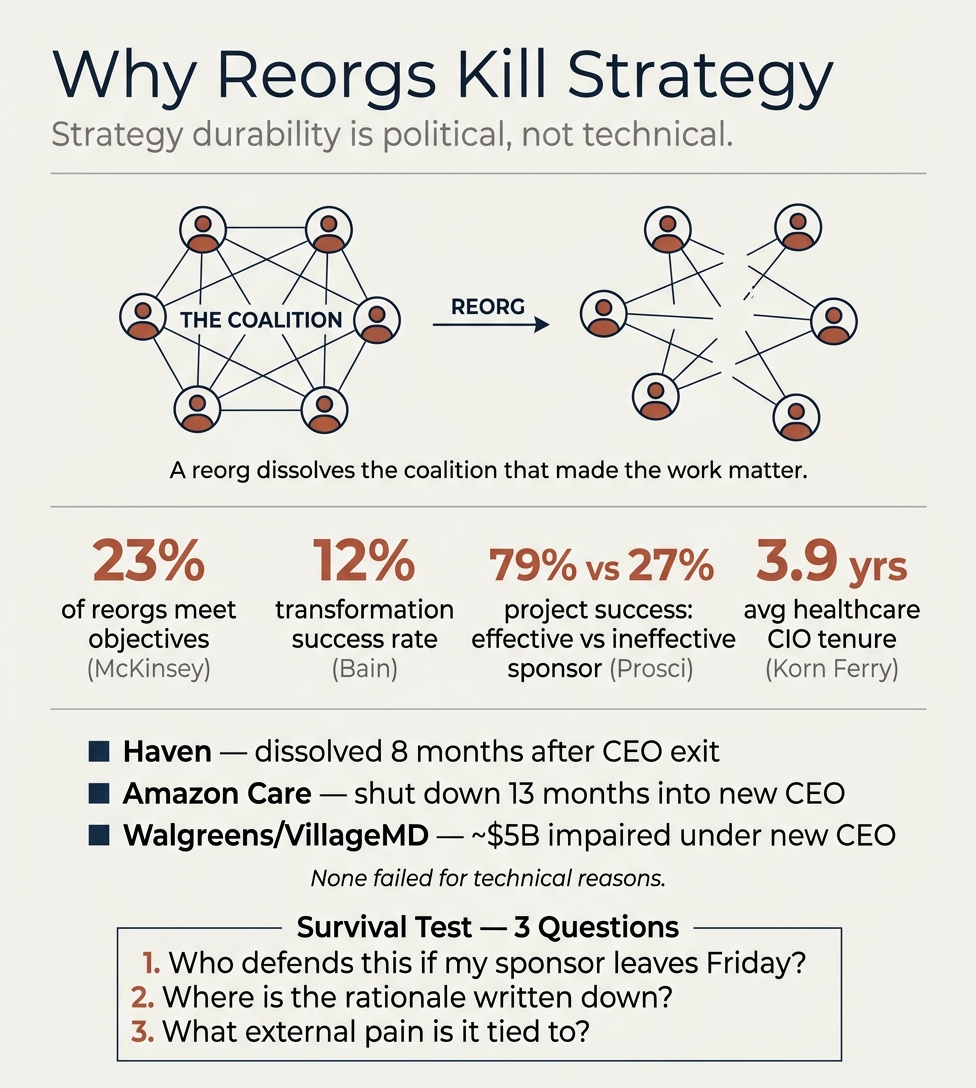
The proof is indisputable.
THE INSIGHT
A technical strategy can be elegant, well-funded, and technically sound, and still die on a Tuesday because someone announced a reorg on Monday.
I've watched this happen often enough to stop being surprised. A new CTO arrives, two divisions merge, reporting lines shift, and within six months the initiative everyone agreed was important last quarter is quietly defunded or absorbed into something with a different name and owner.
I used to assume this was about priorities. But priorities are downstream of something deeper. A reorg dissolves the coalition of people who collectively believed the work mattered, and once that coalition is gone, the rationale evaporates with it.
The numbers are uncomfortable. McKinsey finds only 23% of reorganizations meet their objectives. Bain puts transformation success at 12%. A 2025 Management Science paper across 102 CEO transitions and 500 million emails found a 10% drop in internal communication post-transition, recovering only around month five.
Prosci's data should make every strategist careful. Projects with extremely effective sponsors meet objectives 79% of the time; with ineffective sponsors, 27%. Threefold difference, one variable. When a reorg changes the sponsor, the project loses the resource control, decision authority, and political cover that justified its ambition.
Kotter has said for decades that the guiding coalition is the nerve center of any change effort. Pfeffer adds the sociological angle: coalitions hold together because members recognise common interest. A reorg breaks that even when people stay, because they have new bosses, new metrics, new claims on their attention.
Healthtech makes this concrete. Healthcare CIOs average 3.9 years in post, the lowest of any sector Korn Ferry tracks. Walgreens spent roughly five billion on a co-located primary care strategy with VillageMD; the next CEO booked an impairment within months. Haven dissolved eight months after losing its CEO. Amazon Care was shut down thirteen months into Jassy's tenure. None were killed because the technology stopped working.
Strategy durability is mostly a function of how widely the rationale is distributed. If the diagnosis lives only in one executive's head, it leaves with them. If it's written in plain language, understood by four to six credible sponsors across functions, and tied to a pain obvious from outside the building, it has a chance.
The practical work looks less like technical planning and more like political archaeology. Who can defend this if my sponsor leaves Friday? Where is the diagnosis written in a form the next leader could audit? What externally measurable pain is this attached to, and would that still be true if the org chart looked completely different?
Reorgs are coming. The strategies that survive them are the ones whose reasons for existing have already escaped the building.
THE EVIDENCE
TL;DR
- The empirical evidence supports the user's thesis: strategy durability through leadership change depends less on technical soundness than on how widely the rationale, sponsorship, and political coalition behind it are distributed. Across PMI, McKinsey, BCG, Bain, Kotter, and Prosci research, the single strongest predictor of an initiative surviving a reorg is the breadth and quality of its coalition, not the elegance of its plan.
- Reorgs and executive transitions are common and mostly fail on their own terms: McKinsey finds only about 23% of reorganizations meet their objectives, Bain's 2023 Transformation and Change Survey finds only 12% of transformations achieve their original ambitions, and McKinsey reports roughly 70% of mergers fail to create value. In healthcare specifically, CIO tenure runs about 3.9 years per Korn Ferry, the shortest of any sector tracked, which compresses the runway any technical strategy actually has. [1]
- Concrete cases (Haven, Walgreens/VillageMD under Tim Wentworth, Walmart Health, Amazon Care, Olive AI) show a recurring pattern: when the sponsoring executive leaves or a reorg redraws reporting lines, even well-funded healthtech initiatives get rescoped or killed within 12 to 24 months, regardless of clinical or technical merit.
Key findings
- CTO and CIO tenure is short and getting shorter, especially in healthcare. Korn Ferry's analysis of the 1,000 largest US companies by revenue puts average CIO tenure at 4.6 years across industries, with healthcare CIOs at 3.9 years, the shortest of any sector. An earlier Korn Ferry analysis cited by CIO.com put the figure at 4.3 years. CEO tenure globally has fallen too: Russell Reynolds' Global CEO Turnover Index Annual Report 2025 documents the full trajectory of average outgoing CEO tenure at "7.1 years, a slight decrease from 7.4 years in 2024 and well below the 8.3 years recorded in both 2021 and 2023," and reports 6.8 years in H1 2025 for the largest listed companies, the lowest since the firm began tracking in 2018. [2]
- Reorgs themselves usually fail. McKinsey's most-cited reorganization research finds only 23% of reorganizations are deemed successful by the companies that ran them. Forty percent stall during implementation and are never completed, and roughly 10% actively impair performance. A typical reorg takes about 10 months from plan to practice, and more than half of executives report that productivity falls during that period. McKinsey's 2024 update on operating model redesign (Weddle, Mahadevan et al., based on a survey of 2,000 executives across 16 sectors) found that following more than six of the traditional "golden rules" now drives only a 55% success rate, down from 73% a decade earlier; the rules that used to work are losing power. [3]
- Transformations fare little better. Bain's 2023 Transformation and Change Survey of over 400 executives and senior leaders, released in April 2024, found that only about 12% of business transformations achieve their original ambitions, and 88% fall short, with 68% achieving "value dilution" (more than half of stated goals but well short of ambition). McKinsey's separate research consistently cites a 70% failure rate for large change programs, a figure originally popularized by Kotter and widely repeated. M&A is comparable: McKinsey states that "roughly 70 percent of mergers fail" to deliver expected value, and Christensen, Alton, Rising and Waldeck put the figure at 70 to 90% in their 2011 HBR "New M&A Playbook." [4]
- Executive sponsorship is the single most consistent predictor of project survival. PMI's 2018 Pulse of the Profession found that 26% of organizations report inadequate sponsor support as the primary cause of failed projects, rising to 41% in organizations with low project management maturity. The same Pulse showed that organizations with a higher percentage of projects backed by actively engaged executive sponsors report 40% more successful projects. Prosci's 12th Edition Best Practices in Change Management (© 2023) quantifies the sponsorship effect specifically: "projects with extremely ineffective sponsors were only 27% likely to meet their objectives as compared to 79% with extremely effective sponsors, a nearly threefold increase in the likelihood of success." Prosci's broader research base shows that initiatives with excellent change management overall are roughly six to seven times more likely to meet objectives than those with poor change management. Prosci also reports that 50% of executives do not understand their sponsorship role. [5]
- CEO turnover quietly halts the org for months. Impink, Prat and Sadun, "Communication Within Firms: Evidence from CEO Turnovers," Management Science vol. 71(1), January 2025, pp. 470–487, analyzed 500 million emails and 80 million meeting invitations across 102 CEO transitions. The published paper reports an initial decrease of roughly 10% in communications relative to the pre-transition period, followed by a +33% increase approximately five months after the turnover once the new strategy was articulated. The implication: the average initiative spends a quarter or more in a communication freeze the moment the top sponsor changes. [6]
- New CEOs prune aggressively. McKinsey's study of nearly 600 S&P 500 CEO transitions between 2004 and 2014 found that the number of deals (acquisitions, mergers, divestitures) in year two was 50% higher than the average in the five years before they took the helm, and that the pace dropped sharply by year seven. Strategic reviews were correlated with +4.3% excess TRS for poorly performing companies. McKinsey's "Change is changing" research illustrates the pruning bluntly: a CHRO at a top financial institution found 130 functional initiatives in her remit, and only six survived an outcomes-based cull. At one Dow 50 company fewer than 20% of initiatives had meaningful outcomes that could be tracked. [7]
- The Kotter and Pfeffer thesis: initiatives are political objects. Kotter's research on change, summarized in Leading Change and the eight-step model, repeatedly states that creating and sustaining a "guiding coalition" of leaders and managers with positional power, expertise, credibility, and informal influence is the strongest predictor of change surviving. Pfeffer's Managing With Power and Power in Organizations argue from a sociological view that power derives from control over critical, scarce resources; coalitions survive over time precisely because each member recognizes a common interest. A reorg invalidates an initiative not by deleting the slide deck but by redistributing the resources that the coalition was built around. [8][8]
- Organizational amnesia is real and measurable. Research on institutional memory (Kransdorff's Corporate Amnesia, Holan and Phillips, Pollitt's "Institutional Amnesia: A Paradox of the Information Age") identifies "organizational churn" as the first of four mechanisms that cause organizations to forget. The pattern in the literature: new leaders purge predecessors' programs without evaluating their merit, then often re-invent the same solutions one or two cycles later. A 100-interview Westminster-systems study identifies organizational churn, low absorptive capacity, strategic-instrumental decision making, and weak historical storytelling as the four drivers of institutional memory loss. [9]
- Conway's Law turns reorgs into architectural events. Conway's 1968 observation and the modern reformulation by Ruth Malan ("If the architecture of the system and the architecture of the organization are at odds, the architecture of the organization wins") imply that any reorg is a covert re-architecture. Skelton and Pais's Team Topologies and the DORA/Accelerate research (Forsgren, Humble, Kim) both argue that team boundaries shape software boundaries, so merged divisions or shifted reporting lines do not just disturb priorities; they begin pulling the system architecture toward a new shape whether you intend that or not. [10][11]
- Healthtech is a particularly hostile environment for sponsor continuity. The Walgreens/VillageMD reset under new CEO Tim Wentworth (hired October 2023) is the cleanest recent example: a roughly $5 billion bet on co-located primary-care-plus-pharmacy, started under his predecessor Rosalind Brewer, was rescoped within months. Wentworth announced the closure of 60 underperforming VillageMD clinics and exit from five markets, booked a $5.8 billion impairment charge in Q2 FY2024, and on the June 27, 2024 earnings call announced Walgreens would shed its 53% VillageMD stake. ECG Management Consultants' analysis put the pattern explicitly: "It is not uncommon for new executives to use restructuring events as a mechanism to step away from nonprofitable or devalued business units and 'clean house' in preparation for new business and corporate strategies." Walmart Health (announced closure April 30, 2024 of 51 clinics across five states plus Walmart Health Virtual Care) was preceded by sustained executive churn: Cheryl Pegus, the EVP hired in December 2020 to lead the strategy, departed in November 2022, and no permanent successor was named before the business shut. Amazon Care was shut down (December 31, 2022) thirteen months after Andy Jassy succeeded Jeff Bezos and in tandem with the One Medical acquisition; SVP Neil Lindsay's August 24, 2022 internal memo stated that Amazon Care "is not a complete enough offering for the large enterprise customers we have been targeting." Olive AI raised exactly $902 million across 10 funding rounds, churned through its CFO, CPO and president in 2022 to 2023, and shut down by October 31, 2023. Haven, the Amazon/Berkshire/JPMorgan venture, lost CEO Atul Gawande in May 2020 and disbanded eight months later; the Christensen Institute's post-mortem concluded that the three parents "separately developed and implemented their own healthcare strategies, effectively defeating the purpose of the joint venture." [12]
Details
The base rates the user can quote with confidence
| Datapoint | Source | Figure |
|---|
| Reorg success rate | McKinsey (Keller and Meaney; 2014 Global Survey) | 23% met objectives; 40% bogged down; 10% impaired performanceGraphite |
| Typical reorg duration | McKinsey | ~10 months plan to practice; >50% of execs say productivity fell during itMcKinsey & Company |
| Operating model redesign success today | McKinsey 2024 (Weddle, Mahadevan et al.; 2,000 executives) | 55% using more than six classic rules, down from 73% a decade agoMcKinsey & Company |
| Transformation success | Bain 2023 Transformation and Change Survey, 400+ executives (released April 2024) | 12% achieve original ambition; 88% fall shortBain & Company |
| Change program failure | McKinsey, citing Kotter | ~70% fail to meet goals |
| M&A failure | McKinsey; Christensen, Alton, Rising and Waldeck (HBR 2011) | 70 to 90% of deals fail to create value |
| Failed projects attributed to inadequate sponsor support | PMI 2018 Pulse of the Profession | 26% overall;PMI41% in low-maturity organizationsCapterra |
| Sponsorship effect size | Prosci 12th Edition Best Practices in Change Management (© 2023) | 79% of projects with extremely effective sponsors meet objectives vs 27% with extremely ineffective sponsorsProsci |
| Executives who do not understand sponsorship role | Prosci | 50% |
| Communication freeze after new CEO | Impink, Prat, Sadun,Management Science71(1), Jan 2025, pp. 470–487 (102 firms, 500M emails) | -10% emails and meetings post-transition; +33% at approximately five monthsSSRN |
| Average CIO tenure, all sectors | Korn Ferry (1,000 largest US companies) | 4.6 years |
| Average CIO tenure, healthcare | Korn Ferry | 3.9 years, shortest of any sector |
| Average CEO tenure | Russell Reynolds Global CEO Turnover Index 2025 | 7.1 years (2025), down from 7.4 (2024) and 8.3 (2021 and 2023);Russell Reynolds Associates6.8 years in H1 2025 |
| New CEO deal-making | McKinsey, ~600 S&P 500 transitions 2004–2014 | M&A in year 2 is 50% higher than the 5-year pre-arrival average |
| Initiative pruning anecdote | McKinsey, "Change is changing" | One CHRO cut 130 functional initiatives to 6McKinsey & Company |
Why a reorg is uniquely lethal to a technical strategy
A reorg simultaneously attacks four things that an initiative depends on:
Sponsorship. PMI's research is the strongest single data point here. The 2018 Pulse is the most-cited figure (26% of failed projects attributed to inadequate sponsor support), and Prosci's longitudinal Best Practices study has placed active, visible sponsorship at the top of contributors to change success across every edition since 1998. When a reorg changes who the sponsor is, the project does not simply get a new manager; it loses the resource control, decision authority, and political cover that justified its original size and ambition. The Prosci 12th Edition number (79% success with extremely effective sponsors, 27% with extremely ineffective sponsors) is the cleanest way to express the magnitude. [5][13]
Coalition. Kotter's central claim, made in Leading Change and reaffirmed in his 2018 Kotter Inc. eBook on the eight steps, is that the guiding coalition is the "nerve center" of any change effort and "must consist of members from multiple layers of the hierarchy, represent many functions, receive information about the organization at all levels and ranks, and synthesize that information into new ways of working." Pfeffer's coalitional model of organizations (Pfeffer and Salancik, 1977; later in Managing With Power, 1992) argues that coalitions survive over time precisely because their members "recognize a commonality of interests." A reorg breaks those commonalities of interest, even if the people remain. Allies in a merged division now have new bosses, new metrics, and competing claims on their time. [14][14]
Rationale. Rumelt's "kernel of strategy" (diagnosis, guiding policy, coherent actions) is useful here because it isolates what actually has to be re-justified. A reorg changes the diagnosis (the challenge a new CTO sees is rarely identical to the challenge the previous CTO saw), which means the guiding policy and the coherent actions can no longer be defended on the original logic. If the diagnosis only existed in the head of the departing executive, it cannot be re-defended at all. This is where the user's thesis lands hardest: the technical soundness of the actions does not save them when the diagnosis disappears. [15]
Architecture. Conway's Law and Team Topologies together imply that even a "purely organizational" reorg is an architectural intervention. Ruth Malan's reformulation, cited in Team Topologies, is the cleanest statement: when org and architecture diverge, the org wins. Forsgren's research in Accelerate shows that DORA outcomes (deployment frequency, lead time, change failure rate, MTTR) are predicted by team and organizational structure, not just engineering practice. So a reorg that merges previously independent product groups will drift the architecture toward shared services and coupling, whether the technical strategy called for that or not.
What the research says about which initiatives survive
Three findings converge:
- Distributed sponsorship beats heroic sponsorship. Kotter's guiding coalition principle and Pfeffer's coalitional model both argue against single-executive ownership. PMI's Pulse and Prosci's research both find that the level of sponsor engagement matters, but the number of credible sponsors at multiple levels predicts survival through transitions.
- Documented diagnosis travels; documented activity does not. Roger Martin and Rumelt both emphasize that strategy is a coherent argument, not a list. The institutional-amnesia literature (Kransdorff, Pollitt) finds that organizations forget because the rationale lived in people, not in artifacts the next leader could pick up and audit.
- Coupling to durable business pain helps. Christensen's Innovator's Dilemma notes that initiatives detached from the core revenue stream are the first to be killed when leadership changes; this is exactly the Haven pattern. Initiatives that are visibly attached to revenue or to a regulatory deadline survive transitions disproportionately.
What complicates the thesis
Two honest caveats:
- Some strategies should die when leadership changes. McKinsey's research on CEO transitions found that strategic reviews are associated with positive excess shareholder returns for poorly performing companies. Sadun's 2025 working paper "CEO-Firm Matches and Productivity in 42 Countries" (Dahlstrand, László, Schweiger, Bandiera, Prat, Sadun; HBS Working Paper No. 25-033, January 2025) shows that mismatched CEOs (a leader where a manager was needed, or vice versa) reduce productivity by 15 to 20%. A reorg that kills a poorly grounded strategy is doing its job. The user's thesis is not "all initiatives should survive reorgs"; it is "if you want yours to, distribute the rationale." [6][16]
- The 70% change failure figure is contested. Mark Hughes (2011, "Do 70 per cent of all organizational change initiatives really fail?") and others have pointed out that the widely cited 70% figure traces back to a 1993 Hammer and Champy "unscientific estimate" and has been repeated without replication. The Bain 12% and McKinsey 23% figures are better-grounded, but the broader "70% of change fails" claim should be cited with care. [17]
Recommendations
For a Director of Technical Strategy at Numan thinking about how to make a technical strategy reorg-resistant, the research supports a small number of high-leverage moves.
- Write the diagnosis down where the next leader will find it. Rumelt's kernel framing is the cleanest tool. Document the diagnosis in plain language, separate from the activity list. Sadun's data show the average org spends about five months in a communication freeze and recovery cycle after the top sponsor changes; written diagnosis is what survives that freeze.
- Build a guiding coalition of at least four to six sponsors across functions and levels. Kotter's coalition criteria (positional power, expertise, credibility, informal influence) should be the explicit selection rubric. PMI and Prosci agree the engagement level of sponsors is the strongest single predictor; combine that with multiplicity to survive the loss of any one. Prosci's 12th Edition spread (79% vs 27% success depending on sponsor quality) makes the cost of betting on a single sponsor concrete. [13]
- Tie the initiative to a durable business or regulatory pain. Christensen's research and the healthtech case studies (Haven, Amazon Care, Walmart Health) suggest that initiatives detached from a clearly measurable, externally driven pain are the first to be cut in a new-CEO portfolio review. If the initiative is justified only by an internal vision, the vision leaves with its owner.
- Surface and document the political map. Pfeffer's work argues that political mapping of allies, blockers, and resource controllers is a strategic artifact, not a soft skill. Make it real: name the people, the dependencies, and the trades. When a reorg happens, this is the artifact that allows the new sponsor to inherit a coalition rather than rebuild one.
- Design the team topology so that Conway's Law works for, not against, the strategy. Team Topologies and DORA both support the "inverse Conway maneuver." If the strategy requires a particular architecture, lock the team boundaries that produce that architecture into the org chart now, so that a future reorg has to actively undo them rather than passively rearrange them.
- Pre-commit a 90-day survival plan for the moment a sponsor changes. Couch's 2017 PMI article on sponsor departures and the 2025 Management Science paper by Impink, Prat and Sadun imply the most dangerous window is the first three to five months. Have a documented re-onboarding pack ready before it is needed.
Benchmarks that would change these recommendations. If the initiative has fewer than three credible sponsors at the start of a transition, the PMI and Prosci data say it is statistically more like a failed project than a successful one. If sponsor turnover exceeds one change per 12 months (the Korn Ferry healthcare CIO figure of 3.9 years suggests this is plausible for any multi-year program), treat sponsor continuity as a primary risk and design around it explicitly.
Caveats
- Self-reported and survivorship bias. Most of the cited research (McKinsey, Bain, Prosci, PMI) is based on executive surveys, which over-represent successful firms and rely on self-assessment. Bain's 12% and McKinsey's 23% should be read as directional, not precise.
- The 70% figure for change-program failure has a thin empirical foundation. It is traceable to a Hammer and Champy unscientific estimate from 1993 and has been criticized by Mark Hughes (2011) for being repeated without replication. Use it as folklore-level shorthand, not as a hard number. [17]
- Healthtech case studies are illustrative, not statistical. Walgreens/VillageMD, Walmart Health, Amazon Care, Olive AI and Haven are all single cases with multiple confounders (reimbursement environment, capital cost cycle, valuation collapse). They demonstrate the pattern; they do not prove the population-level rate at which healthtech initiatives die from sponsor turnover specifically.
- Tenure figures are mixed across studies. Korn Ferry's analysis of the 1,000 largest US companies puts average CIO tenure at 4.6 years; an older CIO.com summary cites 4.3 years; healthcare CIOs specifically run 3.9 years in the Korn Ferry data. Russell Reynolds' CEO tenure figures (7.1 years globally in 2025, down from 7.4 in 2024 and 8.3 in 2021 and 2023) are from listed-company data and skew larger than private-company averages. [2]
- Reorgs are not always destructive. Sadun's 2025 working paper and McKinsey's CEO-transition research both find that strategic resets and reorganizations are associated with positive returns for poorly performing companies. The user's thesis is about durability of good strategies, not preservation of all strategies.
- Prosci figures vary across publications. The 12th Edition (© 2023) reports the specific 79% vs 27% sponsor-effectiveness spread; the broader "six to seven times more likely to meet objectives" figure that appears on Prosci's marketing pages refers to overall change-management quality, not sponsorship in isolation. Both numbers are defensible but should not be conflated.
- Meirik Sp. z o.o. + 2 — https://www.meirik.com/articles/why-business-transformations-fail-and-how-to-build-the-capability-to-succeed
- CIO Dive + 4 — https://www.ciodive.com/news/the-average-cio-age-is-on-the-rise/570777/
- McKinsey & Company + 3 — https://www.mckinsey.com/capabilities/people-and-organizational-performance/our-insights/reorganization-rules-that-work
- Bain & Company + 3 — https://www.bain.com/about/media-center/press-releases/2024/88-of-business-transformations-fail-to-achieve-their-original-ambitions-those-that-succeed-avoid-overloading-top-talent/
- PMI + 7 — https://www.pmi.org/learning/library/working-problem-sponsors-11365
- Harvard Business School + 2 — https://www.hbs.edu/faculty/research/publications/Pages/default.aspx?faculty=rsadun
- McKinsey & Company + 2 — https://www.mckinsey.com/capabilities/strategy-and-corporate-finance/our-insights/a-deal-making-strategy-for-new-ceos
- Simplifyingprocesses — https://www.simplifyingprocesses.com/blog/leading-change
- ResearchGate — https://www.researchgate.net/publication/241209846_ORGANIZATIONAL_AMNESIA_THE_BARRIER_TO_ORGANIZATIONAL_LEARNING
- Medium — https://medium.com/@fwynyk/conways-law-in-team-topolgies-did-you-really-get-it-69c1a4d702af
- Lawsofsoftwareengineering — https://lawsofsoftwareengineering.com/laws/conways-law/
- Fierce Healthcare + 11 — https://www.fiercehealthcare.com/retail/walgreens-plans-strategic-review-business-including-role-its-retail-stores-healthcare-assets
- Prosci — https://www.prosci.com/blog/change-management-best-practices
- Kotter — https://www.kotterinc.com/wp-content/uploads/2019/04/8-Steps-eBook-Kotter-2018.pdf
- Fred Perrotta — https://www.fredperrotta.com/kernel-of-strategy/
- Harvard Business School — https://www.library.hbs.edu/working-knowledge/misfits-in-power-company-needs-a-leader-ceo-but-gets-manager
- LinkedIn — https://www.linkedin.com/pulse/70-organisational-change-failure-rate-still-living-myth-berggreen
EDITORIAL BRIEF
Commissioned from our research desk. Subject to final editorial discretion.
Why the most dangerous input to a technical strategy is a reorg. Dig into how leadership restructuring—new CTO, merged divisions, shifted reporting lines—invalidates not just priorities but the entire coalition of sponsors and allies that made an initiative viable. Look into research on initiative survival rates across leadership transitions. The reader should understand that strategy durability is less about technical soundness and more about how deeply the rationale is distributed across the org.